

WASHINGTON, DC – APRIL 06: U.S. President Donald Trump speaks alongside Central Intelligence Agency Director John Ratcliffe (L) and U.S. Secretary of War Pete Hegseth (R) during a news conference in James S. Brady Press Briefing Room of the White House on April 06, 2026 in Washington, DC.
Alex Wong | Getty Images News | Getty Images
A temporary U.S.-Iran ceasefire sparked a broad relief rally across assets on Wednesday, but experts warned that any deal concerning lasting peace will be complicated by a major trust deficit.
The ceasefire came following hastened diplomatic efforts led by Pakistan and just hours before Trump’s threatened deadline for wiping out the entire Iranian civilization, briefly pulling the region back from the brink of a massive military bombardment.
Oil prices cooled to below $100 per barrel following the ceasefire announcement, but remain far above the pre-war levels of around $70 per barrel.
While U.S. President Donald Trump said the two-week ceasefire was contingent on the “complete, immediate, and safe opening” of the Strait of Hormuz, Iranian officials stated that safe passage through the strait would be “possible,” subject to coordination with its armed forces and “technical limitations” — caveats that may give Iran some room to define compliance on its own terms.
“This is a problem that could derail the ceasefire later this year,” said Matt Gertken, chief geopolitical strategist at BCA Research, warning that the coordination requirement remains a risky ambiguity in both sides’ statements so far.
Trump may temporarily accept Iran as a gatekeeper — with U.S. midterm elections approaching and gasoline prices sharply higher than before the war — but after the election, the U.S. national security establishment will start to demand a more permanent solution,” said Gertken. “Fighting will ignite later this year, if not later this month.”
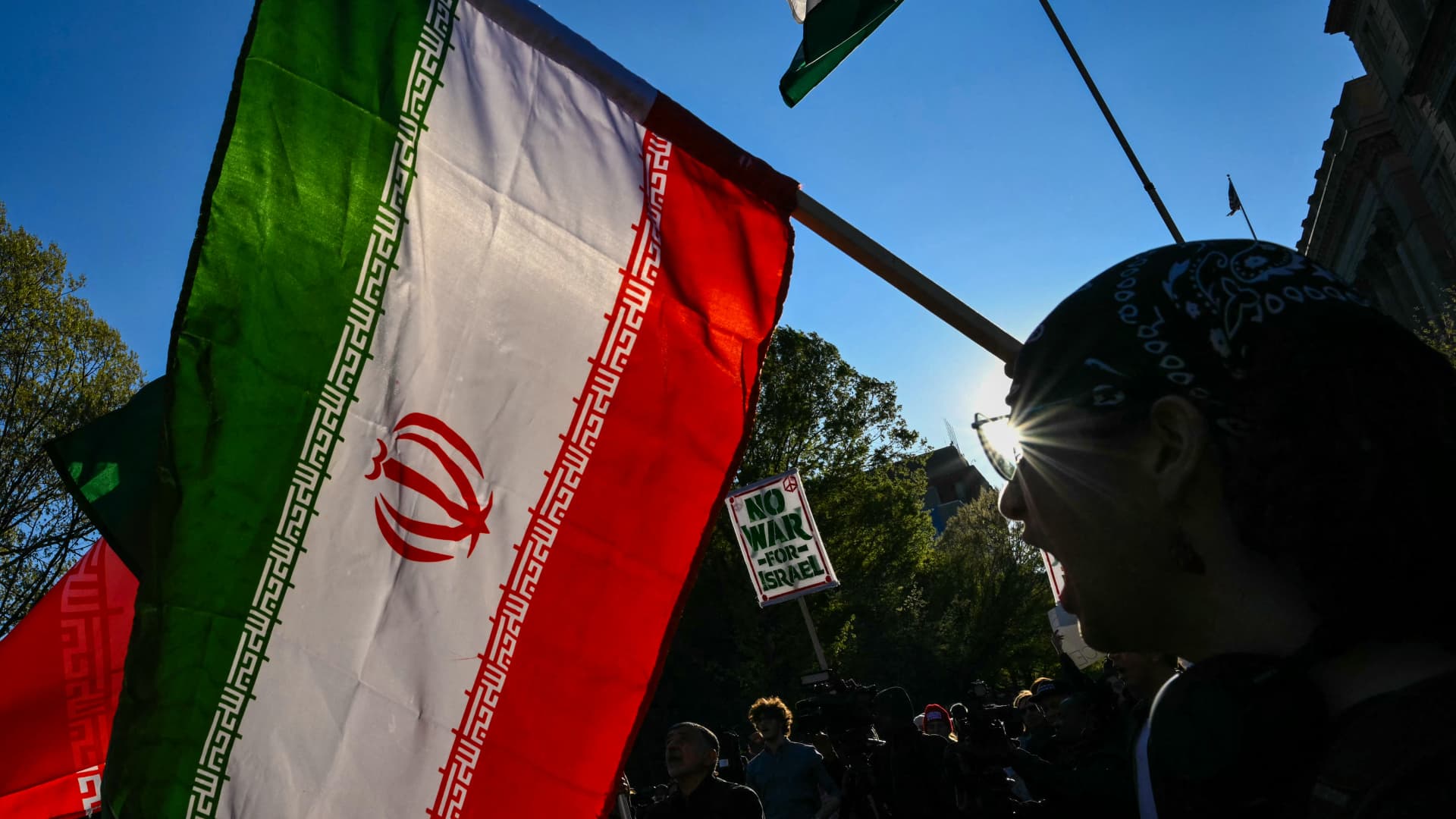
A protester waves an Iranian flag and shouts slogans during a demonstration against US military action in Iran near the White House in Washington, DC, on April 7, 2026.
Mandel Ngan | Afp | Getty Images
Tehran also said that its armed forces will cease defensive operations if attacks against Iran are halted. After the ceasefire came into effect at 8 p.m. ET Tuesday, missiles were still launched from Iran towards Israel and several Gulf states.
The reprieve on Tuesday would allow some time for the two sides to reach a longer agreement to end the six-week-old war, which has killed thousands of people and sparked a global energy crisis, with their delegations expected to meet in Islamabad on Friday.
Iran is reportedly finalizing a joint maritime protocol with Oman to institutionalize coordinated management of tanker traffic through the strait, which could embed Iranian authority over the crucial energy artery into a standing bilateral agreement.
Fragile truce
The ceasefire, holding together a group of parties with sharply diverging interests, also leaves questions open over whether resumed peace talks will yield meaningful results without renewing tensions.
Pratibha Thaker, regional director, Africa and the Middle East at the Economist Intelligence Unit, described the ceasefire agreement as “a huge relief” but warned that a significant lack of trust on both sides will complicate upcoming negotiations.
“What are we are seeing right now, I would really like to stress is a pause in the conflict, rather than any kind of lasting resolution,” Thaker told CNBC’s “Europe Early Edition” on Wednesday.
“But, and this is a big but, it is a very fragile arrangement. The ceasefire hinges on Iran suspending its military activity [and] fully reopening the Strait of Hormuz to commercial shipping,” Thaker said.
“Crucially, there is a deep trust deficit on both sides. From Washington’s perspective, longstanding concerns over Iran’s nuclear program. From Tehran’s side, deep skepticisim about U.S. intentions, especially given past withdrawals from agreements and continued military presence and pressure as well.”

Israel agreed to suspend strikes but urged Washington to press for deeper Iranian concessions, including the surrender of enriched uranium stockpiles. In its 10-point terms, Iran requested Washington to accept its uranium enrichment program and the lifting of all sanctions.
The ceasefire will likely hold in the near term, given the economic costs accruing to the global economy from six weeks of conflict, said Michael Langham, emerging markets economist at Aberdeen Investments. “Parties with vested interest in stopping the conflict and reopening the strait will double down on efforts to find a compromise,” he said.
If the truce holds and the strait reopens, the global economic damage should prove manageable, Langham added. Central banks could broadly resume their pre-conflict paths — and attention may shift from inflation to growth, if commodity prices normalize quickly, he added.
The market calculation
The ceasefire sparked a relief rally in markets amid repricing for a de-escalation in the conflict, but investors will watch for something more durable than a two-week pause, Geoff Yu, senior market strategist at BNY, said on CNBC’s “Squawk Box Asia” on Wednesday.
“What the market is going to start pricing ahead is a first step towards further de-escalation and perhaps something more permanent,” he said, flagging that the disruption has extended beyond crude oil to commodities such as helium, critical to semiconductor manufacturers in South Korea and Taiwan.
Stocks surged across regions, with Asian benchmarks and U.S. futures climbing, amid rising optimism for a potential turning point in a conflict that has rattled markets for weeks.
An Indian Oil Corp. gas station in Noida, Uttar Pradesh, India, on Wednesday, April 8, 2026.
Bloomberg | Bloomberg | Getty Images
Josh Rubin, portfolio manager at Thornburg Investments, cautioned against reading the early market reaction as a definitive verdict. “There’s still low visibility [and] limited predictability” on whether the truce will hold, Rubin said, warning that tail risks remain if the strait remains closed for another two to four months.
Energy and commodity markets are likely to remain on a structurally higher floor regardless of the ceasefire outcome, said BCA Research’s Gertken, as governments hoard and restock in anticipation of renewed conflict, keeping oil and gas prices elevated well above pre-war levels even in a scenario where shipping resumes.
‘A wake-up call for everybody’
Mehran Kamrava, professor of government at Georgetown University of Qatar, said the two-week ceasefire shows that there is “tremendous willpower” from both Washington and Tehran to bring this war to an end.
“Probably the one party that did not want the war to end is Israel and we see that Israel has refused to say that this ceasefire applies to Lebanon. So yes, I think the ceasefire will hold because neither the Trump administration nor the Iranians really want this war to continue,” Kamrava told CNBC’s “Squawk Box Europe” on Wednesday.

When asked how the last 24 to 48 hours may have influenced the way the U.S. is viewed by its allies and adversaries across the globe, Kamrava said the world had been “put on notice” by some of Trump’s comments.
“One of the things we have seen here in the region is that close alliance with the United States does not necessarily bring you security. If anything, it creates adversaries and it creates problems,” Kamrava said.
“So, what we have seen in the past 48 to 24 hours, particularly given President Trump’s extremely incendiary and violent language on social media is kind of a wake up call for everybody, both allies and adversaries, that this is a very unreliable and really unpredictable actor in the White House,” he added.