


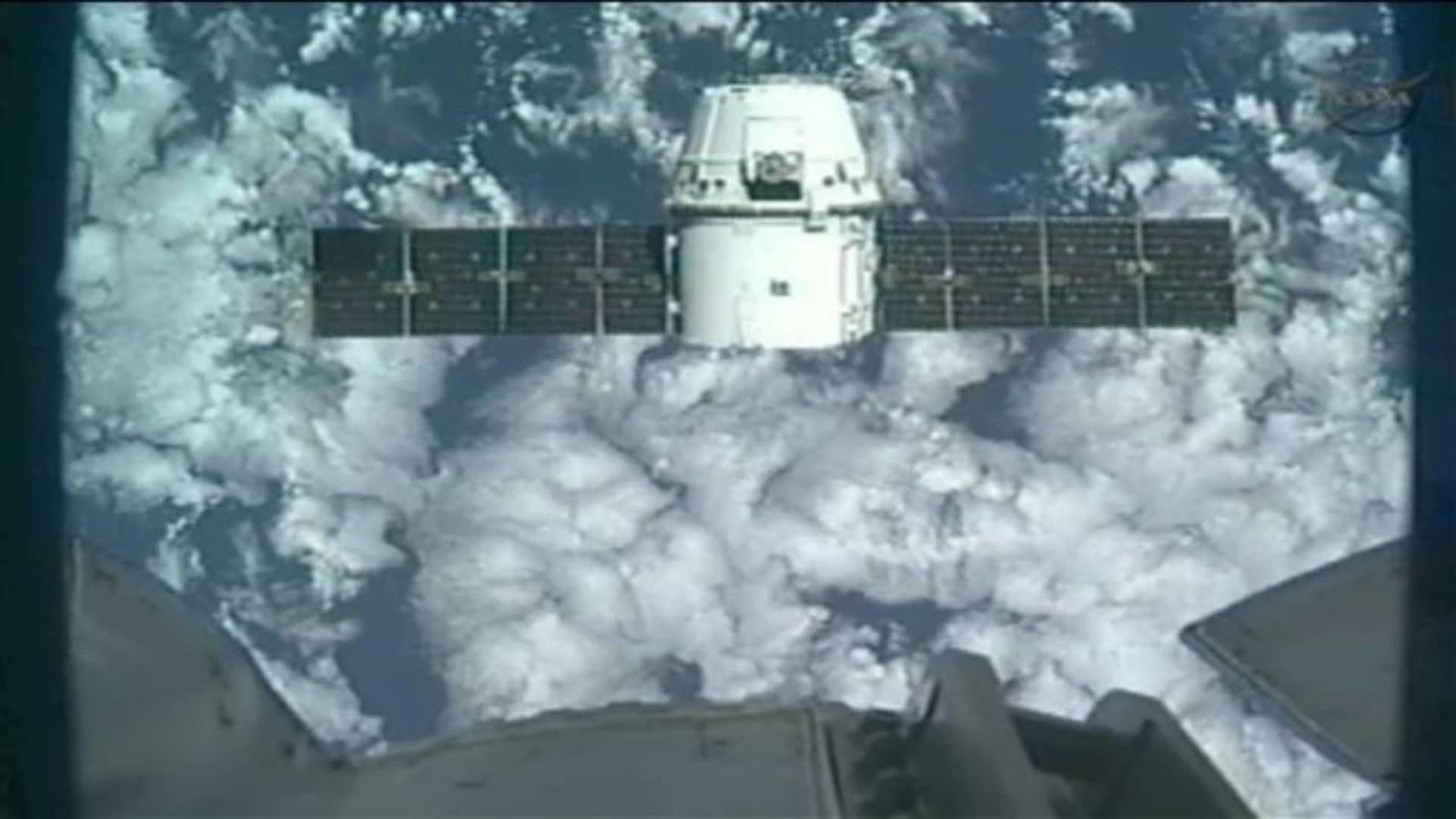
This image provided by NASA-TV shows the SpaceX Dragon commercial cargo craft taken from Canadarm2’s video camera as Dragon approaches the International Space Station, Friday, May 25, 2012. In foreground is a portion of Canadarm2. Expedition 31 Flight Engineers Don Pettit and Andre Kuipers will use the Canadarm2 robotic arm to grapple the supply ship Friday morning with the berthing to the Earth-facing side of the station’s Harmony node following. Dragon is scheduled to spend about a week docked
Uncredited
Orbital data centers would be a help to the massive AI buildout, but a number of major advancements need to come before they’re really practical.
SpaceX CEO Elon Musk is aiming for a launch in late 2027, but other industry watchers say significant scale is more likely to come in the 2030s.
“It’s a next-decade event,” according to Evelyn Chow, portfolio manager at Neuberger. “We’ll need to see significant satellite launches over the next four to five years, and a concomitant buildout of connectivity, before we can start to contemplate true scale in orbital data centers,” she told “Squawk Box Asia” on Wednesday.
Blaine Curcio, the founder of Orbital Gateway Consulting, says the 2030s timeline is a “fair assessment,” but warns that SpaceX has proven investors wrong before. “Had you asked any satellite industry expert in the late 2010s whether SpaceX could launch 10,000 satellites by 2025, every single one of them, myself included, would have said ‘no chance,'” he said.
Here are some of the issues that need to be overcome:
Cooling
“Cooling is a huge issue,” Chow said. Terrestrial data centers can rely on liquid cooling to manage heat, but cooling works very differently in the vacuum of space. “It also needs to be tolerant to radiation.”
Quickly obsolete
Curcio sees hurdles related to the rate of technological advancement.
“GPUs are evolving so quickly that if you launch a state-of-the-art data center into space, at an enormous cost, it might be obsolete in a couple of years,” he said.
High-volume data transfer
Transcelestial, a company that specializes in laser-based communications, is working to solve a key challenge: getting high-volume data back to Earth.
“Anyone can build data centers, but if you can’t talk to these AI systems, then those data centers are useless,” said CEO and Cofounder Rohit Jha.
Powering hyperscale
Jha also said orbital data centers could take another five to seven years to reach hyperscale, a level that would likely require nuclear power.