


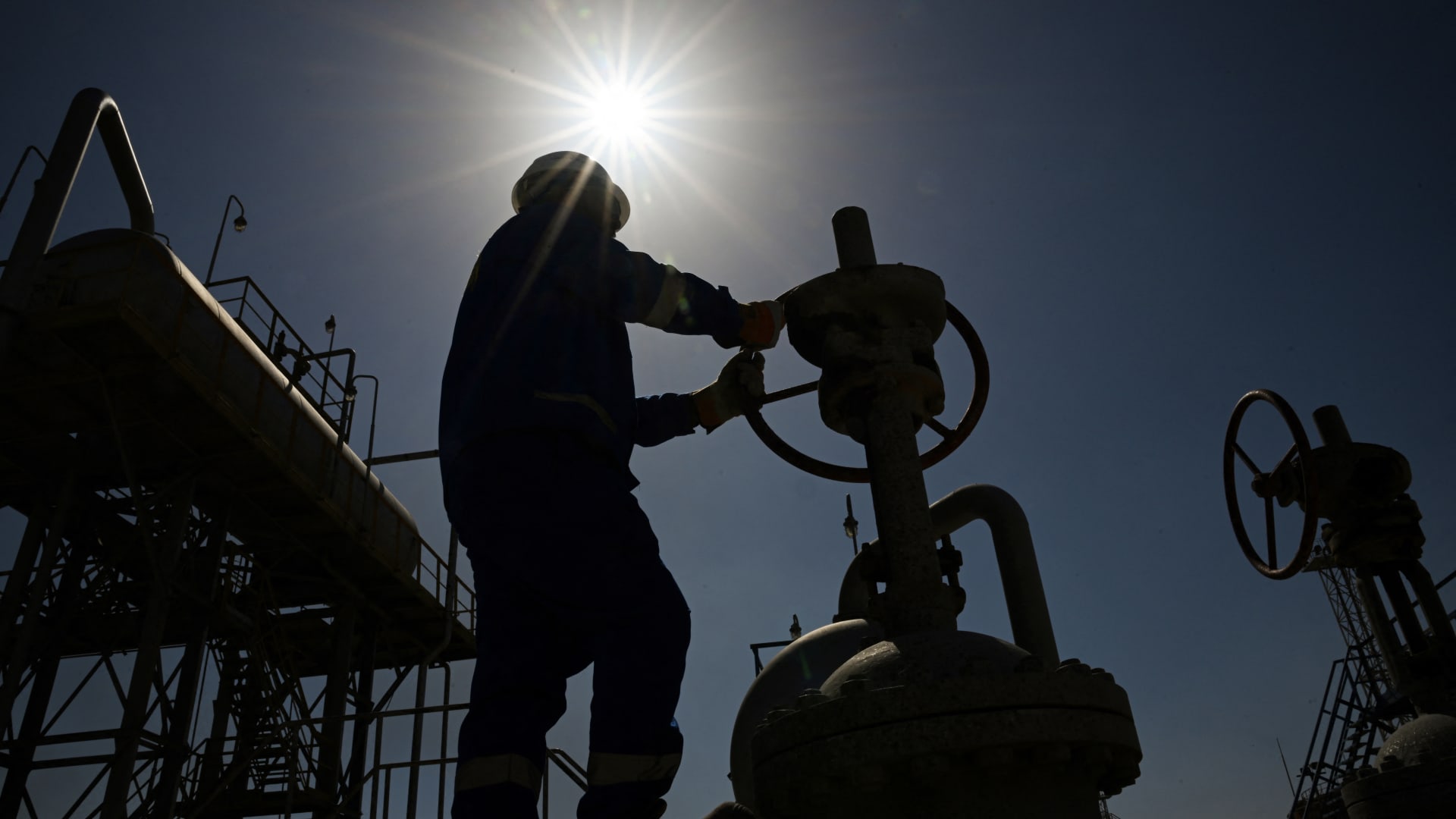
An employee of Basra Oil Company, works at the Nahr Bin Umar Oil and Gas Field on the outskirts of the southern Iraqi city of Basra on April 29, 2026.
Hussein Faleh | Afp | Getty Images
Oil and gas giants benefited significantly from their trading desks through the first quarter, shining a light on a commercially sensitive and often-overlooked unit that tends to outperform during periods of market volatility.
Europe’s oil supermajors TotalEnergies, Shell and BP all pointed to robust trading results as they reported stronger-than-expected profits through the first three months of the year.
The earnings followed a period of extreme volatility for oil prices, particularly in March, as energy market participants closely monitored severe disruption through the strategically vital Strait of Hormuz amid the Iran war.
Oil trading desks are specialized divisions that buy, sell and transport physical oil and gas while managing price risks. These units seek to generate revenue beyond upstream production, particularly during volatile markets. Oil majors typically do not disclose profits from their trading divisions, however.
Trading can be a source of long-term profit, but it can also create volatility and difficulty with cash management.
Clark Williams-Derry
Energy finance analyst at IEEFA
TotalEnergies CEO Patrick Pouyanné said crude oil and petroleum products trading activities achieved “a very strong performance in March” as it posted quarterly net income of $5.4 billion, a 29% jump from a year ago.
Shell Chief Financial Officer Sinead Gorman flagged “significantly higher trading and optimization contributions” through the first quarter, while BP highlighted “exceptional” oil trading contributions in its results.
Shell posted first-quarter adjusted earnings of $6.92 billion, up from $5.58 billion a year ago, while BP reported net profit of $3.2 billion, more than doubling its profit from the same period in 2025.
Maurizio Carulli, equity research analyst at Quilter Cheviot Investment Management, said TotalEnergies, Shell and BP stood out among integrated oil companies as having been particularly successful in establishing large trading units for oil, gas and liquified natural gas (LNG).
A customer fills up a vehicle with fuel at a BP Plc petrol station in London, UK, on Monday, Aug. 4, 2025.
Bloomberg | Bloomberg | Getty Images
“It is important to highlight that oil majors practice trading that is supported by hydrocarbons they produce or of which they have physical availability. And that they can physically move such hydrocarbons around the world via ships and terminals that are either owned or contracted,” Carulli told CNBC by email.
“In other words, it is a ‘proper and long-term activity,’ not financial speculation,” he added.
U.S. oil companies may yet look to build out large trading units too, Carulli said, “particularly given the progressive shift of oil market influence from Opec to the US in recent years.”
Trading ‘thrives in times of volatility’
TotalEnergies, Shell and BP’s trading units were estimated to have earned between $3.3 billion and $4.75 billion extra in the first quarter, compared with the final three months of 2025, The Financial Times reported Monday, citing estimates from five analysts.
Alongside a boost to first-quarter profit, the trading results underscore something of a trans-Atlantic divide, exposing a rare competitive advantage for Europe’s top three oil majors, which have long struggled to close the valuation gap with their U.S. peers.

Brent crude futures and U.S. West Texas Intermediate futures over the last three months.
Allen Good, director of equity research at Morningstar, said it was well understood that having large trading organizations has helped European integrated oil companies diverge from their U.S. rivals, such as Exxon Mobil and Chevron.
“During periods of high volatility, such as in 2022, when Russia invaded Ukraine, or this year, amid the US-Iran war, European integrated oil firms benefit more than US firms, as they can capitalize on trading opportunities alongside high commodity prices,” Good told CNBC by email.
“Given that it thrives in times of volatility, trading’s contribution is inconsistent and, therefore, is not necessarily given full credit by the market,” he continued. “However, most companies estimate trading adds a few hundred basis points to their returns on capital through the cycle.”
BP, for its part, is well known for having one of the world’s most competitive trading businesses, with over 2,000 people serving 12,000 customers in more than 140 countries.
‘A double-edged sword’
Dan Coatsworth, head of markets at AJ Bell, said Big Oil’s trading desks had been thrust into the spotlight because they’ve made sizable contributions to quarterly earnings.
“Big price swings create more opportunities to make money, and we’ve seen frequent movements up and down with oil and gas prices since March,” Coatsworth told CNBC by email.
“In a calmer market, these companies can still make money from trading, but it might take a back seat against income from core operations,” he added.
Gas prices above $6 per gallon are displayed at Chevron and Shell stations in Monterey Park, California, on April 30, 2026.
Frederic J. Brown | Afp | Getty Images
Yet, while oil trading desks played an outsized role through the first quarter, some analysts cautioned that a period of such dramatic price volatility was not necessarily representative of a changing business model.
Alastair Syme, head of global energy research at Citi, cautioned that it would be “slightly unfair” to zoom in on crude price volatility in March alone and conclude that this trend is representative of their businesses.
“Ultimately, these businesses are there to support that integrated business, right? So, their priority is supplying customers, and to supply customers, they need their refining and marketing business to work,” Syme told CNBC by video call.
“If they made a heap of money out of trading and there were shortages at the pump, that would be a massive political issue, right? So, I certainly get the sense that as they look towards fulfilling customer demand in 2Q that they are going to struggle a little on margin capture,” he added.
Away from Big Oil’s headline beats, Clark Williams-Derry, analyst at energy think tank IEEFA, saidthat energy giants took on significant short-term debt and drew down their cash reserves in the first quarter.
For the top five oil supermajors, this culminated in cash flow from operations falling to their lowest level since the coronavirus pandemic, Williams-Derry said.
“This all points to trading and hedging as a double-edged sword. Trading can be a source of long-term profit, but it can also create volatility and difficulty with cash management,” Williams-Derry told CNBC by email.
“And as the oil companies have gotten deeper into trading, they’ve also taken on more debt,” he added.