


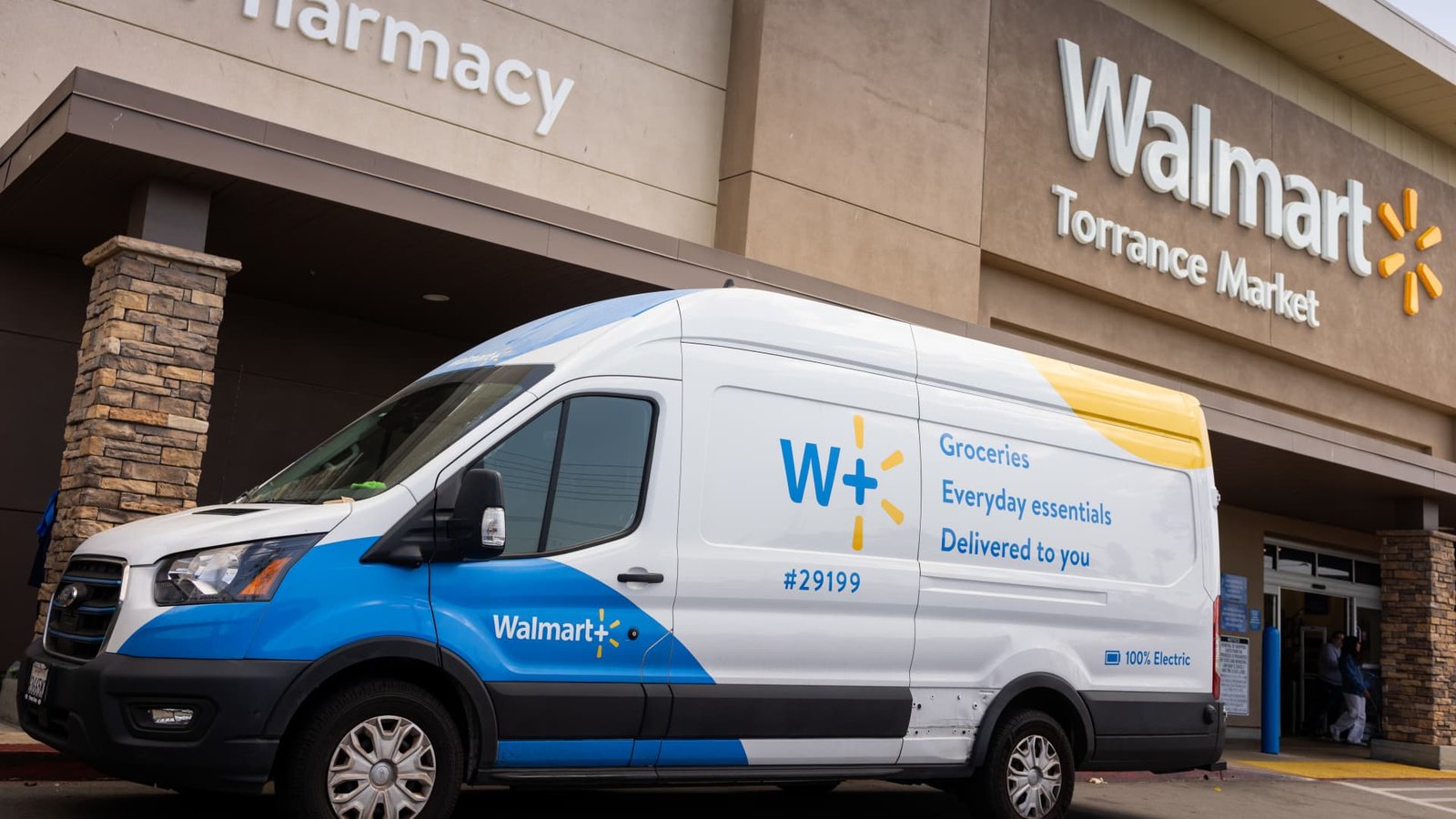
A Walmart delivery van parked in front of the Walmart Torrance Market, on April 3, 2025 in Torrance, California.
Jay L Clendenin | Getty Images News | Getty Images
Walmart will soon be able to bring you an iced coffee and a maple doughnut — from Dunkin’.
The nation’s largest retailer announced this week it will first start delivering Dunkin’ products from its own stores, but will then expand the program over the next year to include most of the doughnut chain’s approximately 10,000 U.S. locations, most located outside Walmart stores entirely. This outside-the-store experiment builds upon the retailer’s similar delivery program with in-store Subway restaurants.
Industry experts say this amounts to Walmart throwing down the gauntlet at rival food delivery services like Uber Eats and DoorDash. For its part, Walmart is billing it as a natural extension of what it is already doing.
“We see this as a way to continue adding value and convenience for customers within a shopping experience they already know and trust. By pairing restaurant delivery with Walmart’s vast assortment, we can create a delivery experience that gives customers more of what they want in one place,” a Walmart spokesperson told CNBC.
In other words, while you are ordering your iced latte or cinnamon cruller, add toilet paper, mouthwash and socks to your order. That, says Hongseok Jang, an assistant professor of management science at Tulane University, is the point. Jang has studied online delivery and said Walmart’s vast reservoir of built-in customers, its stores, and existing logistics network will make it a formidable competitor to other food delivery companies.
The Walmart spokesperson said the Dunkin’ deliveries will run through its new service called Walmart Restaurant Delivery, for which Subway was the first partner.
“To me it seems that Walmart is testing its own delivery system to see if they can handle it, and if it is successful there will be a big competition between Walmart and Uber Eats and DoorDash,” Jang said.
Walmart’s Dunkin’ announcement suggested as much, with the retailer referring to itself as a “rapidly emerging contender in the restaurant delivery business.”
Mike Danford, co-owner and chief strategy officer at Adverio, an e-commerce marketing agency that works with brands selling on Amazon, Walmart, and Target, said Walmart’s shift to delivering items from outside Walmart, such as a Dunkin’ store, is a big change.
“Delivering from a restaurant inside your own building isn’t restaurant-only delivery. It’s simply adding one more item to shopping carts off your own shelf, and the Spark driver was already there staging a grocery order,” Danford said, referring to the company’s Spark Driver platform which allows independent contractors to source gig delivery work.
But “phase two,” Danford says, when Walmart starts delivering from shops outside its store footprint, is another story. “Once you leave your own building, the attachment breaks, and you’re essentially running pure delivery economics against DoorDash and Uber Eats, who have already occupied that ground,” he said.

DoorDash stock performance this past week through Friday, Sept. 4.
The economics of doughnuts by themselves don’t make a lot of sense, but that is not Walmart’s goal. Walmart has huge customer demand for its groceries, and adding one more layer to the orders, like restaurant delivery, will add an incremental revenue source for the retailer, Jang said, with that small doughnut order serving as a gateway for customers to order other items through the Walmart app.
“Walmart’s biggest advantage is 90 percent of Americans are within 10 miles of one of their stores, and they can use that to their advantage by combining restaurant orders with all merchandise,” Jang said.
“On a standalone basis, coffee and doughnut delivery is one of the worst baskets in the business. Low order value, temperature-sensitive, time-critical. It’s next to impossible to profit on just delivering a single-serve coffee by itself, but that’s not what Walmart is doing,” Danford said. “They’re simply attaching a coffee to a grocery order on a trip that was already happening,” he added.
This increases the basket size, and even more tantalizing for Walmart is that groceries are a weekly, biweekly, or monthly order cadence, whereas coffee can be daily. “That can easily increase the frequency of orders per customer. Furthermore, the doughnut and the coffee aren’t the product. They’re the reason someone opens the Walmart app at 6 or 7 a.m. instead of once a week to order a few grocery items,” Danford said.
Walmart alluded to the growing importance of this kind of business on the company’s Q2 earnings call. “Customers are looking for value and convenience and they want things fast, and that’s where Walmart shines,” said CFO John David Rainey. While its latest earnings showed sales weakness that pressured the stock price, fast delivery (under 30 minutes) in the U.S. grew 48% for the quarter.

Walmart senior vice president Greg Cathey wrote in a blog post this week that since launching the Subway service, nearly 65% of restaurant orders were delivered along with items from Walmart the customer needed quickly.
“We are learning a lot about how customers are using the new service, including the fact that restaurant delivery is introducing more customers to Express Delivery,” Cathey wrote, adding that one in five orders that had both Subway and Walmart items were a customer’s first time using Express Delivery, and nearly 30% of those customers came back within 30 days.
But Amrita Bhasin, co-founder and CEO of Sotira, an AI-powered supply chain platform, said that for Walmart to become a true competitor to DoorDash and Uber Eats, it needs to increase delivery density and optimize routing. “If one person in a rural area is ordering food at an odd or off-peak hour and the driver has to undertake that route for a single person, this complicates economics by driving up costs for the user and/or compressing margin for Walmart,” Bhasin said.
In effect, customers will hold Walmart to a different standard than how they would for toilet paper or dog food. “Food delivery is time sensitive, and customers have lower tolerance for long wait times, delays or food being cold. Walmart needs to maintain a certain level of speed and customer experience, as well as keeping costs reasonable for consumers,” Bhasin said.
R.J. Hottovy, head of analytical research at Placer.ai, a location analytics firm, said the Dunkin’ test — assuming iced coffee doesn’t arrive room temperature and hot coffee doesn’t arrive at room temperature — will establish Walmart in the space.
“Walmart’s expansion into third-party delivery is more than an in-store partnership play. Extending delivery to Dunkin’ locations beyond its own stores signals that Walmart wants to be a restaurant delivery marketplace, not just a landlord,” Hottovy said.
Still, because it runs orders through a delivery network that already fulfills from stores, Walmart operates on a fundamentally different cost structure than DoorDash or Uber Eats, he said.
“Coffee and doughnuts are low-ticket purchases, but Walmart doesn’t need a $6 Dunkin’ order to work on its own — it needs to attach that order to an existing $80 grocery basket for the economics to work,” Hottovy said.