


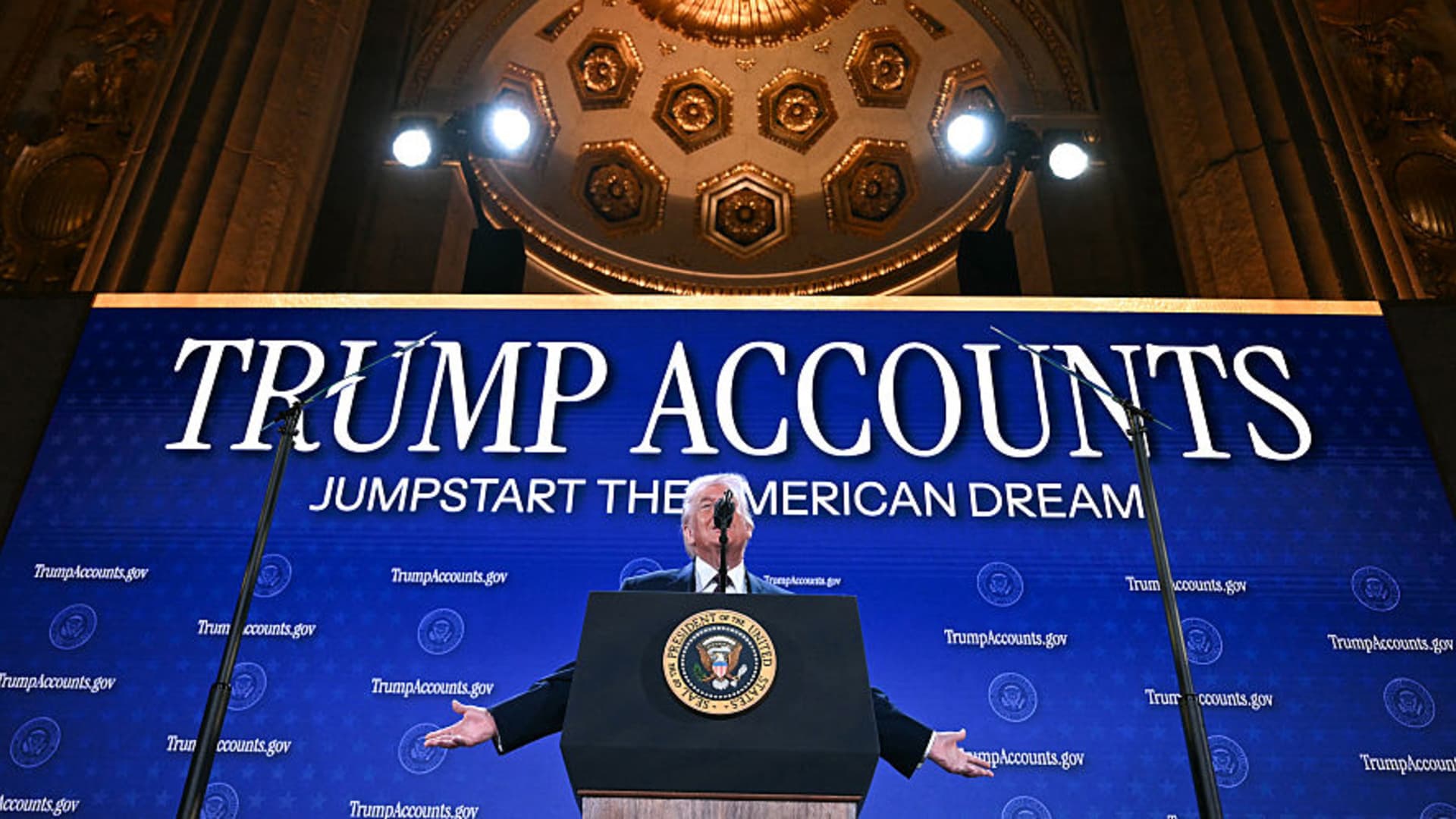
President Donald Trump delivers remarks on Trump Accounts at the Andrew W. Mellon Auditorium in Washington, Jan. 28, 2026.
Brendan Smialowski | AFP | Getty Images
With less than two months until the official launch of Trump Accounts, there are reports that business leaders and philanthropists may, at some point, be able to donate stock to fund grants into the new tax-deferred investing accounts for children.
“We all want to maximize more multi-billion gifts into kids accts & the gifts may be cash / shares!” Altimeter Capital CEO Brad Gerstner, who helped spearhead the Trump administration’s new savings initiative, wrote in a post on X on Wednesday.
Gerstner’s post came in response to a DealBook report from Wednesday, which said that there have been talks about changing the rules to allow for direct stock donations.
CNBC was not able to independently verify the DealBook report, which did not disclose its sources. DealBook reported that White House and Treasury Department officials discussed potentially expanding funding for Trump Accounts to accommodate stock donations.
“The Trump administration is always open to finding new ways to build on the immense success of Trump Accounts and help the next generation of American children build wealth,” a White House official said in an email in response to CNBC’s query about direct stock investment. “There are, however, no new updates to share at this time.”
Gerstner and Invest America, the nonprofit advocacy group that has been promoting Trump Accounts, did not respond to CNBC’s requests for comment.
As it stands, guidance from the Treasury Department says parents and guardians, employers, qualifying charitable organizations and state and local governments can only contribute cash to Trump Accounts, and the money will be invested in “broad U.S. equity index funds.”
There have also been discussions this week about employer Trump Account contributions.
Daniel Aronowitz, the head of the Department of Labor’s Employee Benefits Security Administration, said Tuesday at an event in Washington, held by law firm Mayer Brown, that the EBSA is working with the Treasury on expanding donations into the accounts.
These efforts are all part of a massive administration push to help fund Trump Accounts, also known as Section 530A accounts, at the outset and encourage more families to sign up.
The risks of individual stocks in Trump Accounts
Allowing businesses and philanthropists to make stock donations does not necessarily mean that accountholders would receive shares of those companies, experts say. While DealBook said children could have increased exposure to individual stocks, in his X post, Gerstner said the report was “misleading.”
“100% of all $$ in the @TrumpAccounts will be in a free index fund that tracks the S&P 500. No trading. No buying individual stocks. Period,” he wrote.
In another X post on Wednesday, Invest America wrote, “Wouldn’t it be great if every kid in America got a share of SpaceX or Berkshire Hathaway or OpenAI?!”
While the goal of Trump Accounts is to kick-start wealth-building opportunities, experts say allowing them to receive and hold individual stocks would also increase the risk of losses.
“The whole point of the requirement for holding low-fee index funds is to avoid speculative investing in single stocks, and reversing that rule would encourage much more speculative risk-taking in accounts that are meant for steady accumulation of retirement savings,” said Ben Henry-Moreland, a certified financial planner with advisor platform Kitces.com.
Tax breaks for donating stocks
Donating profitable stocks to charity is a popular strategy among the wealthy who want to support a cause and claim the charitable deduction.
Typically, donors see a bigger tax break for gifting appreciated stocks owned for more than one year rather than cash. Plus, they can bypass federal capital gains taxes of up to 20% plus a 3.8% surcharge for higher earners.
For example, if Elon Musk wanted to donate $1 billion worth of Tesla stock to Trump Accounts, under current rules, he would first need to sell the assets, which would incur capital gains, said Henry-Moreland.
But because it’s not possible for philanthropists to gift stock directly to Trump Accounts under current law, Congress may need to amend Section 530A to allow noncash contributions, Henry-Moreland said, referring to the Internal Revenue Code for the accounts.

Trump Accounts are available to all U.S. children with a Social Security number, and babies born between 2025 and 2028 are eligible for a $1,000 initial deposit from the Treasury.
A growing number of companies have pledged to match the accounts’ $1,000 Treasury deposit, and philanthropists in multiple states have committed to seed the accounts for qualifying families.
Previously, Treasury Secretary Scott Bessent said the aim was to have philanthropists, charities or local governments in every state contribute funds as part of a “50-state challenge.”
Most recently, in late April, the state of Oklahoma approved a one-time $250 Trump Account contribution for eligible children in the state, on top of the $1,000 Treasury deposit.
The new accounts officially launch on July 4, and so far, about 5.5 million children have signed up, according to the Treasury’s latest tally.