

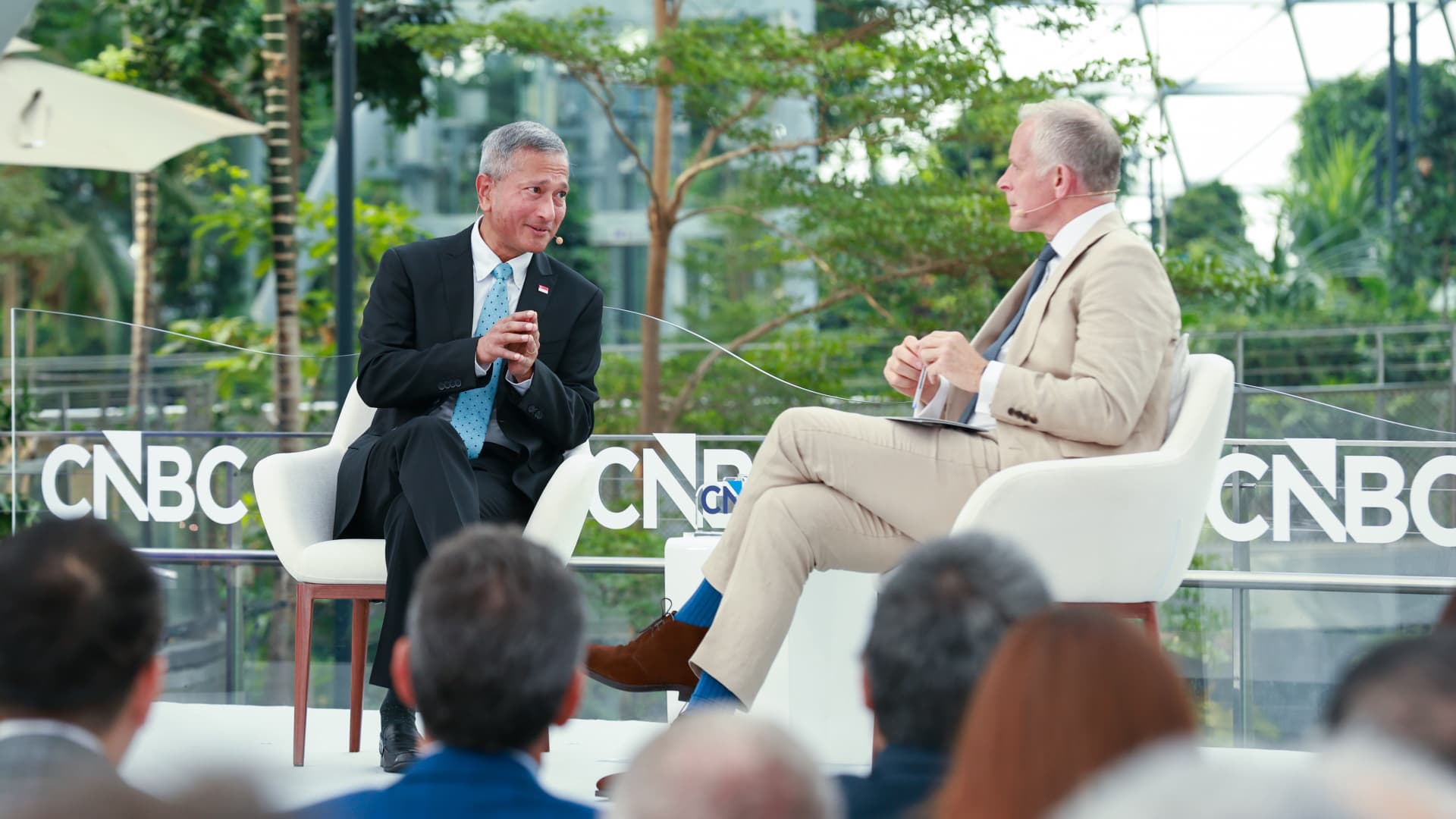
Singapore Foreign Minister Vivian Balakrishnan (left) speaks with CNBC’s Steve Sedgwick at the CONVERGE LIVE event on April 22, 2026.
CNBC
Should a war break out between China and the U.S. in the Pacific, “what you are seeing in the Strait of Hormuz will be a dry run,” Singapore Foreign Minister Vivian Balakrishnan said Wednesday.
Balakrishnan made the remarks at CNBC’s CONVERGE LIVE event in Singapore, responding to a question on whether the city-state was facing any pressure from Washington and Beijing to choose between the two.
Singapore has relationships with both the countries, and is uniquely positioned to take advantage of developments in the U.S. and China, Balakrishnan told CNBC’s Steve Sedgwick.
The U.S. is Singapore’s largest foreign investor with around 6,000 American companies based in the city-state. Singapore also runs a goods trade deficit with Washington to the tune of about $3.6 billion, according to the office of the U.S. Trade Representative.
Meanwhile, China has been Singapore’s largest trading partner, and Singapore has been China’s largest foreign investor.
Singapore will “refuse to choose” one over the other, he added. “The way we conduct our affairs is we assess what is in Singapore’s long term national interests, and if I have to say no to Washington or Beijing or anyone else, we don’t flinch from that.”
“We are acting in our own long term national interest. We will be useful, but we will not be made use of,” he added.
‘Choke points matter’
Separately, Balakrishnan also said that said the conflict in the Middle East had shown that “chokepoints matter,” pointing out that Singapore also sits astride one of the world’s critical trade arteries in the form of the Strait of Malacca.
At its narrowest point, the Strait of Malacca is two nautical miles, compared to 21 nautical miles for the Strait of Hormuz.
The minister was also asked if the actions of Iran in trying to extract tolls from ships passing the Strait of Hormuz would be have other countries thinking of also collecting tolls through chokepoints such as the Strait of Malacca.
In March, Iran’s state media reported that Tehran was preparing legislation that would impose tolls on ships passing through the Strait of Hormuz.
Balakrishnan said that it was a risk if this scenario came to fruition, but the states alongside the Strait of Malacca — Singapore, Malaysia and Indonesia — have a strategic interest in keeping it open and not collecting tolls.
“With respect to both America and China, we have told both of them we operate on the basis of UNCLOS,” he said, referring to the United Nations Convention on the Law of the Sea.
Article 44 of UNCLOS states that “States bordering straits shall not hamper transit passage … There shall be no suspension of transit passage.”
“The right of transit passage is guaranteed for everyone. We will not participate in any attempts to close or interdict or to impose tolls in our neighborhood,” Balakrishnan said.