

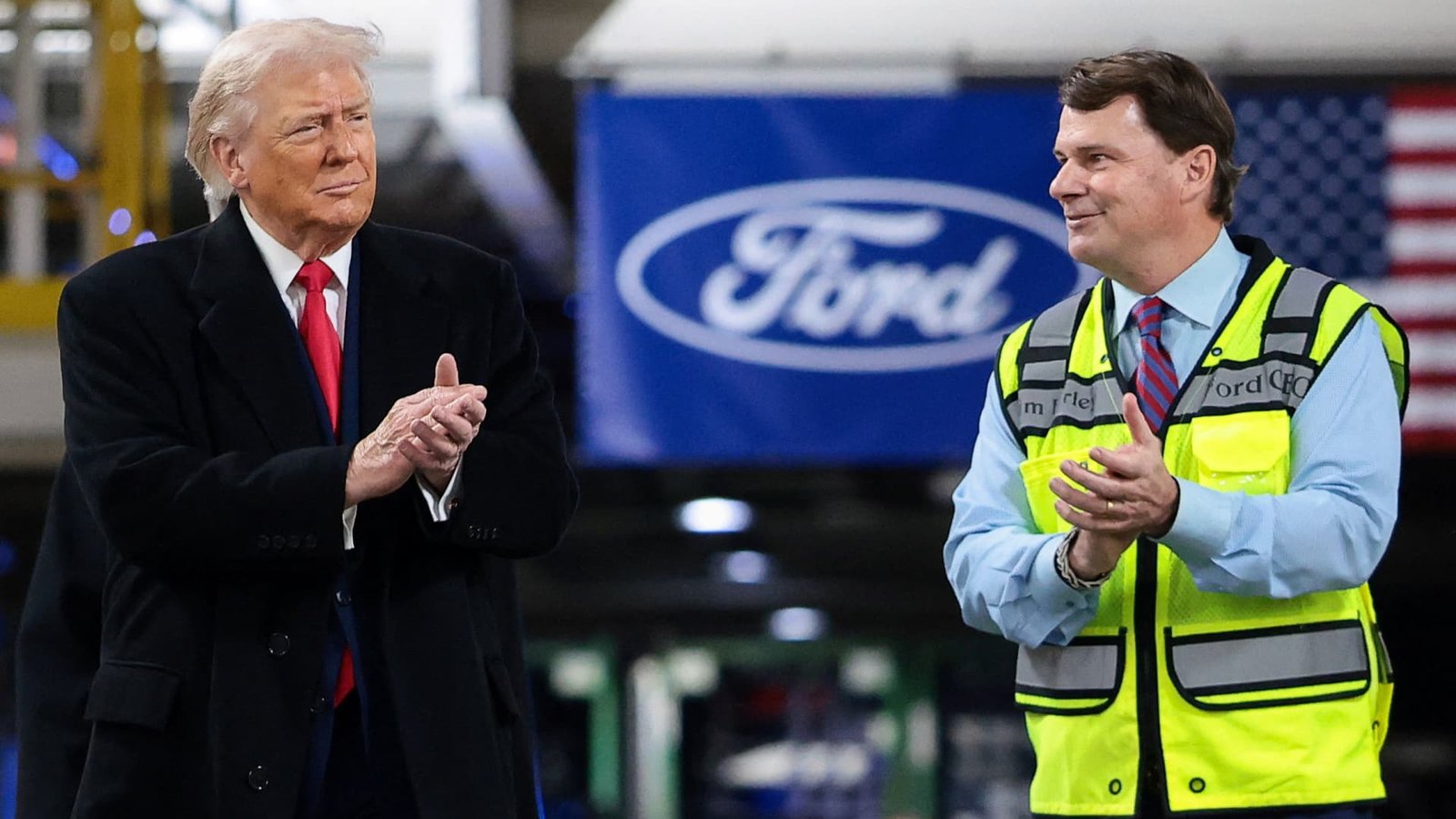
U.S. President Donald Trump and CEO of Ford Jim Farley clap, as President Trump visits a Ford production center, in Dearborn, Michigan, U.S., January 13, 2026.
Evelyn Hockstein | Reuters
The Trump administration expressed “profound concern” Tuesday about Ford Motor‘s ties to Chinese companies that it believes could be detrimental to the Detroit carmaker and U.S. automotive industry.
In a letter addressed to Ford CEO Jim Farley, Transportation Secretary Sean Duffy questioned the automaker’s strategic trajectory with Chinese companies “as it pertains to American national automotive manufacturing integrity, supply chain exposure, and reliance on technologies of foreign adversaries.”
Ford, which regularly touts its position as the top-producing automaker in the U.S., called the letter a “wrongheaded attempt to capture headlines.”
It also defended its stance as America’s top-producing carmaker and said it employs more hourly workers in the country than any other automaker, while calling out “factual errors” in the letter. Ford said those errors included Duffy’s comments about Farley proposing a joint-venture framework for Chinese automakers to enter the U.S.
The letter is the latest incident in a series of contentious discussions between the U.S. automotive industry and the Trump administration, which has caused uncertainty with its changes to trade and federal rules and regulations.
In the letter, Duffy took issue with Ford’s ties to Chinese companies such as battery provider CATL and a framework Farley proposed during an auto show earlier this year in Detroit “to facilitate Chinese joint ventures on United States soil.”
Ford has a licensing agreement to utilize battery technologies, including the production of lithium iron phosphate batteries, from Contemporary Amperex Technology Co., or CATL.
Ford’s deal with CATL was originally announced in 2023 but has drawn renewed attention amid tensions between the U.S. and China as well as Ford’s plan to use the battery technologies for energy storage systems.
“While DOT recognizes the intense competitive pressures of the global market, the Company’s recent strategic decisions paint a troubling picture of a foundational American brand actively intertwining its future with Chinese state-backed enterprises,” Duffy’s letter read.
Ford CEO Jim Farley at a battery lab for the automaker in suburban Detroit, announcing a new $3.5 billion electric vehicle battery plant in the state to produce lithium iron phosphate batteries, Feb. 13, 2023.
Michael Wayland/CNBC
Duffy urged Farley, who has been complimentary of Chinese competitors as well as the Trump administration’s attempt to promote U.S. manufacturing, to “reflect on these concerns and national necessities and adopt reasonable strategies that prioritize American workers, utilize allied supply chains, and promote the self-reliance and integrity of the domestic automotive industry.”
Ford urged Duffy to more openly communicate with the company.
“Ford supports the Trump administration’s vision for advancing American innovation and manufacturing,” the company said. “Had Secretary Duffy reached out before issuing his letter to the press, we would have been happy to share more details about Ford’s U.S. commitment.”
— CNBC’s Meghan Reeder and Phil LeBeau contributed to this report.