

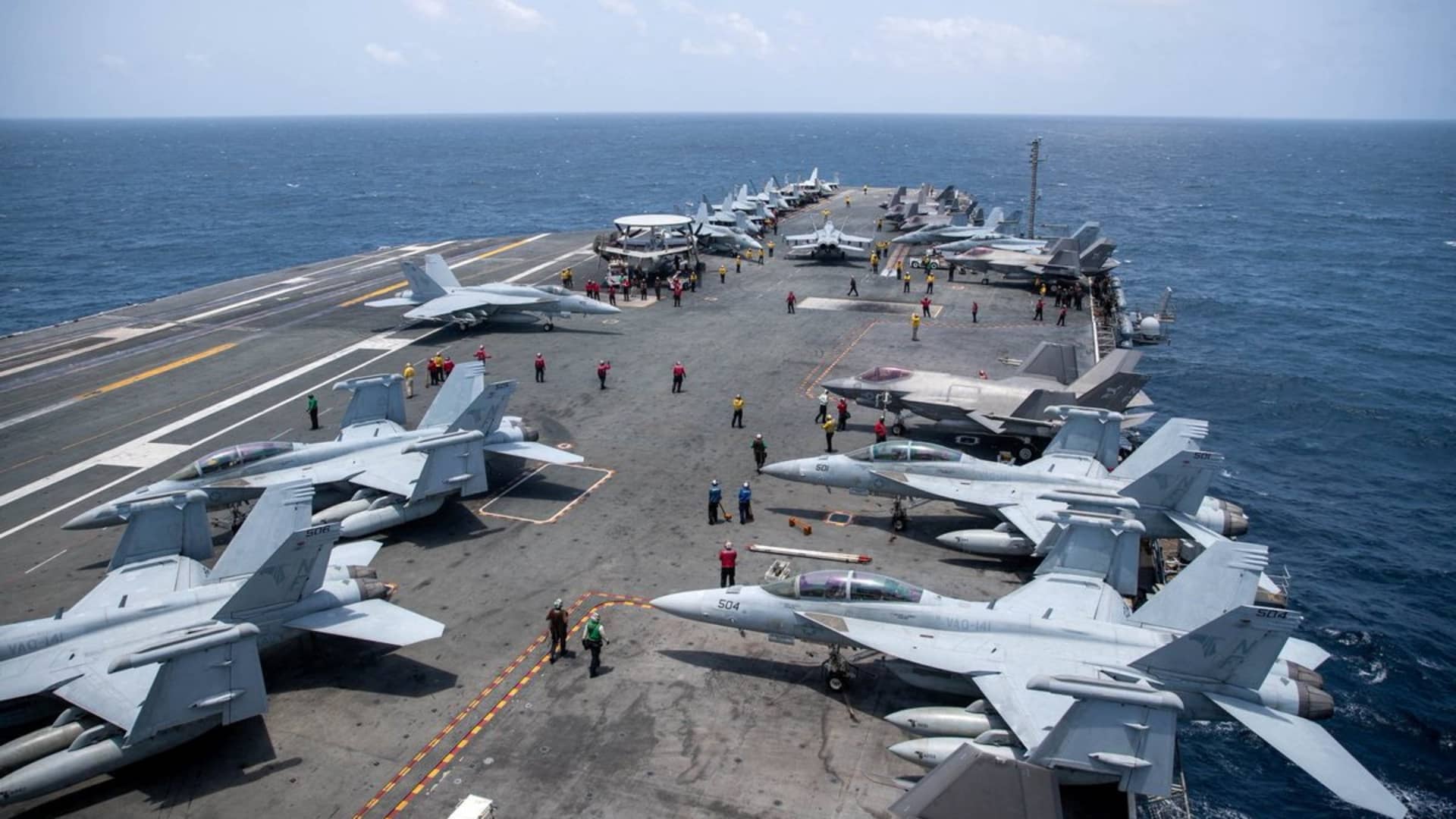
U.S. Navy sailors work on the flight deck of the aircraft carrier USS George Washington as it transits the Arabian Sea to support U.S. military operations in the war with Iran Aug. 20, 2026.
U.S. Navy | Via Reuters
Iran’s foreign minister said on Friday that a return to diplomatic negotiations with the U.S. is not out of the question, as Tehran set out its conditions for the reopening of the Strait of Hormuz.
The U.S.-Iran war has been raging for six months and talks between the belligerents appear to have collapsed, but Seyed Abbas Araghchi wrote in an X post that “putting diplomacy back on track isn’t impossible.”
But following “creative discussions” with Qatari officials to reopen a safe transit route through the Strait of Hormuz on Thursday, Araghchi said the potential for renewed negotiations with Washington “hinges on U.S. understanding of one simple fact: pressure doesn’t work.”
“The U.S. should build trust, speak respectfully, acknowledge our rights, and uphold commitments,” he added.
Tehran: Lebanon, Gaza and Syrian conflicts must cease
It came after Mohsen Rezaei, secretary of Iran’s Supreme National Security Council, told Lebanese media outlet Al Manar TV that any understanding on the strait with the U.S. will include an end to wars and military operations in Lebanon, Gaza and Syria.
He added that the conflict in the Gaza Strip has to end, while demanding that Israel withdraw from Lebanon and halt attacks on Syria.
Rezaei said that the Strait of Hormuz cannot be separated from the broader regional conflict, adding that the U.S. must “prove its seriousness” in implementing these commitments “before any new trust could be established.”
However, a return to diplomacy does not seem imminent. The Wall Street Journal reported on Thursday that the Trump administration has no interest in going back to the terms of the memorandum of understanding it reached with Iran in June.
Citing people familiar with the matter, the Journal said that U.S. President Donald Trump was no longer interested in the June deal framework, and is instead waiting to see if his administration’s strategy of pressuring Iran economically will work.
The U.S. on Monday announced an “economic D-Day” campaign against Teheran, threatening countries that do business with the Islamic Republic, shifting its focus from military action to economic pressure.
Temporary relief
Iran is now allowing a “temporary and limited” corridor for ships to pass through the Hormuz Strait, and the future of maritime traffic will depend on developments in understandings with Washington, according to Rezaei.
Earlier this week, Oman and Iran discussed a proposal to establish a temporary joint shipping route through the Strait of Hormuz as well as a mission to clear mines from the key oil export corridor.
However, a video posted on X late Thursday stateside by Admiral Brad Cooper, commander of U.S. Central Command credited U.S. forces for clearing the mines from the strait.
Centcom forces have helped facilitate the transit of approximately 1,500 commercial vessels and 750 million barrels of crude oil over the past several months, Cooper said. “Today, international shipping lanes are open, and momentum is building.”
However, the latest available Kpler data showed that only five ships crossed Hormuz on Tuesday, a far cry from the approximately 130 ships that used to transit the crucial waterway before the war broke out in February.