

In the five months since the Iran war began on Feb. 28, each pause in fighting has underscored the complexities of ending it.
The June 17 memorandum of understanding opened a 60-day negotiating period over the Strait of Hormuz, sanctions and Iran’s nuclear and missile programs, but frayed within weeks as Iranian attacks on shipping prompted escalation.
The U.S. resumed strikes for 13 consecutive nights until it paused on July 24, only for the fighting to resume on Tuesday, with strikes overnight on Wednesday and Thursday. Iran’s army said on Friday it had launched attacks on strategic U.S. assets and military bases in Kuwait and Bahrain.
Whenever negotiations resume, Iran’s opaque power structure — spanning the Supreme Leader, the Revolutionary Guards, civilian government, commanders and other groups — will shape not only what is agreed, but whether any deal can be enforced.
Any ceasefire would have to pass through layers of command, and the Islamic Revolutionary Guard Corps (IRGC) commanders and Tehran-aligned groups may interpret the terms differently. Attacks attributed this week to Iran-aligned Iraqi militias on Saudi oil facilities and to Yemen’s Houthis on pipeline infrastructure show how groups sympathetic to Iran could widen the conflict.
Why Iran’s power structure complicates a ceasefire
Attacks on commercial shipping could become an early test of Iran’s wartime balance of power.
The U.S. has always emphasized it wants to see the Strait of Hormuz reopened without tolls. While Tehran’s civilian government is seeking economic relief and sanctions easing, elements within the security establishment may view continued pressure in the strait as an important source of leverage.
Iran’s civilian government hopes to unlock frozen funds to provide financial relief for the population of over 90 million Iranians crippled by decades of sanctions.
Vessels in the Strait of Hormuz near the beach of Bandar Abbas, following the signing of the Islamabad Memorandum of Understanding between the United States and Iran, Iran, June 18, 2026.
Amirhosein Khorgooi | Reuters
The government has long been undermined by the IRGC, who are “the dominant force on war and national security,” Sanam Vakil, director, Middle East North Africa Program at Chatham House, told CNBC.
They operate “missiles, drones, intelligence networks and regional armed partnerships, and during active conflict its commanders can exercise considerable autonomy,” she added.
“The civilian government still matters, and the president can shape diplomacy, economic policy and the work of the Supreme National Security Council, but he does not command the armed forces,” Vakil continued.
Who controls Iran’s military decisions?
President Masoud Pezeshkian leads Iran’s civilian government but ultimate authority over national security rests with Supreme Leader Ayatollah Ali Khamenei, while the IRGC exercises significant operational autonomy.
While the Supreme Leader has the final say over national security, “he does not personally direct every tactical operation,” Vakil said.
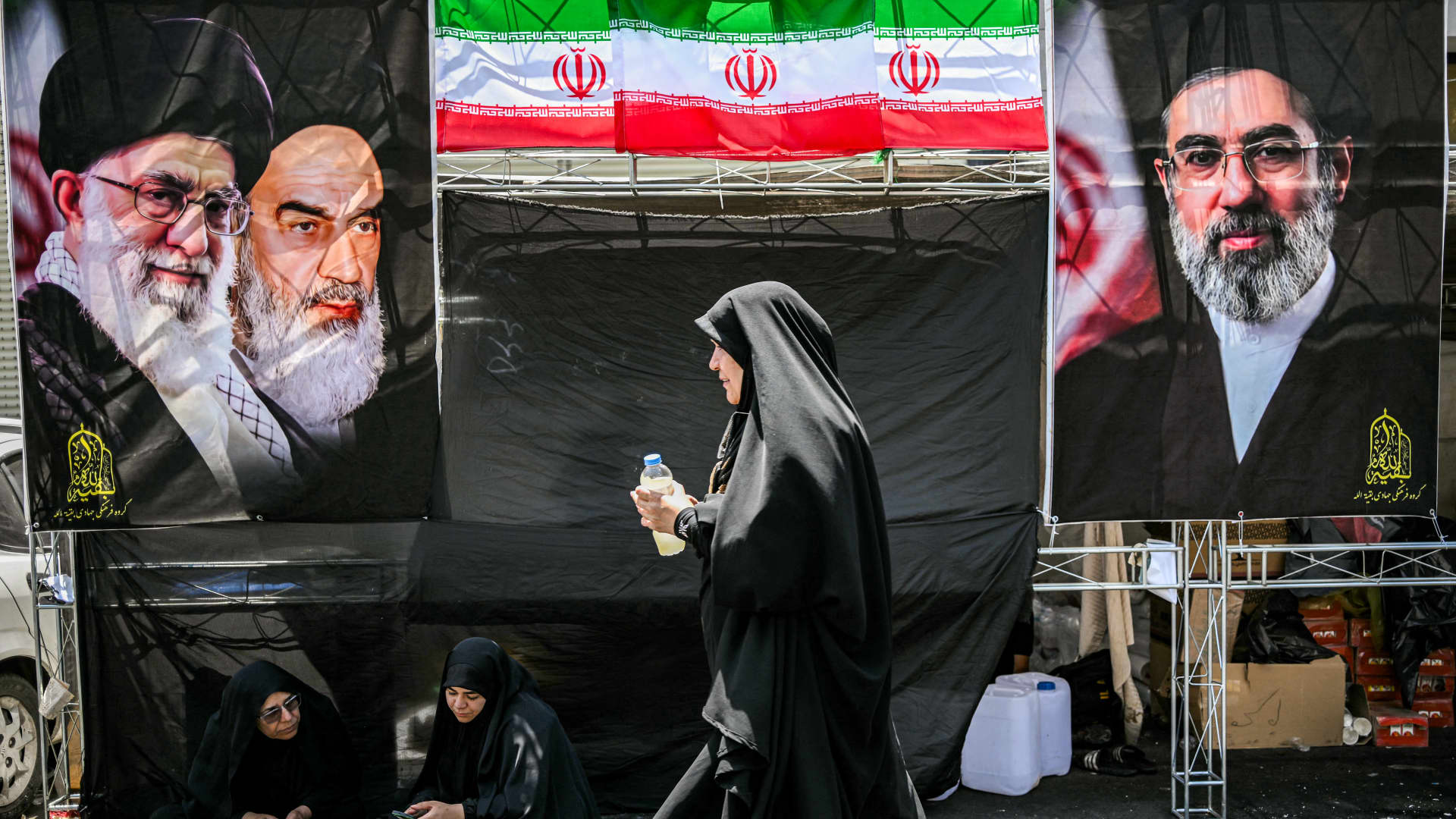
A woman walks past images of Iran’s current supreme leader Mojtaba Khamenei (R) and his predecessors: his slain father Ali Khamenei (L) and the late Ruhollah Khomeini (2nd-L) while on the way to the Grand Mosalla in Tehran on July 5, 2026, for the funeral ceremonies of Ali Khamenei.
Ozan Kose | Afp | Getty Images
The IRGC has become Iran’s dominant military and security institution, overseeing missile forces, drones, regional operations and relationships with armed groups aligned with Tehran. It answers directly to the Supreme Leader rather than the civilian government.
It exists alongside Iran’s conventional military but is more powerful politically and oversees foreign operations and Iran’s proxies, like Hezbollah. Crucially, these proxies export the ideology of the Islamic Republic through weapons, training and funding. The IRGC also oversees Iran’s internal security through the Basij paramilitary force.
What it means for negotiations
This week marked the end of a temporary halt in hostilities, after the U.S. and Saudi Arabia struck Iran-backed militias in Iraq. Iran launched a surprise missile attack on U.S. forces in Jordan, all of which were intercepted according to the U.S. military.
The strike underscored how quickly the conflict can expand even as diplomats attempt to restart negotiations.
Earlier this week, diplomats sought to give peace talks “some space.” Iran’s Foreign Ministry spokesperson, Esmail Baghaei, on Monday said Iran currently has “no negotiations with the United States.”
Amos Hochstein, former senior advisor to President Joe Biden and managing partner at TWG Global, told CNBC: “Iran has no intention of returning to the status quo before the war.”
“A ceasefire is not a switch that can simply be flipped. Iran wants to translate battlefield realities into political gains before locking itself into a new status quo,” Alex Vatanka, senior fellow at the Middle East Institute, told CNBC.