

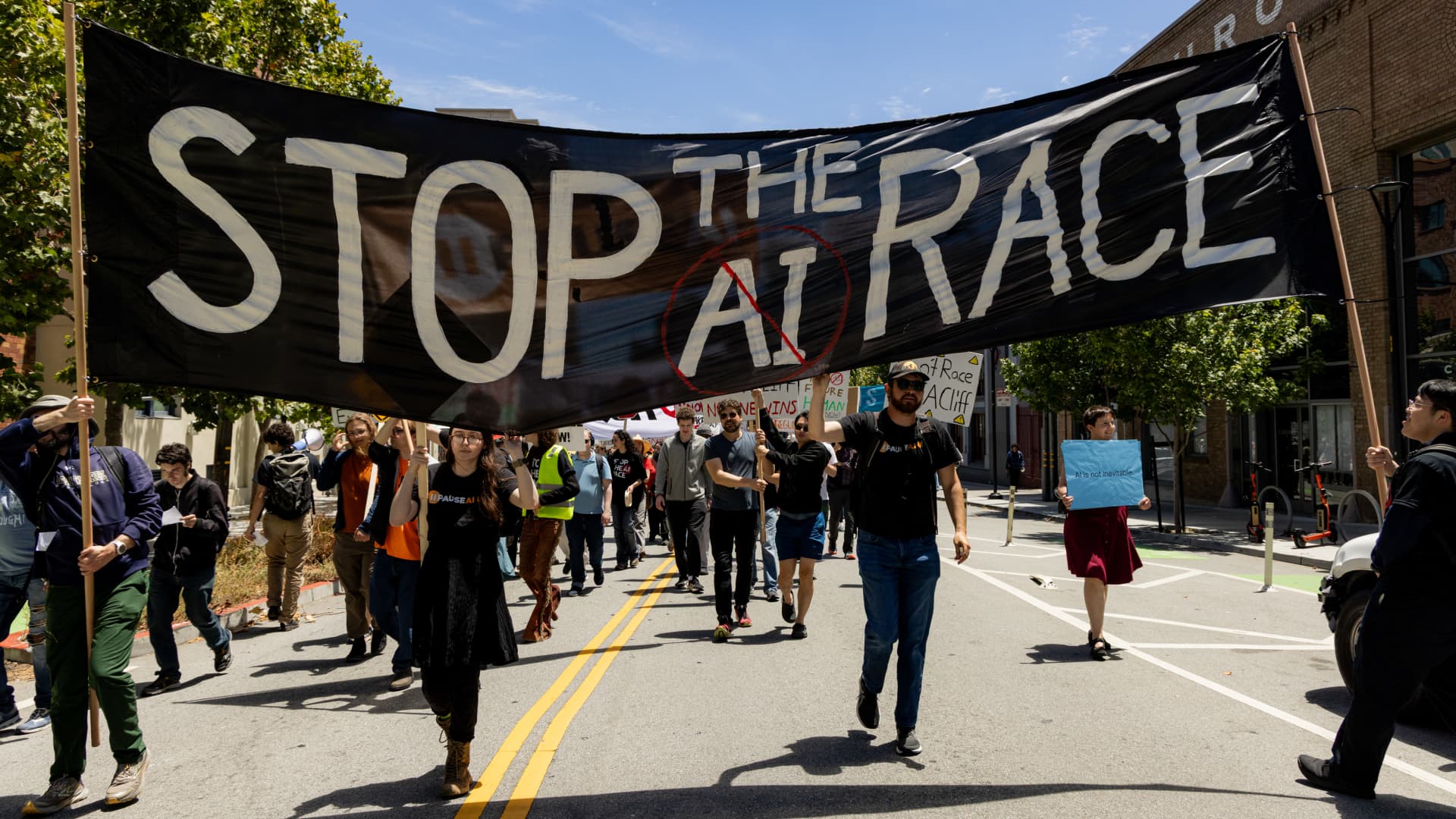
Demonstrators march during a protest against artificial intelligence (AI) in San Francisco, California, US, on Saturday, July 11, 2026.
Jason Henry | Bloomberg | Getty Images
The emerging coalition of religious leaders, labor unions and local activists that worries about artificial intelligence and the broader economic upheaval it portends poses a political problem for anyone who gets on the wrong side of that issue. And President Donald Trump is the person most at risk.
AI is positioned right in his blind political spot. The industry and its rapidly developing technology threaten to overwhelm Trump’s often-uncanny ability to sense changes in the political winds and could damage his party’s fortunes in the midterm election and the longer-term legacy he values.
Trump seems aware of the danger, yet can’t help himself from hurtling toward it.
On Thursday, he touted commitments by data center developers and utilities not to raise electricity prices, nodding to fears across the country that a surge in data center construction will spike Americans’ energy bills. The pledge is a no-brainer for the likes of OpenAI and Oracle, giving them political cover as the complex economics of making changes to aging U.S. grids plays out over years and decades.
But Trump couldn’t help but align himself with the companies, even at an event at the Environmental Protection Agency on the pledge that was designed to show he’s looking out for the little guy. He exhorted the assembled governors and other local officials to sell their constituents on data centers. “You can’t fight it. You have to go with it,” he said.
Someone is going to get rich on data-center development, and it might as well be you, he told the audience. “If you don’t take all that money, somebody else is going to take it. You might as well do it yourself.”
Here’s the thing about getting rich. If Americans sniff a chance it could happen to them, they don’t need to be told twice to get behind it. That’s why crypto and prediction markets are ideas that can’t be killed, no matter how unlikely it is that you, personally, will really get rich off them.
When it comes to artificial intelligence, however, rank and file Americans just aren’t buying the idea that Big Tech is handing them a golden lottery ticket. Trump can tout the stock market boom all he likes — the Nasdaq composite has had 20 record closes this year — but too few Americans have enough of a stake in the market for rising share prices of a select few tech companies and the indexes that contain them to overcome their worries about job instability and the continuing concentration of wealth.
To wit, Elon Musk‘s SpaceX looked like a great opportunity for those who were able to invest early. For those Regular Joes fortunate enough to have a few bucks in a brokerage account during its IPO last month, shares are down 30%.
And now add to the class-and-wealth problems of AI a heavyweight political coalition that has sway with the voters Trump would most like to persuade.
The president may be willing to write off Pope Leo XIV, who issued an influential encyclical in May warning that AI needed guardrails to protect our humanity. But Trump can’t so easily swipe away the same language when it comes from the heart of the evangelical movement here in the U.S.
Walter Kim, president of the National Association of Evangelicals, praised the pope’s warnings on AI. “There are positive benefits, but there are also extraordinary harms,” Kim said on CNBC’s “Squawk Box” on Wednesday.
Kim worried that the prominence of AI in healthcare, education and warfare risks taking human beings out of the loop on our most important decisions.
“It is, as the Pope described in his recent encyclical, the construction of a Tower of Babel, the trust in a technology that reflects human hubris, that not only disconnects us from God but disconnects us from each other,” Kim said.
Kim’s evangelical group doesn’t endorse candidates and isn’t threatening any kind of overt political campaign against Trump. But Kim’s message is a warning sign that the ground is shifting, even among a voting bloc that has backed Trump since early in his first presidential run.
Other groups whose favor Trump and fellow GOP politicians might want to win are being even more blunt. Republicans made a play for union support under Trump to mixed success. Increasingly, if they want to win union backing, that will require taking AI concerns more seriously.
Liz Shuler, president of the AFL-CIO, the largest U.S. labor federation, laid that out at the union’s convention last month.
“For all of those candidates who are already out there starting to run for president in 2028, if you want to hold the highest office in the land, hear these words: Working people should come before algorithms,” she said.
Shuler doesn’t claim to be anti-AI, but she wants to see the new technology help more than the tech firms and their investors. So does Sean O’Brien, head of the International Brotherhood of Teamsters, who spoke at the Republican National Convention in 2024. “We’ve never had a seat at the table,” he said in a recent event with Palantir CEO Alex Karp organized by the center-right group American Compass.
Karp, who grew up in a union household, chimed in, “I think the biggest challenge to AI in this country is political unrest.”
The potential for that unrest is clear in the nationwide rumbling against data centers.
It may be liberal New York state that has moved first to impose a moratorium on building data centers under Gov. Kathy Hochul. But so far, the issue isn’t polarized along familiar lines. A majority — 53% — of conservative Republicans opposes building data centers locally, according to a June poll by the Yale Program on Climate Communication.
A majority of registered voters, or 58%, shared that opposition to local data center construction, as did 74% of liberal Democrats, in the poll.
The religious right, labor unions, and the broad coalition of local activists are all coming together to say, “slow down” on AI. The politicians who listen will find a powerful groundswell of support behind them.
Those who don’t? Well, Election Day in November is just 101 days away.