


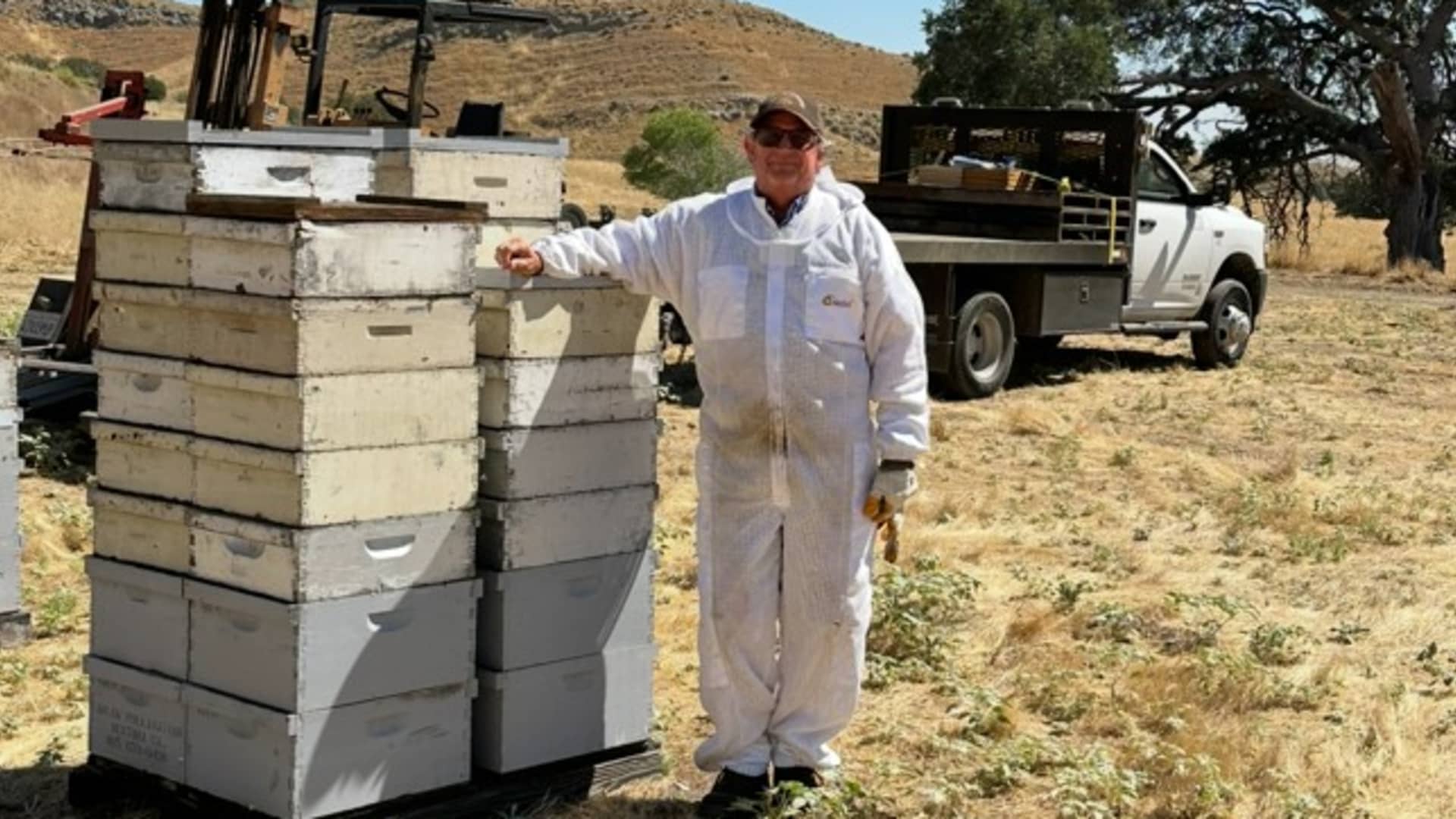
For David Bradshaw, beekeeping has always been a family affair.
Bradshaw, 70, is the second-generation owner of Bradshaw Honey Farms in Visalia, California. His father, Howard Bradshaw, founded the farm in the backyard of their home in 1958.
As a young child, David Bradshaw remembers playing outside and “learning not to get too close” to the beehives, he says. Since then, he’s been stung “thousands of times,” but that hasn’t deterred him from sticking with the business.
He’s also gotten the next generation involved: Bradshaw’s daughter works full-time on the farm, where she manages honey bottling operations, and his son helps out as needed. And, he says, “in a way, I guess my bees are my kids” too.
Founding the family farm
Before he started Bradshaw Honey Farms, Howard Bradshaw worked as an aircraft mechanic and raised bees as a hobby. According to David, he left his job to focus on beekeeping full-time after witnessing a fatal workplace accident.
“I remember as a kid, he just came home crying — probably the first time I saw my dad cry,” David Bradshaw recalls. “He said, ‘I quit. I’m not going back. Bees are much safer.'”
In 1970, the Bradshaw family, including David and his four siblings, moved to a five-acre property in Visalia, where Howard Bradshaw built his honey operation and began renting his bees to local farmers to pollinate their crops.
A young David Bradshaw among the beehives in his family’s backyard.
Courtesy of David Bradshaw
Was David Bradshaw always interested in taking over the honey farm? “Heck no,” he says. As a “teenage rebel kid,” he wanted to become a car mechanic. But his father needed help with the bees, so he got an associate’s degree in agricultural mechanics and started working on the farm instead. By the mid-80s, Bradshaw says that he and his father each owned 2,000 bee colonies.
Howard Bradshaw was thrilled to have his son take on more responsibility at the farm. “He said, ‘All I need is a lunch pail, and you tell me what to do,'” David Bradshaw recalls. “He was happy as could be.”
The duo ran Bradshaw Honey Farms together until Howard passed away in 2019 at age 81.
Working in ‘wide open spaces’
David Bradshaw still operates Bradshaw Honey Farms from that same property in Visalia, where he lives with his wife, but his bees travel all over the San Joaquin Valley to pollinate crops and make honey.
He rents his bees out to farmers in a yearly rotation that starts with the almond bloom, dropping off his hives in almond orchards in mid-February. Next, he takes the bees to pollinate cherries and prunes, before moving on to oranges, lemons and grapefruit in late spring. From summer through early fall, Bradshaw takes his bees to the Sierras so that they can stock up on pollen and make some honey from native plants.
Bradshaw tends to his bees.
Courtesy of David Bradshaw
Extracting honey is long, hard, hot work, according to Bradshaw. He and his employee collect the honey supers — specialized boxes that sit atop the hives and store surplus honey — from each colony. Using a forklift, they load the heavy supers into Bradshaw’s truck and drive back to the Visalia property, where they spend “days and days extracting honey.” Bradshaw’s daughter bottles the honey to sell.
When his bees aren’t busy pollinating crops, Bradshaw rents pastures from local farmers, particularly cattle ranchers, to host his hives while the bees rest and build up their food stores for winter. Many are willing to lend their land in exchange for a steady supply of free honey, Bradshaw says.
Bradshaw rents land from local ranchers and farmers for his bees to rest and gather pollen.
Courtesy of David Bradshaw
“If you’re a beekeeper of any size, you have to rely on the generosity of farmers and ranchers to allow you to put bees on their land,” he says. “You need wide open spaces, and you need to be constantly moving them.”
Keeping up with rising costs
The majority of Bradshaw Honey Farms’ revenue comes from renting out the bees for pollination services, according to documents reviewed by CNBC Make It.
Over the last decade, “the bees just have not been making very much honey,” he says, and as domestic honey production has declined, the market has flooded with cheaper imported honey products.
Bradshaw still sells small batches of honey, though it’s no longer a major source of revenue. He also sells custom beekeeping equipment and bee food supplements through the farm’s online store, and extracts honey for other local beekeepers to make some extra income.
Bradshaw sells small batches of his honey via the farm’s online store.
Courtesy of David Bradshaw
Bradshaw Honey Farms brought in about $1.8 million in gross income last year, according to documents reviewed by CNBC Make It, but after expenses, the business ended the year at a loss. Labor is one of the farm’s biggest expenses, with two full-time employees, including his daughter. Rising fuel prices and tariffs on key supplies like honey bottles have added extra financial challenges, he says.
Bradshaw typically lives on “what’s left over” after all the bills are paid, but for the past few years he’s had to draw on his savings, which are now “down to zippo,” he says. “I’m constantly putting the money back into the business,” he adds. “It’s a legacy that I feel responsible for.”
Protecting the hive
In the bee business, “you depend on Mother Nature,” Bradshaw says, but nature doesn’t always cooperate. If there’s not enough rain, the plants won’t grow, which diminishes the pollen supply. If it rains too much, the bees can’t leave their hives to gather food, so Bradshaw has to supplement their stores with artificial protein and sugar syrup.
A frame of bees from one of Bradshaw’s hives.
Courtesy of David Bradshaw
One of Bradshaw’s primary concerns is parasitic mites, which can weaken or kill honeybees and transmit deadly diseases like deformed wing virus. He and his employees regularly medicate the bees to prevent mites, but once a virus gets into the hive, “you’re done for,” he says.
Bradshaw estimates that he lost about 60% of his bee population in 2025, in large part due to viral infections caused by mites. He’s far from alone: 62% of commercial honeybee colonies in the U.S. died between June 2024 and February 2025, according to a survey from nonprofit bee research organization Project Apis m. published in April 2025. Beekeepers reported that the primary causes of death were parasites, pathogens, exposure to pesticides and inadequate nutrition.
“Our challenge right now is to make sure the bees get to next year,” Bradshaw says.
Fighting for the farm’s legacy
Bradshaw says he worries about the future of Bradshaw Honey Farms, and about the future of the American beekeeping industry as a whole. Many independent beekeepers are giving up and selling their operations to larger corporations, he says. “They’re just saying, ‘Forget it, it’s just too difficult.'”
There’s one key prerequisite to being a beekeeper, according to Bradshaw: “You have to care about the bees.” People who go into beekeeping with the sole aim of making money typically don’t last in the business, he says: “In the end, they just give up.”
But Bradshaw says he can’t imagine doing the same: “I’m a beekeeper inside out,” he says. “I’ll probably do it ’til I die.”
Despite the difficulties of the past few years, Bradshaw says he still feels that the bee business “has been really good to me.” The best part of his job is “the feeling of accomplishment when you make a nice honey crop, when you have thriving bees,” he says. “There’s just nothing like it.”
Want to get ahead at work? Then you need to learn how to make effective small talk. In CNBC’s new online course, How To Talk To People At Work, expert instructors share practical strategies to help you use everyday conversations to gain visibility, build meaningful relationships and accelerate your career growth. Sign up today!