


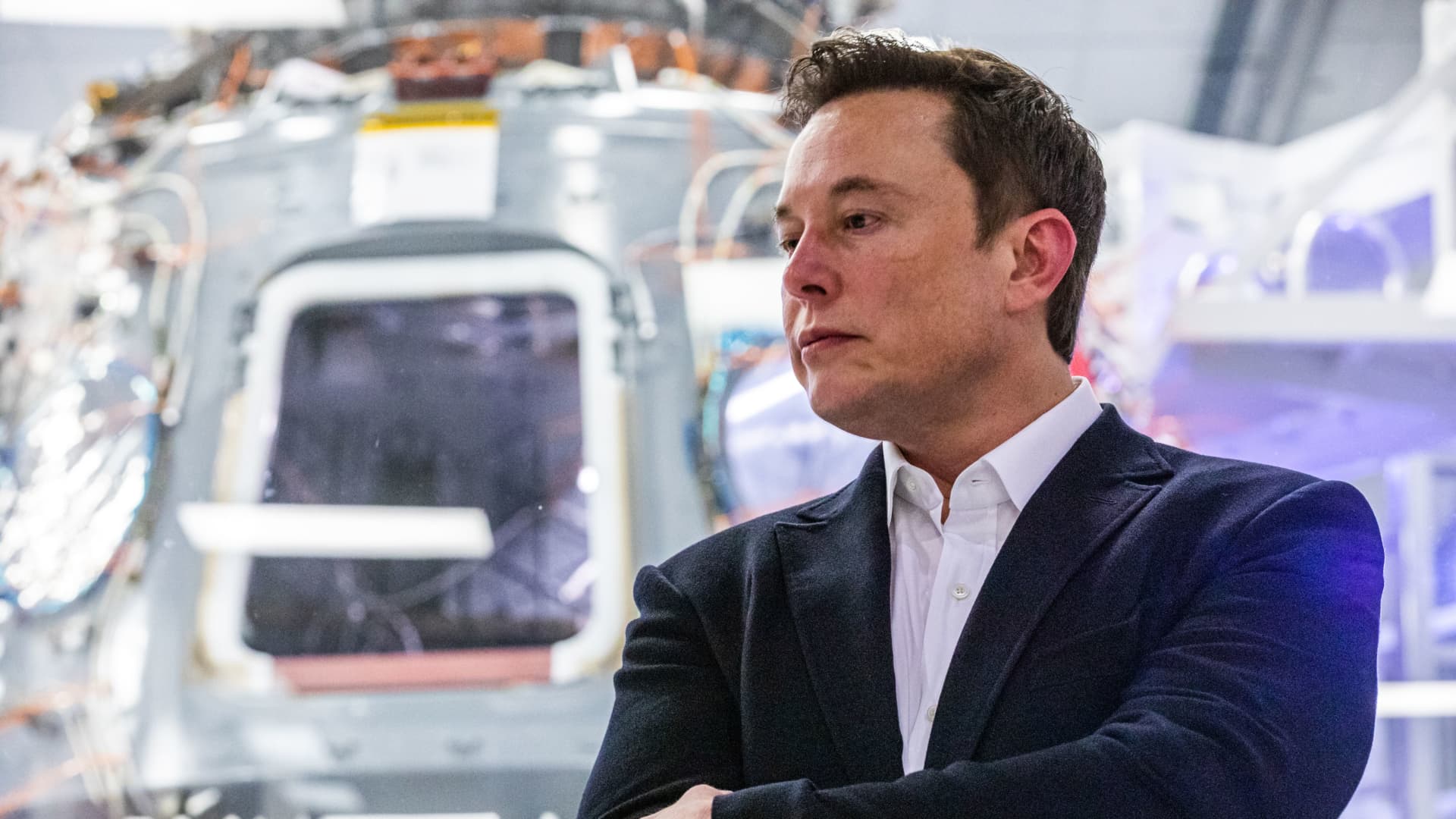
SpaceX founder Elon Musk addresses members of the media during a press conference announcing new developments of the Crew Dragon reusable spacecraft, at SpaceX headquarters in Hawthorne, California, Oct. 10, 2019.
Philip Pacheco | Afp | Getty Images
It was a rough week for Elon Musk.
Tesla shares plunged 18% during the week to close at $313.03 on Friday, their worst weekly slump since 2022. And SpaceX’s stock continued its downward slide, dropping 7.2% over five days to close at $115.07 Friday, its lowest since the company’s record initial public offering last month.
The declines in both stocks wiped away about $130 billion of Musk’s wealth, weeks after he’d become the world’s first trillionaire. In a post on X on Friday, Musk wrote, “(Former) trillionaire.”
Tesla’s slump was spurred by weaker-than-expected earnings when the electric vehicle maker reported second-quarter results late Wednesday. The company turned cash flow negative due to a surge in spending on futuristic projects like robotaxis, humanoid robots and a giant chip fab.
“We expect this to pressure free cash flow and delay earnings growth, without providing any near-term shareholder return,” wrote analysts at Argus Research, which has a hold rating on the stock, in a report on Friday. “We believe it will be nearly impossible for Tesla to generate any consistency in profit growth in the near-term.”
Tesla’s stock is now down 30% for the year, by far the worst performer among tech’s mega-caps.
Meanwhile, SpaceX’s stock has been on a steady downward trajectory over the past month following an initial pop when the company went public. The shares have dropped for four of the past five weeks and are about 43% off their peak close on June 16.
On Friday evening, SpaceX will again attempt the 13th test flight of Starship, the largest rocket ever built or flown. The company plans to fly the new version of the rocket, Starship V3, from its company town and launch facility in Starbase, Texas. The rocket is designed to be fully reusable and is considered crucial for SpaceX’s near-term aims to vastly grow its Starlink satellite network.
In a post on X, which is owned by SpaceX, the company said it delayed the test flight planned for Thursday “due to weather.” SpaceX previously scrubbed a test flight last week, after the rocket’s booster triggered a hold, which “shut down the engines right as they were starting to ignite,” a SpaceX employee said during a livestream of the event.
A successful launch of Starship V3, an upgraded version of its roughly 400-foot-tall rocket, would be the first since the company’s IPO.
SpaceX plans to use Starship to bring U.S. astronauts back to the Moon’s surface, and Musk wants the rocket to eventually power manned missions to Mars.
Musk made a public appearance this week, sitting down for what turned out to be a contentious interview with The Economist.
Zanny Minton Beddoes, editor-in-chief of the publication, asked Musk about his support for “not just the populist right, but the far right, in fact very fringe parties in some countries.”
In addition to his financial and vocal support for President Donald Trump, including his work for the second administration, Musk has endorsed Germany’s AfD, an extreme anti-immigrant party, as well as the U.K.’s Restore Britain, founded by Rupert Lowe, who also calls to “reverse mass migration.”
“It’s just normal people!” Musk said in response. He berated Beddoes and “the traditional media” for an “absurd characterization of the far right.”
WATCH: SpaceX learning as much as it can about newest rocket