

Swedish defense company Saab beat earnings expectations in the second quarter, as booming demand for military equipment propelled the fighter jet maker to another quarter of record orders backlog.
Shares rose as much as 4.5% in early trading in Stockholm, while other major European defense names were in the red.
New order bookings in the quarter ended June were 68.4 billion Swedish crowns ($7.1 billion), above the FactSet estimates of 57.1 billion Swedish crowns, which included a Polish submarine deal worth 47 billion crowns.
The total backlog amounted to 317.7 billion crowns, up from 197.6 billion a year ago and marking a fifth consecutive quarter of order book growth.
It comes as European governments ramp up defense spending, driving up book orders with the region’s companies, in response to Russia’s growing threat and invasion of Ukraine.
U.S. President Donald Trump’s push to shift the responsibility of defending Europe onto the region’s own governments – and his threat to withdraw troops from the continent – has hastened this urgency.
“We operate in a market with structurally growing demand and remain focused on scaling capacity, delivering to customers, and advancing new capabilities,” said Saab CEO Micael Johansson in a statement.
Investors are increasingly focusing on companies’ ability to execute and deliver, as well as growing order books.
Sales came in at 25.5 billion crowns, beating FactSet estimates of 23.9 billion crowns, while operating profit (EBIT) was 2.8 billion crowns, compared to expectations of 2.4 billion crowns.

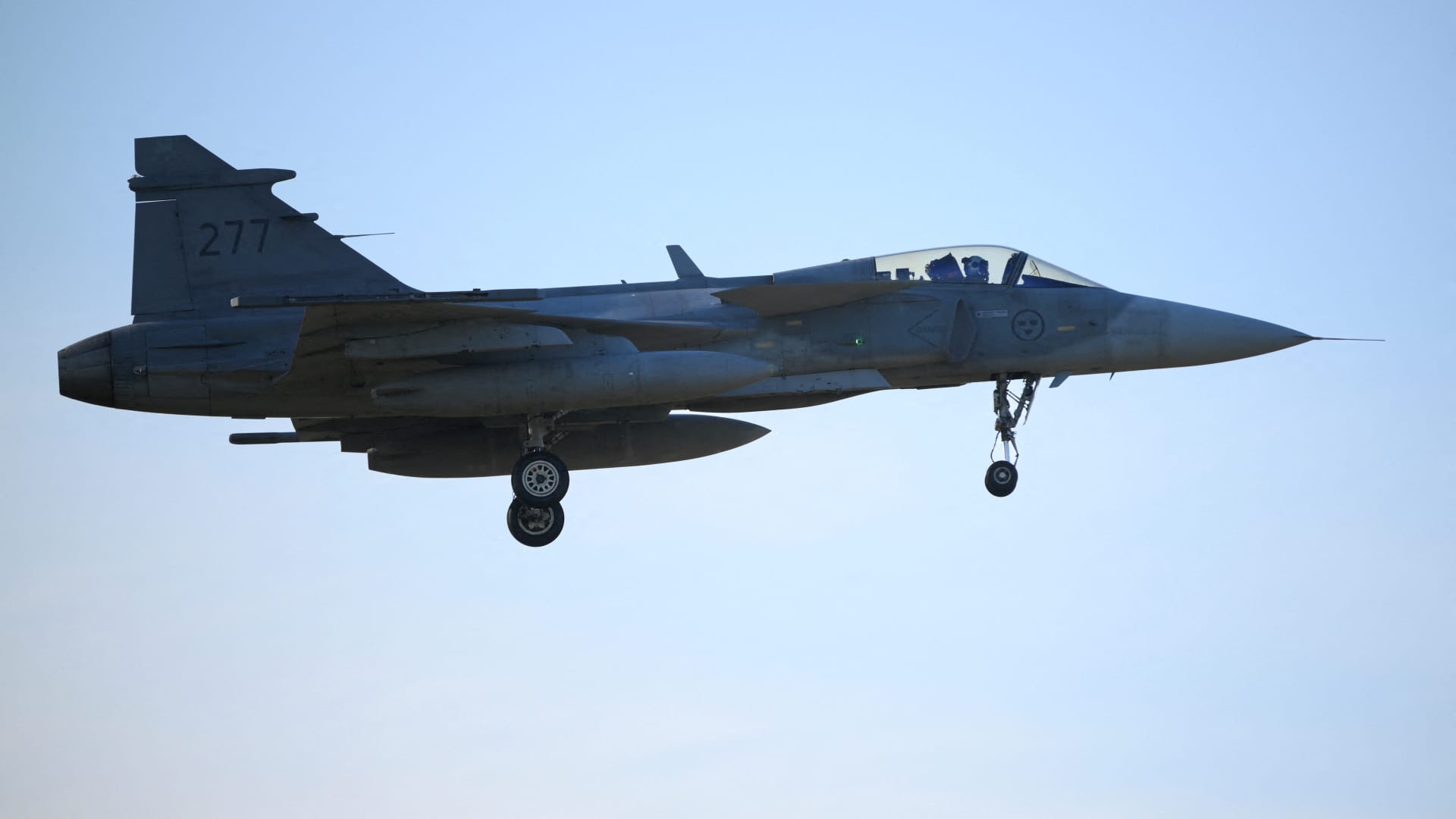
Saab, whose products range from Gripen fighter jets and submarines to missiles and advanced electronics, has seen exponential order growth since Russia’s full-scale invasion of Ukraine in early 2022.
Earlier this month, NATO Secretary General Mark Rutte said the alliance would order up to 10 spy planes from Saab, in a deal that could be worth nearly $5 billion based on the price of the GlobalEye aircraft.
Even with an ever-growing order book, booming sales, and increasing profitability, Saab stock, like many of its peers, has taken a hit in recent months as investors question whether valuations have run ahead of the industry’s ability to deliver.

European defense stocks have fallen this year.
While defense spending remains unequal among European NATO countries, most countries have made progress on increasing the means devoted to military capabilities.
Sweden joined NATO only in 2024, citing Russia’s increasing aggression and a shifting geopolitical landscape. Saab’s home country has increased defense spending as a share of GDP to 2.5% from 1.2% in 2021, according to SIPRI data.