


What do you do when you need a moment to focus? For thousands of people around the U.S., the answer might be reaching for a technicolor piece of plastic that, when pressed, emits a soft and satisfying “click.”
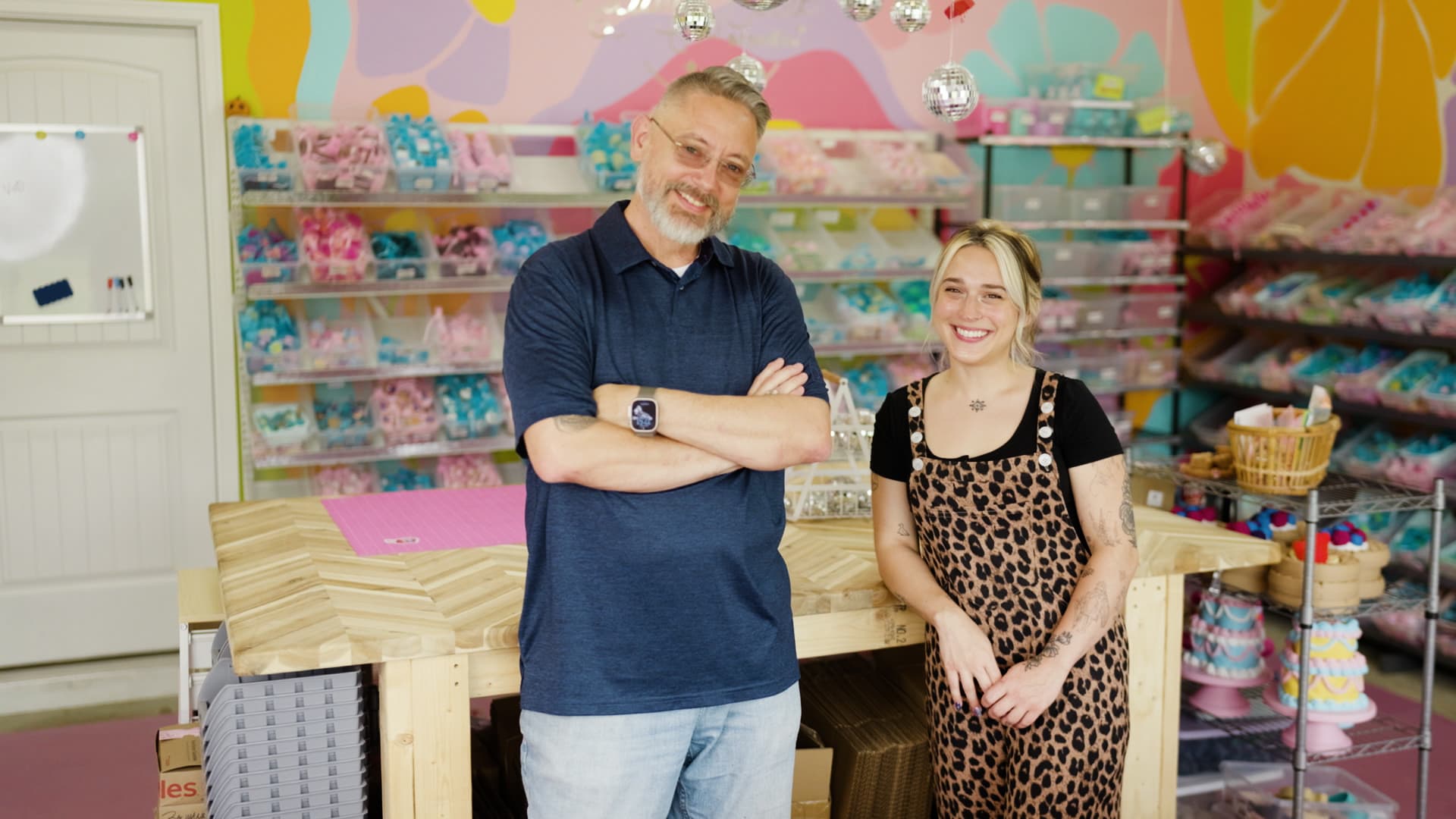
A lot of those people have Victoria Baumann and Charlie Moreton to thank, the father-daughter duo behind Victoria Essie Studio that produces fidget toys and other knickknacks out of their homes in North Carolina.
It’s only been about a year since the pair stumbled into the niche of 3D printing fidget clickers, and they’ve already captured the attention of millions (including the adoration of content creator Brittany Broski) through their ASMR-style behind-the-scenes social posts.
Baumann, 32, started Victoria Essie Studio in 2018 to sell her art and jewelry as a side business while working as a full-time teacher. Moreton, 51, is a 3D printing hobbyist who joined his daughter’s company in 2025 after he came across a design for a cake-shaped fidget clicker that fit his daughter’s artistic style: cute, colorful, and influenced by Y2K nostalgia.
Baumann’s artistic style is cute, colorful, and influenced by Y2K nostalgia.
Nathanael Berry for CNBC Make It
Together, they tapped into the market of fidget clickers, or small devices designed to keep a user’s hands busy when they’re inclined to fidget. Consider them the next iteration of the 2010s-era fidget spinner. In 2025, the global fidget toys market was valued at over $9 billion, according to Fortune Business Insights, with projections to grow in the next decade.
Victoria Essie Studio generated $428,000 in revenue in 2025, according to documents reviewed by CNBC Make It. What started as a two-printer operation has now turned into a full-fledged business with big plans to expand.
Clicking into a trend
Fidget clickers are a type of tactile tool, sometimes with an auditory component, that people press, click or fidget with to help regulate their emotions or concentrate on tasks. Health experts say they can be particularly beneficial to people who have anxiety, attention deficit hyperactivity disorder (ADHD) or Autism Spectrum Disorders (ASD).
The Victoria Essie Studio fidgets have “the same type of mechanical component as a mechanical keyboard,” Baumann says. “So it has that really nice tactile feel and click.”
Fidgets aren’t just for kids, Baumann says. “There’s a lot of adults who just need something to click through the day.”
Nathanael Berry for CNBC Make It
After initial success selling their first cake fidgets, the two began working with artists who create designs for the fidgets — from cereal bowls to toadstools — then pay a commercial license for the design so they can print them. Baumann and Moreton have also started making some of their own designs, including fidgets that look like inhalers, sticky note holders and crayons.
The two work together closely throughout the production process: Baumann goes over to Moreton’s house, they decide which fidget they want to make, choose the colors and get printing. Each fidget is made up of roughly two to six 3D printed plastic parts. One printed sheet produces a few dozen fidget components, depending on their size. Printing the pieces of simpler fidgets can take about 17 hours; more complex and larger projects with different colors can take around three to four days.
Moreton and Baumann now have more than two dozen 3D printers for Victoria Essie Studio.
Nathanael Berry for CNBC Make It
The assembly process is pretty straightforward: Baumann and Moreton say they can put together about 100 fidget clickers in less than an hour. Once assembled, Baumann takes the products to her home to package and ship them.
Themed product drops work well, they say: Think of a food collection featuring whimsical-looking pastries, ice cream cones, candy and the like. One of their best-selling fidgets is a heart-shaped box of chocolates, like one you might pick up for Valentine’s Day but with clickable plastic truffles embedded inside instead of edible treats. The chocolates look so realistic that oftentimes when Baumann posts videos of her assembling the pieces, people will comment (jokingly or otherwise) that she should be wearing food-safety gloves.
Running the numbers
In 2025, the business brought in a gross revenue of about $428,000 and a net profit of about $94,000, according to documents reviewed by Make It.
The business averages about 1,500 orders a month, Moreton says; on drop days when new designs are released, up to 400 orders can come in at once. Standard-sized or hand-held fidgets cost between $5 to $30, while life-sized fidgets (like a full-sized plate of “waffles” instead of a mini version) run $100 to $125.
Victoria Essie Studio has seen success with whimsical food designs, with fidgets made to resemble cakes, ice cream, waffles, chocolate, cereal and more.
Nathanael Berry for CNBC Make It
The business’s biggest costs include paying for equipment (they now have 30 printers), product parts (including the filament that gets fed into the printers), shipping supplies, and subscriptions to the artists whose designs they print.
Their customer base tends to be women, as well as people who are neurodivergent, and they range in age.
“People have realized it’s not just [for] kids,” Baumann says. “There’s a lot of adults who just need something to click through the day.”
Leaving education for entrepreneurship
Baumann says she never thought she’d start a business. She began her career as a preschool teacher working with 2- to 5-year-olds and taught between 2015 and 2019. Baumann says the pay was low, and she often worked odd jobs on nights and weekends.
“I absolutely loved being a teacher, but being a teacher really burnt me out,” she says. Baumann started creating and selling watercolor paintings and polymer clay jewelry on the side for extra income in 2018 and says her students’ parents encouraged her to keep at it.
She quit teaching in 2019 due to burnout, she says, and took a part-time job running an ice cream shop. By 2022, she quit her ice-cream gig and made Victoria Essie Studio her full-time job.
“I thought I was going to be teaching and working two part-time jobs for the rest of my life,” Baumann says. “Being able to do this, it’s a breath of fresh air.”
Nathanael Berry for CNBC Make It
“I really thought I was going to be a teacher for the rest of my life, but I’m very, very grateful for the opportunity that this has all brought me,” Baumann says.
She says she feels good about having a steady income — she paid herself $36,000 in 2025 and says she plans to increase that to $78,000 in 2026, nearly four times her salary as a teacher. Baumann says she feels like a more present mother to her 5-year-old daughter while working from home.
“I thought I was going to be teaching and working two part-time jobs for the rest of my life,” she says. “Being able to do this, it’s a breath of fresh air.”
Building a family business
Moreton works with his daughter on top of his day job as a network security engineer. He opted out of taking a salary from Victoria Essie Studio in 2025, he says: “That was part of me buying in and making sure the business was healthy enough before I was able to draw any money out of it.”
In 2026, he began taking a salary of $750 per week. He spends about 40 additional hours per week on studio-related work on top of his full-time job.
Aside from their salaries, the business partners reinvest their profit back into the studio and have never had to take out a business loan, Moreton says.
The father-daughter duo behind Victoria Essie Studio, flanked by mom and boyfriend.
Nathanael Berry for CNBC Make It
Both father and daughter agree that their working relationship comes naturally, even during long days of packing hundreds of orders. “[A] benefit of working with your family is that we can each see when the other person’s falling a little bit behind or low on battery, and we pick up each other’s slack,” Baumann says.
Moreton says the best part of working on the business is spending time with his daughter and choosing new designs together.
Looking ahead
Beyond the fidgets that make up the majority of their inventory, Victoria Essie Studio still sells an assortment of earrings and homewares like trinket dishes and coasters.
Baumann says her current lifestyle is much better than it used to be when she was teaching and juggling multiple part-time jobs.
“I loved what I was doing, and I loved the impact that I was making. But today’s teaching climate and what [people] expect out of teachers is just not why I went into teaching and just not where I see myself in the future,” she says, citing the daily challenges, low pay and overall stress that she says plagues the teaching profession.
Baumann says she’s glad her business still benefits kids, in particular neurodivergent kids. While the bulk of her customers are adults, many of them also buy items for the kids in their lives, like a teacher buying clickers for their students, or a dental practice replenishing the toy box for kids who visit their office.
She doesn’t regret making the pivot, she says: “I am definitely happier running a fidget business than I was being a teacher.”
Want to get ahead at work? Then you need to learn how to make effective small talk. In CNBC’s new online course, How To Talk To People At Work, expert instructors share practical strategies to help you use everyday conversations to gain visibility, build meaningful relationships and accelerate your career growth. Sign up today!