


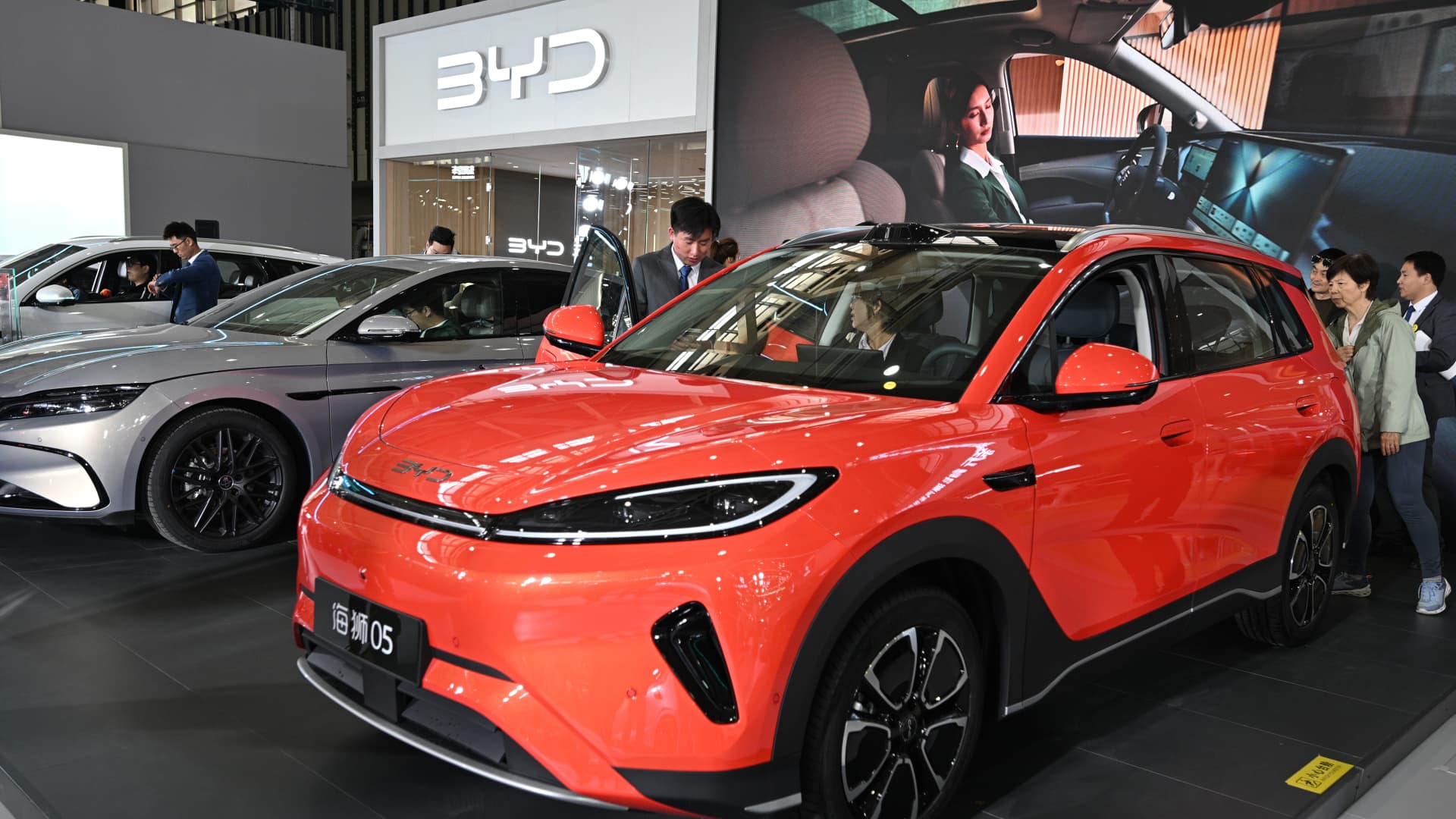
NANJING, CHINA – APRIL 30, 2026 – Tourists visit the BYD exhibition area at the Auto Expo in Nanjing, Jiangsu Province, China on April 30, 2026. (Photo credit should read CFOTO/Future Publishing via Getty Images)
Cfoto | Future Publishing | Getty Images
BYD‘s passenger vehicle sales fell for an eighth consecutive month in April, while its domestic rivals Leapmotor and Zeekr notched record-high monthly deliveries as the market becomes more competitive.
BYD reported Sunday that it delivered 314,100 new energy passenger vehicles last month — comprising battery electric and plug-in hybrid models — a 15.7% decline from the year before but up 6.2% from March, CNBC’s records show.
Export figures for BYD rose to an all-time high of 135,098, according to a Hong Kong Stock Exchange filing — a record, and up more than 70% compared to the same period in 2025, according to CNBC’s calculations. The split in the Shenzhen-headquartered automaker’s domestic and overseas fortunes underscores its growing reliance on overseas markets amid intensifying competition at home.
In April, the market-leading EV giant reported a nearly 55.4% drop in profits year over year in the first quarter as operating revenue fell 11.8% to 150 billion yuan ($22 billion) amid strong showings from its domestic rivals in the same quarter.
Second-place Chinese EV maker Leapmotor posted its highest-ever number of monthly deliveries in April, with 71,387 units, up 73.9% over the same period in 2025. The Stellantis-backed company logged its previous monthly high in November 2025 and turned its first annual profit last year.
Geely‘s premium EV brand Zeekr also notched a fresh high in monthly sales with 31,787 units, representing a 131.6% year on year increase.
Chinese tech giant Xiaomi posted more than 30,000 EV deliveries in April, a more than 7.1% increase from the same period a year ago. The company has also reportedly received over 70,000 pre-orders of its upgraded SU7 sedan.
Nio delivered 29,356 EVs in April, up by 22.8% from the same period a year before. This figure includes sales from its lower-priced Onvo and Firefly brands.
April deliveries from startup Li Auto held steady at 34,085 units, up 0.4% from the same period the prior year.
Following the launch of its new GX SUV in the middle of the month, Xpeng posted a year-on-year sales decline — apart from BYD, the only other automaker to have reported a drop in year-on-year sales — with 31,011 deliveries, an 11.5% fall from the year before.
Overseas forays
With plans to export more than one million units in 2026, BYD has increasingly asserted itself abroad.
The company accounted for at least 70% of EV sales in Mexico and 75% of Argentina’s EV sales in 2025, according to estimates from consultancy Latam Mobility.
New registrations of BYD’s passenger EVs across the European Union, the European Free Trade Association, and the U.K. rose by more than 155% year-on-year over the first quarter of 2026, according to figures from the European Automobile Manufacturers Association (ACEA).
In a bid to gain influence in Europe, BYD in April also reportedly sought to gain admission into the ACEA — Europe’s automotive lobby — according to a Bloomberg report, citing an ACEA spokesperson. CNBC has reached out to the ACEA for comment.
Though BYD established itself through extensive in-house production, it set up manufacturing facilities in Brazil and Hungary. However, the automaker’s overseas plants have been marred by labor abuse controversies.
Other Chinese EV companies are also seeking gains in the overseas market. Leapmotor is looking to expand abroad through its joint venture with the automotive conglomerate Stellantis, with more than 800 sales and service outlets across Europe, and at least 30 in Latin America by the end of 2025.
Although Leapmotor does not publish its monthly export figures, the company announced in February that it targets to export between 100,000 and 150,000 units.
In April, Beijing-headquartered Li Auto announced its entry into the Middle East, signing a memorandum of understanding with local distributors to bring its cars into Saudi Arabia and the United Arab Emirates, while also unveiling plans to expand into Cambodia, Laos, Macau and Myanmar.