

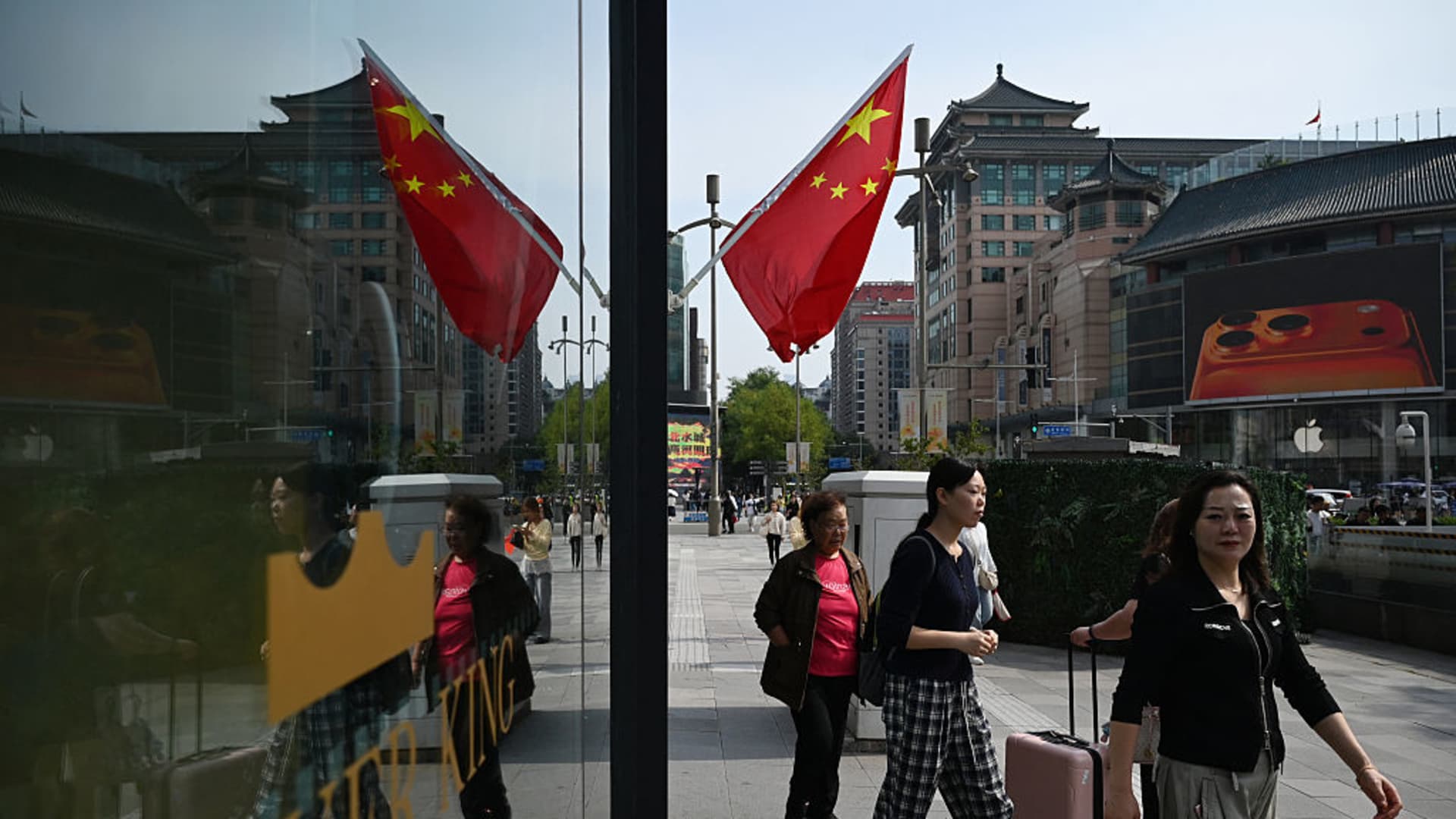
People walk outside a shopping mall during a week-long National Day holiday in Beijing on October 7, 2025.
Greg Baker | Afp | Getty Images
China’s economy gathered steam in the first quarter, as robust exports growth offset tepid domestic demand, though the Iran war-fueled energy shock clouds growth outlook, threatening global demand.
Gross domestic product grew 5% in the three months to March, data from the National Statistics Bureau showed Thursday, accelerating from 4.5% in the prior quarter and exceeding economists’ forecast for a 4.8% growth in a Reuters poll.
Beijing had lowered its growth target this year to a range of 4.5% to 5%, the least ambitious goal on record going back to the early 1990s, in a tacit acknowledgement of demand slowdown and lingering trade tensions with the U.S.
“We should be aware that the external environment is becoming more complex and volatile,” the statistics bureau said in a statement, warning of “acute” imbalance between “strong supply and weak demand.”
Separately, urban fixed-asset investment, including real estate and infrastructure investment, climbed 1.7% in the first quarter from a year earlier, missing expectations for a 1.9% growth in a Reuters poll. Investment in the property sector dropped 11.2%.
In March, China’s retail sales grew 1.7% from a year earlier, slowing from a holiday-boosted 2.8% increase in February and undershooting economists’ forecast for a 2.3% growth. Industrial output expanded 5.7% last month from a year ago, stronger than analysts’ expectations for a 5.5% rise, and compared with 6.3% expansion in February.
For the first quarter, industrial production jumped 6.1% year on year, outpacing retail sales’ quarterly growth of 2.4%, underscoring manufacturing’s continued dominance as the economy’s primary growth engine even as consumption lags.
Robust growth at the start of 2026 has reduced the need for policymakers to double down on fiscal stimulus or monetary easing, with policy focus shifting to sustaining private consumption and investment, said Tianchen Xu, senior economist at EIU. “Growth remains lopsided towards exports,” Xu added.
In the first quarter, China’s exports grew 14.7% from a year earlier in terms of U.S. dollars, the fastest pace since early 2022, according to Economist Intelligence Unit. But that growth has stalled amid the Middle East conflict.
As the world’s largest oil importer and a heavily export-reliant economy, China is vulnerable to an oil shock that’s already slowing trade, pushing up factory costs, and darkening the outlook for the rest of the year.
In March, the country’s exports growth slowed to 2.5%, down sharply from 21.8% in the January-to-February period as the Iran war pushed up energy and logistics costs, weighing on global demand.
China’s factory‑gate prices rose in March for the first time in more than three years, signaling that a spike in energy costs has started seeping into the manufacturing sector and threatening already-thin corporate margins.
— CNBC’s Evelyn Cheng contributed to this report.