


The U.S. Capitol building, weeks into the continuing U.S. government shutdown, in Washington on Oct. 27, 2025.
Kylie Cooper | Reuters
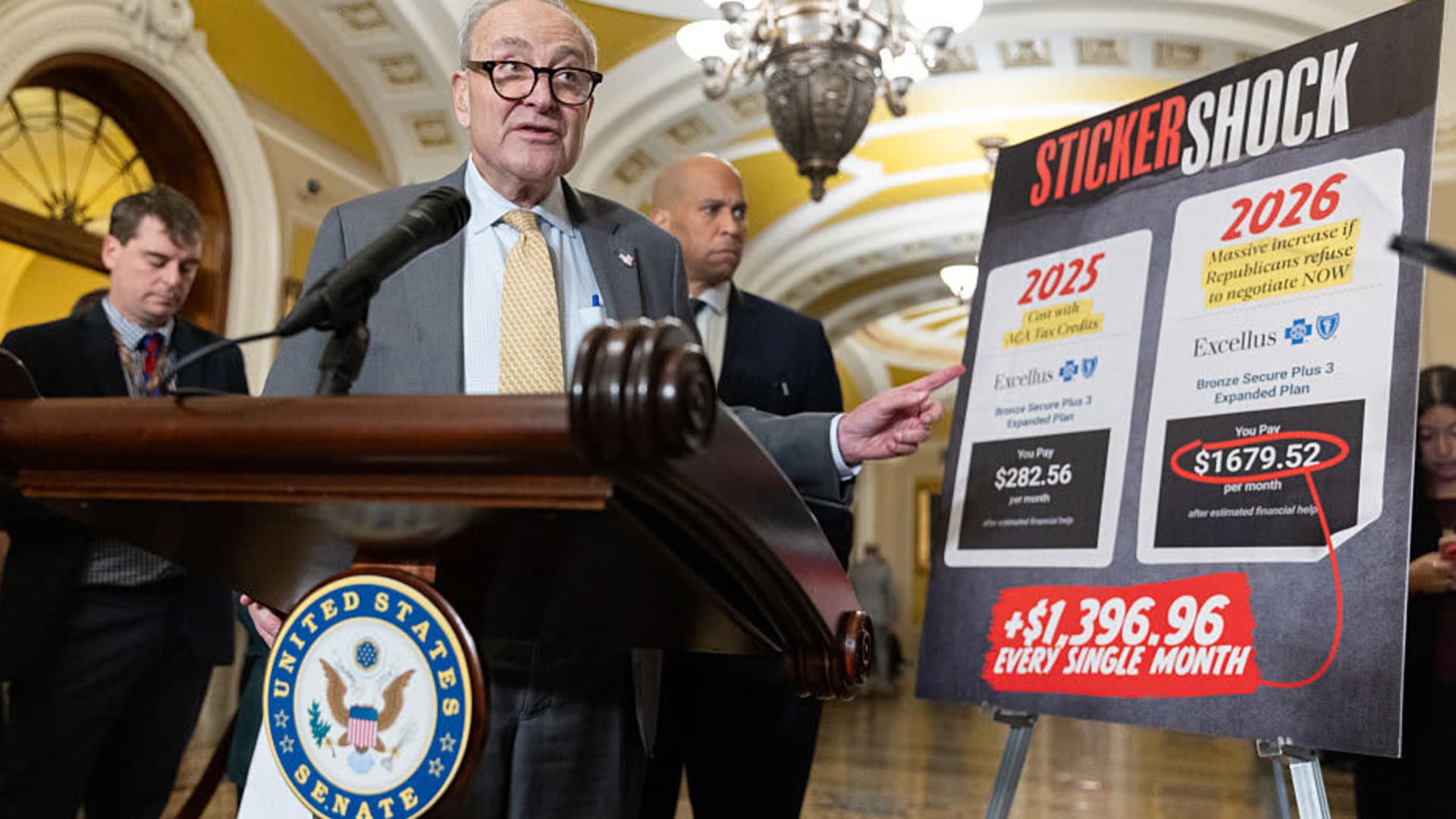
Open enrollment for health insurance bought on the Affordable Care Act marketplace starts Nov. 1 in most states — but millions of people may get a financial surprise when they try to sign up.
That’s because a congressional deadlock tied to the extension of enhanced subsidies for insurance premiums has continued with no end in sight.
Consumers are “going to get huge sticker shock, because prices are going up,” said Carolyn McClanahan, a physician and certified financial planner based in Jacksonville, Florida.
That sticker shock could have significant ramifications for consumers’ finances and the choices they make about health coverage, experts say, contributing to a higher population of uninsured and underinsured consumers and soaring premiums in years to come.
While the percentage of Americans who have ACA marketplace health insurance is small, the share could be large enough to swing a close election, KFF reported in October.
ACA subsidies at the heart of the government shutdown
During open enrollment, consumers pick their health plans for the coming year.
While open enrollment generally lasts through Jan. 15, there’s a Dec. 15 deadline to ensure coverage starts at the beginning of 2026.
However, prospective enrollees are in financial limbo.
Congress has yet to extend the enhanced subsidies that make insurance premiums cheaper for about 22 million of the 24 million Americans who buy insurance over the ACA exchanges.
Recipients’ health premiums are set to increase by 114% in 2026, on average, without the enhanced subsidies, according to KFF, a nonpartisan health policy research group.
Certain enrollees, such as early retirees with modest incomes, face much larger increases, health experts said.
The enhanced subsidies are at the heart of the federal government shutdown that started Oct. 1. The shutdown is already the second-longest in U.S. history, behind a 35-day shutdown during President Donald Trump’s first term.
The enhanced subsidies, also known as enhanced premium tax credits, have been available since the Biden administration passed them in 2021 and extended them in 2022. They are scheduled to expire at the end of 2025.
Democrats are pushing to extend the subsidies as part of a deal to end the shutdown. Republicans have said they want to negotiate the subsidies separately.
More than half, 57%, of ACA marketplace enrollees live in Republican congressional districts, according to a KFF analysis from earlier this month. This year, about 80% of all premium tax credits, or $115 billion, went to ACA marketplace enrollees in states won by President Trump in last year’s election, KFF found.
There are 39 congressional districts where at least 10% of the population is enrolled in the ACA marketplaces and where, had it not been for enhanced subsidies, their 2024 average premium payments would have been double or more, according to KFF.
These districts are largely concentrated in Trump-won states: The bulk, 20, are in Texas, with another seven in Florida and three in Georgia.
What this means for open enrollment
Absent a deal, many people who try to enroll in a health plan via the Affordable Care Act marketplace will see significantly higher premiums during open enrollment, said Cynthia Cox, vice president and director of the ACA program at KFF.
The financial stakes vary according to factors such as household income, age and state.
For example, the average 60-year-old couple making $85,000 would see their annual premiums increase more than $22,600 in 2026, according to KFF.
A 45-year-old earning $20,000 in a state that didn’t expand Medicaid would see premiums rise from $0 to $420 per year, on average, it found.
There are many potential implications to the congressional impasse and consumers’ sticker shock during open enrollment, Cox said.
Many people may opt not to sign up for coverage rather than pay higher premiums, and therefore would be uninsured, Cox said.
Others, such as self-employed entrepreneurs and gig workers, may choose to try to find a more traditional job that offers employer-based health insurance so they don’t have to sign up for a marketplace plan, Cox said.
Some people may opt to buy lower-tier plans that come with smaller upfront premiums but much higher deductibles on the back end, meaning they’d be on the hook for a hefty bill if they need to use their insurance, Cox said.
If young, healthy people don’t enroll, insurers would be left with a relatively older, less healthy population of enrollees — likely leading insurers to raise their annual premiums even more in the future due to the pool of higher-risk enrollees, she said.
The damage may be done, even if Congress does eventually extend the enhanced subsidies, experts said.
“There’s certainly a very real possibility that people will log on Nov. 1 and say, ‘Gosh, I can’t afford that premium,’ and they don’t come back to look again even if there were a subsequent enactment of enhanced subsidies,” said Jonathan Burks, executive vice president of health and economic policy at the Bipartisan Policy Center.
What prospective ACA enrollees should do
As things stand, enhanced subsidies will expire.
Prospective enrollees in an ACA marketplace plan should pick their 2026 health insurance coverage with this in mind, Cox said. In other words, don’t pick a plan based on the expectation that Congress will extend the enhanced subsidies, she said.
However, she recommends enrollees pay close attention to the news. If Congress reaches a deal, enrollees should come back and look again, because their options and costs may have changed, Cox said.
“If it were me, I’d probably make a note on my calendar to shop over Thanksgiving or in early December,” with an eye to the Dec. 15 deadline, Cox said.
There’s certainly a very real possibility that people will log on Nov. 1 and say, ‘Gosh, I can’t afford that premium.’
Jonathan Burks
executive vice president of health and economic policy at the Bipartisan Policy Center
Luckily, the open enrollment period offers relative flexibility, Burks said.
Consumers can pick a plan and select another plan later within the open enrollment period without consequence, he said.
“People shouldn’t feel the need to rush into a decision, nor is there a real cost if they make a decision early on, [then] circumstances change and they want to evaluate that decision before the end of the open enrollment period,” Burks said.
Current enrollees who take no action will be reenrolled into the same plan or a similar one if the current plan is no longer available, experts said.
How to think through health insurance decisions
Even consumers who are healthy and rarely go to a doctor should have insurance, even a plan with a high deductible, in case there’s a major unforeseen health event, said McClanahan, the founder of Life Planning Partners and a member of CNBC’s Financial Advisor Council.
Those with minor health issues such as hypertension or diabetes and who see a doctor regularly can consider buying a high-deductible plan — which generally carry lower upfront premiums — on the ACA marketplace, she said.
Pair that coverage with a direct primary care physician model. Such doctors charge a subscription for care — maybe $150 or $200 a month — and provide all basic primary care such as basic laboratory tests and imaging services, she said.
Those with serious illnesses who go to the doctor frequently would be best suited by buying a good health insurance plan with a broad network of doctors and, ideally, a lower deductible, McClanahan said.
Of course, this may be challenging for households that lose enhanced subsidies, she said.