

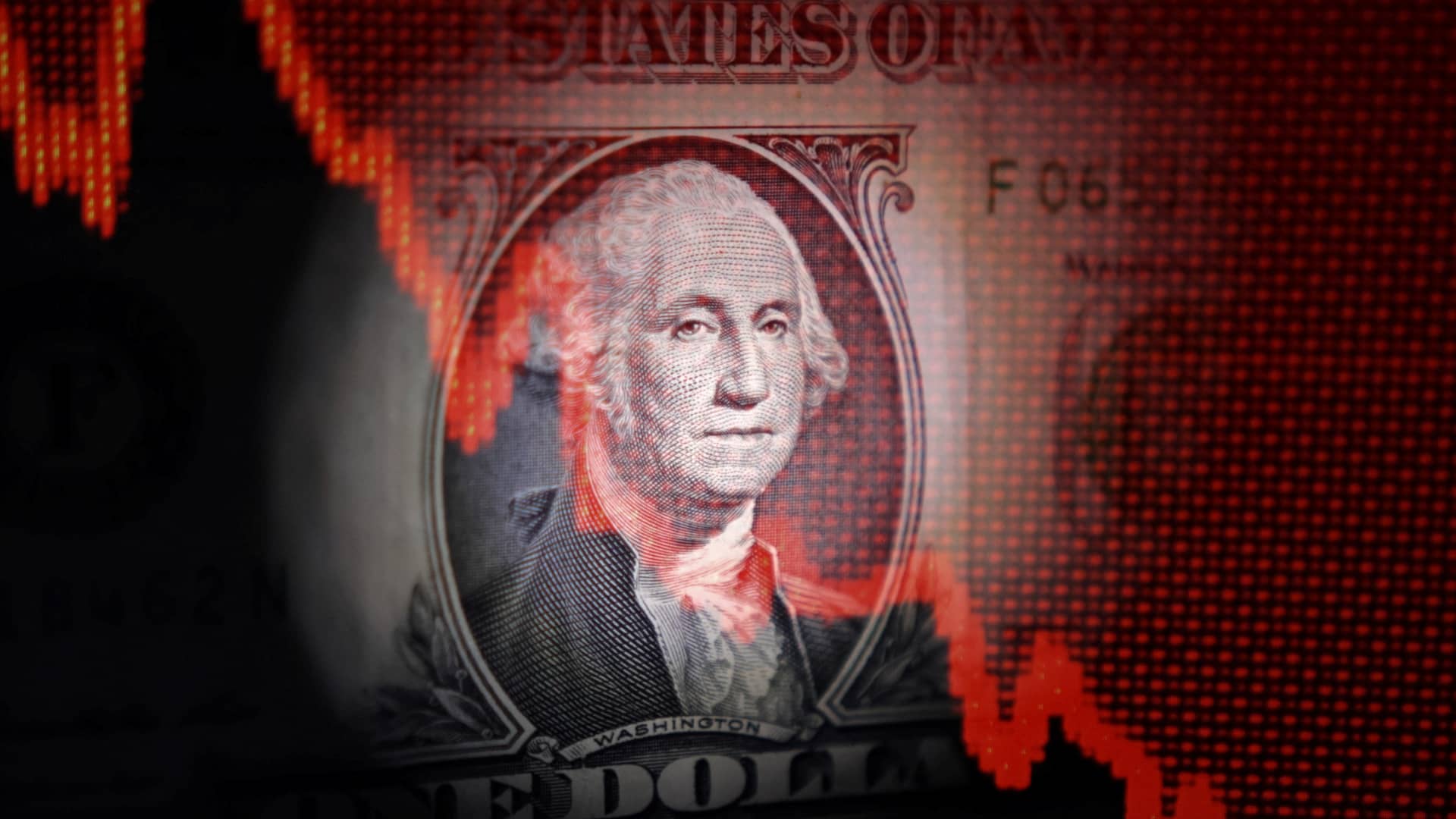
U.S. dollar banknote and decreasing stock graph are seen in this illustration taken April 25, 2025.
Dado Ruvic | Reuters
Fresh off its worst performance since Richard Nixon was president, the U.S. dollar faces a variety of headwinds heading into the second half of the year that could have important investing implications.
The greenback tumbled 10.7% against its global peers through June, making it the worst first half since 1973, back when Nixon broke the Bretton Woods gold standard. At its bottom, the currency hit its lowest point since February 2022.
The path ahead may not look much brighter.
That’s because many of the same factors — policy volatility, swelling debt and deficits and potential interest rate cuts from the Federal Reserve, just to name a few — likely will stay on the minds of investors as they seek other avenues for safe havens.

Dollar drop
“Some of this was probably due, and then we’ve certainly given currency traders enough to contemplate for what’s the catalyst now,” said Art Hogan, chief market strategist at B. Riley Wealth Management. “You could check a lot of boxes. You’re running massive deficits, and nobody wants to stop that on either side of the aisle. You’re alienating friends both militarily and trade-wise. You’ve got enough potential negative catalysts. And then once momentum starts, it’s hard to kind of stop it.”
Indeed, the dollar’s slid started in mid-January and has shown only occasional signs of moderating since. Hopes that President Donald Trump’s tariffs would not be as steep as thought helped spark a brief rally in mid-April, but for the most part the gravitational pull has been lower.
Market impact
Of course, the dollar’s slide hasn’t exactly been poison for stocks.
With more than 40% of revenue for S&P 500 companies coming from international sales, a weaker dollar helps make American exports cheaper, an important point to consider amid the ongoing trade war.
However, the move lower has coincided with growing chatter about the potential end of American exceptionalism and dollar hegemony, with the public share of U.S. debt nearing $30 trillion and the 2025 deficit on track for close to $2 trillion. Should American assets such as the greenback and Treasury debt lose its prominence on the global stage, that could have strong ramifications for risk assets like stocks.

Global central banks, for one, are ramping up their gold purchases, to 24 tons a month, per the World Gold Council, as an alternative to U.S. assets. Gold had its best first-half run since 1979.
“We think central banks are buying gold to diversify reserves, reduce reliance on the [dollar], and hedge against inflation and economic uncertainty,” Lawson Winder, research analyst at Bank of America, said in a note. Winder said it’s “A trend that we think is set to continue, especially amid uncertainty surrounding US tariffs and fiscal deficit concerns.”
Likewise, TS Lombard is maintaining a short position on the greenback, which it calls “the gift that keeps on giving.”
“Trump’s attacks on the Fed and the administration’s explicit desire for a weaker dollar only add to that view,” wrote Daniel Von Ahlen, senior macro strategist at the firm. “The dollar remains overvalued on most FX metrics … With USD negatives ubiquitous, why not expect the dollar to become undervalued? We remain firmly short dollar across a range of trades in our book.”
The Federal Reserve also could exert more downward pressure by coming through on expected rate cuts in the back part of the year. However, the impact of Fed loosening can be tricky t handicap, considering that the dollar and Treasury yields rose sharply when the central bank last cut in 2024.
Hope for a reversal
To be sure, the dollar’s continued decline is by no means a sure thing, and others on Wall Street think the trend down could reverse.
Thomas Matthews, head of Asia Pacific markets at Capital Economics, said the recent rally in stocks points to growing comfort with U.S. assets, with the earlier dollar weakness perhaps just a product of the intended appreciation of other currencies as well as a switch in hedging strategies.
Wells Fargo also thinks dollar-related fears are overblown.
“Taking a statistical approach to analyzing the U.S. dollar’s role, it is clear to us that the greenback remains the linchpin of global trade and finance and is far from becoming irrelevant,” Wells Fargo investment strategy analyst Jennifer Timmerman wrote. “We believe the U.S. dollar benefits from deep-seated advantages (such as the rule of law, transparency, and a highly liquid financial market) that make a global shift away from the dollar an extremely difficult and slow-moving process – especially because of underlying weaknesses of the most visible dollar alternatives.”
Treasury Secretary Scott Bessent also weighed in, telling CNBC on Monday that the currency fluctuations are “not out of the ordinary.”
However, rising yields on Treasury debt also signifies that concerns over the dollar and other U.S. assets linger.
“We’re in that stage of being overdone to the downside in terms of the momentum,” said Hogan, the B. Riley strategist. “But fundamentally, you could certainly whiteboard out plenty of things that you’d be concerned about.”