


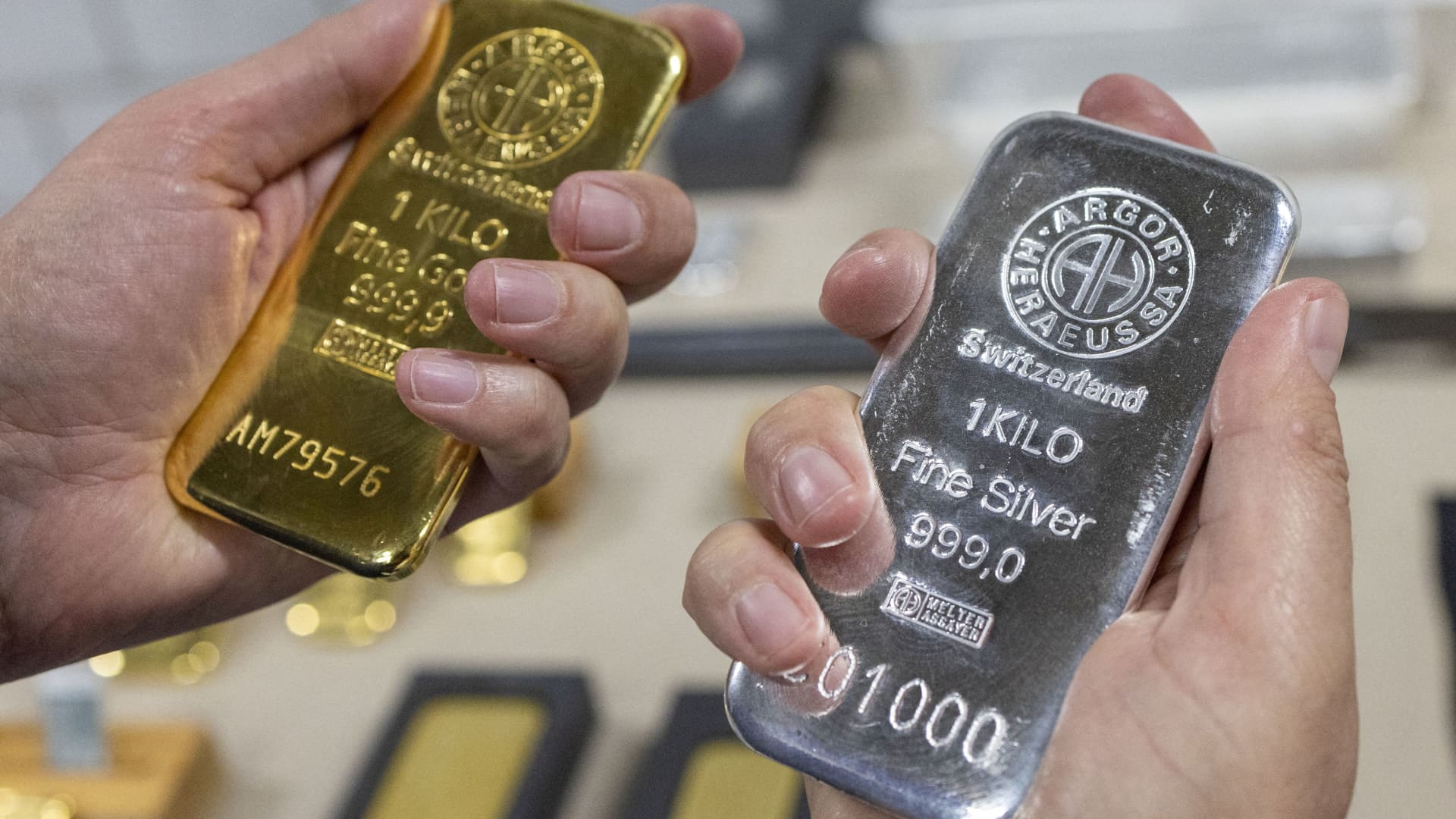
Precious metals have rallied in recent days after a sustained period of selling pressure, but analysts say gold and silver prices could face a difficult path back to all-time highs achieved earlier this year.
Spot silver traded at $59.47 an ounce in early trading on Wednesday (6:33 a.m. ET), up by around 6.3% from $55.9/oz at the end of last week. Spot gold traded around 2.4% higher over the same period at $4,119.04/oz.
In a Wednesday note, ING commodities strategists Warren Patterson and Ewa Manthey attributed gains to “bargain hunting after recent weakness” rather than “a material shift in the geopolitical or macroeconomic backdrop.”

Gold and silver spot prices remain well below all-time highs achieved in late January,
Silver could outperform, gold could languish
Both precious metals remain well below all-time highs achieved earlier this year after a blistering rally that extended throughout and beyond 2025. Both achieved their all-time highs in late January, when spot gold hit $5,589.38/oz and silver hit $121.67/oz.
Higher interest rates and a stronger U.S. dollar have taken the shine off the precious metals, as higher oil prices brought about by the Iran war have shifted market dynamics elsewhere.
“While tensions in the Middle East remain supportive for precious metals, markets are weighing softer US economic data against the inflationary risks from higher energy costs,” Patterson and Manthey said.
The ING analysts added that gold is “likely to remain sensitive to developments in energy markets and expectations for US monetary policy,” but said silver “could continue to outperform if strength in industrial metals persists alongside safe-haven demand.”
“Silver’s performance reflects not only its safe-haven appeal but also support from improving sentiment across the industrial metals complex, particularly copper,” they said.
By contrast, analysts at Bank of America see the potential for gold prices to deteriorate further after recording their worst quarter in 13 years in the three months to the end of June.
“A death cross signal, elevated net-long positioning and similarities to major peaks raise the risk of a longer, deeper correction,” BofA said in a 16 July note.
A “death cross” pattern occurs when a stock’s short-term moving average — commonly calculated over 50 days — falls below its longer-term moving average, typically measured over 200 days.
Silver not at an attractive entry point… yet
UBS is skeptical of the potential for a silver rebound and has cautioned against investors starting to build exposure to the metal.
The Swiss bank this week reduced its price target for an attractive entry point for silver from around $55/oz to a range of $48-$50/oz.
“We believe near-term headwinds for silver are likely to persist as escalating Middle East tensions, higher opportunity costs, and a firm US dollar continue to weigh on investor sentiment,” UBS Strategist Dominic Schnider wrote in a July 20 note. “Silver faces a top-down backdrop that offers investors little impetus to increase long positions. With investment demand patchy, silver prices have yet to find a solid floor.”

Miners say gold and silver outlook continues to shine
But executive chair and CEO of U.S.-based gold and silver developer Hycroft Mining Diane Garrett told CNBC’s “Squawk Box Europe” on Tuesday that recent price deterioration is a “normal correction,” adding “this is not a broken bull market.”
“The fundamentals for commodities remain extremely strong, particularly on gold because it has surpassed the U.S. Treasuries as the number one asset class, and it’s… becoming the architecture of the financial system,” she said.
“People don’t want to own hard assets that are backed by another country’s debt, and we’re seeing 17 straight months of central bank buying. These are very compelling numbers.”
“For silver as well, because it’s not just a monetary metal, but also an industrial metal, and it’s feeding the AI revolution and the supercomputers – all of that that you have to have silver for, and there’s no substitute.”
— CNBC’s Joe Wilkins also contributed to this report.