


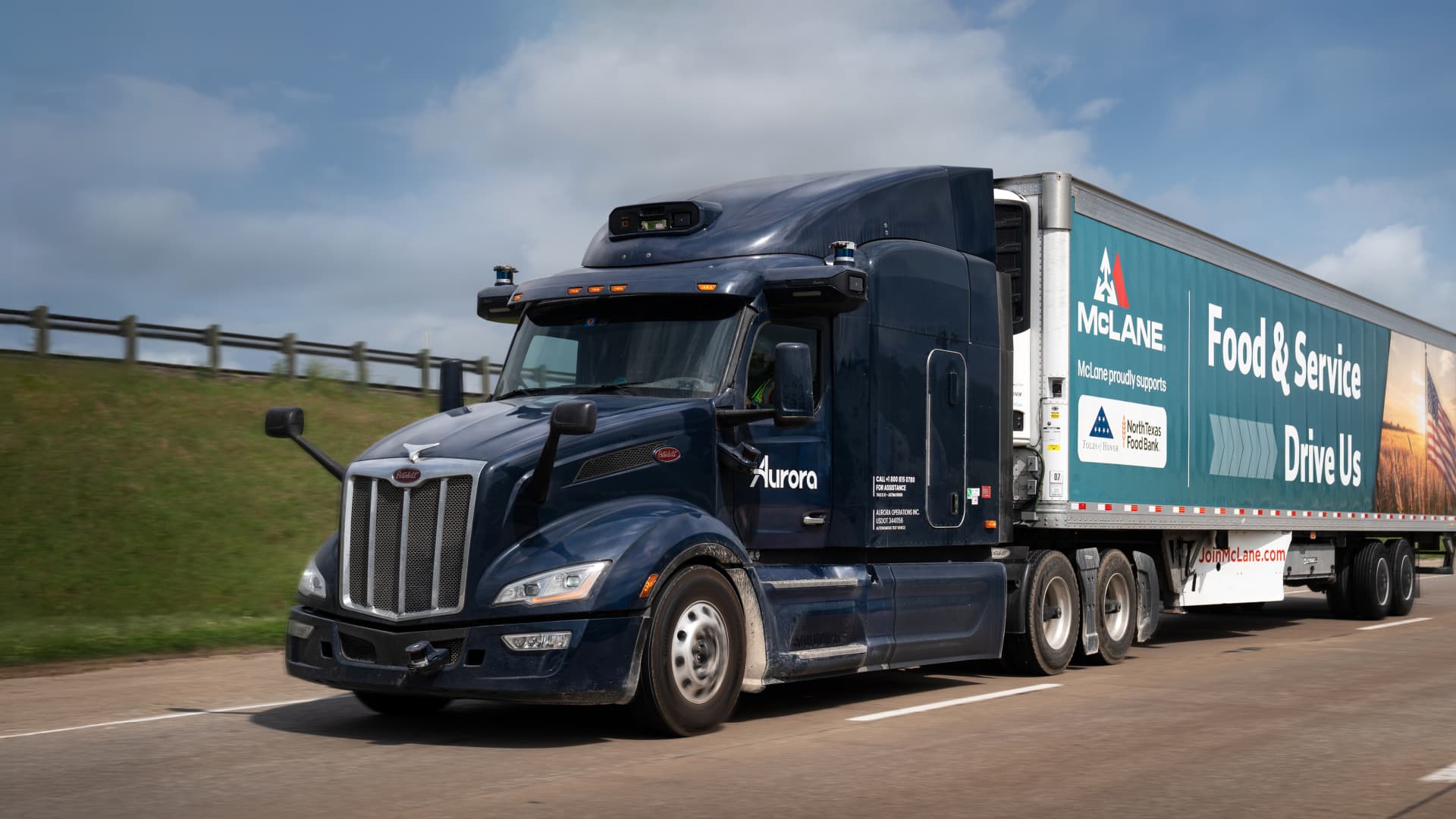
Berkshire Hathaway subsidiary McLane is planning to deploy self-driving trucking technology from Aurora Innovation on routes in Texas and across the U.S. Sun Belt by the end of the year, expanding on an autonomous freight pilot program the companies began in 2023, McLane and Aurora announced Wednesday.
Temple, Texas-based McLane is one of the largest distribution companies in the U.S., with more than 80 distribution centers that cover nearly every ZIP code in the country, and 25,000 employees. It will use the Aurora Driver technology in long-haul trucking to move supplies, including perishables, to restaurant brands.
The existing pilot includes two round-trips daily between Dallas and Houston, seven days a week, with what is called “supervised” autonomous technology controlling the “middle mile” in long-haul trucking, while McLane drivers take over for last-mile local delivery of loads to customers using separate trucks.
Since 2023, McLane routes using this technology logged 280,000 autonomous miles in Texas, covering 1,400 loads delivered to restaurants. Now McLane has approved driverless operations between Dallas and Houston and plans to add new routes between McLane distribution centers across the U.S. Sun Belt by the end of the year.
“Autonomous technology helps us drive greater efficiency across the supply chain, while our drivers remain focused on the critical last mile — and continuing to serve as the face of our company to customers,” Susan Adzick, president of McLane Restaurant, said in a statement.
Trucks operating in the middle mile of logistics networks move orders between centralized distribution facilities and last-mile delivery points. Automating the middle mile is a current focus for many distribution networks, including at Amazon, and for self-driving freight companies.
The companies declined to specify the number of trucks or loads to be part of driverless hauls, only saying that Aurora Driver software-powered trucks will continue to make multiple trips between Dallas and Houston every day.
Importantly, there is still a human “observer” in the cab on these routes, which move loads on trucks from OEM Paccar, which has requested the observers remain in the cabs for now. Unlike “supervised” trips, the observer never operates the vehicle and Aurora Driver is “fully responsible for all driving tasks, including pulling over to a safe location if required,” according to the company.
Aurora has plans to deploy a new fleet of trucks from Volkswagen subsidiary International LT starting this quarter that will not have observers, with 200 trucks in all expected by the end of the year. Aurora declined to say whether McLane has plans to adopt these trucks. Aurora is McLane’s only current self-driving truck partner.
The companies said there are plans to expand the effort in the future. McLane Company serves convenience stores and mass merchants, in addition to chain restaurants. One of its biggest customers is Walmart, which once owned McLane and sold the company to Berkshire Hathaway in 2003.
McLane declined to identify customers that the driverless trucking will extend to in the future.
Autonomous freight trucking is expected to scale rapidly starting this year. Autonomous freight companies have converged on Texas as a primary deployment point, and it’s not just because of the pro-business, light regulatory touch for which the state is known. The Sun Belt traffics in a massive amount of freight, with routes stretching from Texas to Arizona and California. Lack of severe weather conditions such as snow and ice also removes one variable for the autonomous technology to navigate.
Uber Freight founder and chairman Lior Ron, who joined self-driving tech company Waabi as chief operating officer last August, said automation is the most fundamental shift of the next decade in transportation. “I can’t think of something that will be as helpful to the next era of logistics and innovation and how goods are being moved. The technology is now here,” he told CNBC in August. In five years time, Ron expects driverless freight trucks will be “a common sight across the U.S. in the supply chain, and especially in the Sunbelt corridors.”
Aurora Innovation recently started a 1,000-mile autonomous route between Fort Worth, Texas, and Phoenix, Arizona, notable for being beyond what a human trucker could handle without a stop. The company also announced earlier this week a deal with Volvo Autonomous Solutions to run a new 200-mile freight route between Dallas and Oklahoma City.