


Gab Marcotti
Close
Gab Marcotti
Senior Writer, ESPN FC
Sam Tighe
Close
Sam Tighe
ESPN
- Sam is a writer, broadcaster and podcaster for ESPN. He will write on the Premier League, scouting and transfers.


Multiple Authors
The UEFA Champions League semifinals are in the books, and we have a lot to discuss!
Arsenal punched their ticket on Tuesday with a 1-0 (2-1 aggregate) win over Atlético Madrid, with defending champions Paris Saint-Germain joining them after hanging on for a 1-1 draw at Bayern Munich, advancing 6-5 on aggregate.
So, what to make of it all? ESPN FC writers Gab Marcotti, Sam Marsden, Julien Laurens and Sam Tighe are here to break down the action as it happened and look ahead the final on May 31.
– Ogden: PSG on brink of greatness after reaching another UCL final
– Reaction: Arsenal set their sights on European glory
– O’Hanlon: Why Champions League can’t tell us much about Premier League
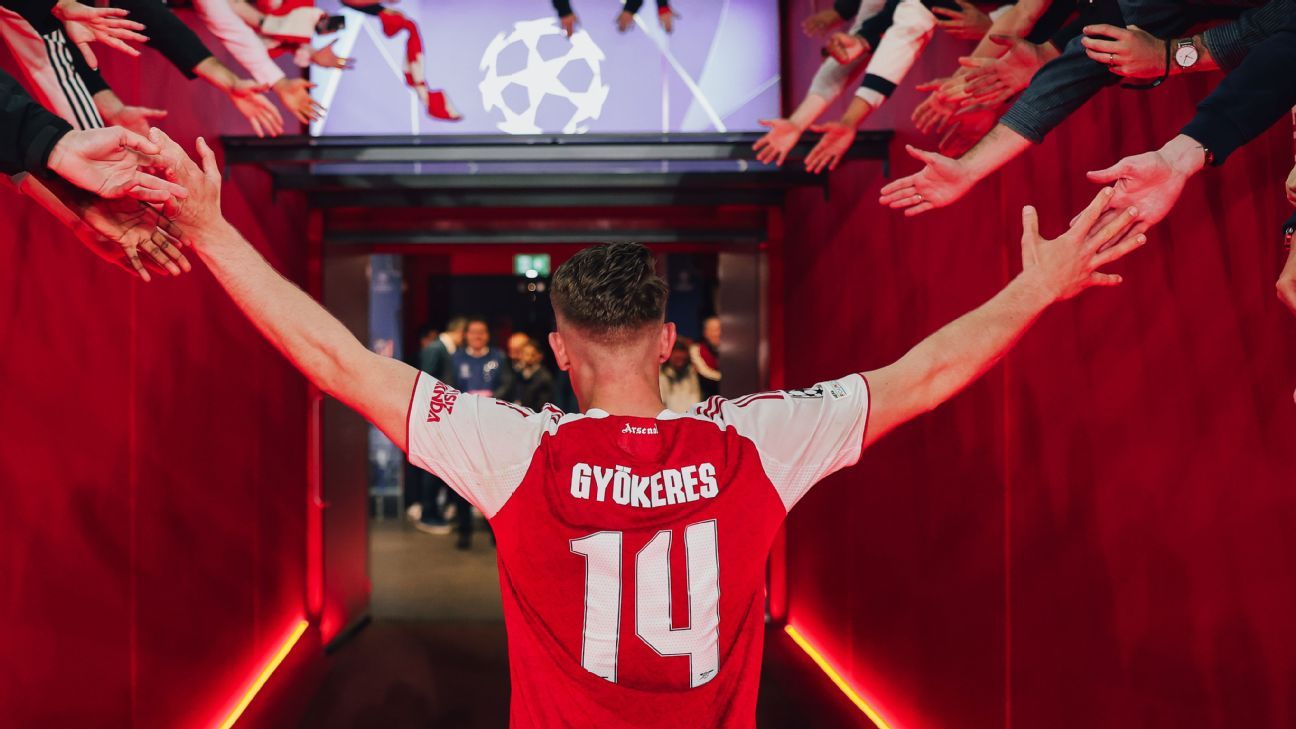
Q1. Tuesday night saw arguably one of Viktor Gyökeres‘ more productive games in terms of leading the press and working hard around the final third … but also he only managed three non-penalty shots (zero on target) in 159 minutes across the two legs, and he missed his best chance on Tuesday night. The Gunners need to be clinical in the final, so should Gyökeres start in Budapest? Or would Kai Havertz make more sense?
Tighe: There’s no “arguably” here, as that was Gyökeres’ best performance for Arsenal and, most pleasingly, it came against a strong team on a big stage. (The accusation that’s followed him around all season — he mostly shows up against bad teams — has an uncomfortable amount of merit to it.)
The 27-year-old has shown huge improvement in the last few weeks, playing well in Madrid, very well against Fulham, and then superbly here. His back-to-goal work looks better and, most importantly, he’s finding his passes into the penalty box, which leads to opportunities for others. OK, he missed the big chance, but the Gunners can look elsewhere for goals.
But here’s my concern: Gyökeres does his best work when he can physically dominate center backs. Will he be able to do that against PSG? If Mikel Arteta is remotely concerned about his chances there, perhaps he should opt for the tried-and-trusted Havertz, saving the Swede for an impact role later on.
Laurens: I don’t want to say that I told you, but I did tell you! Gyökeres was always going to need some time to adapt to the Premier League and to Arsenal. For a player with his qualities, who had only played in the Championship and the Portuguese league before, going into an Arsenal side not used to play with a traditional No. 9, and in the best and most intense league in the world, was never going to be a straightforward transition.
In Portugal, Sporting CP were built around the Sweden international and played everything through him. When he had one second to control the ball and strike it to score last season, he only has half a second to do so in England. So his first few months were tough, but you can clearly see the improvement since the turn of the year both in goals scored and involvement in matches.
It’s not perfect yet, as we saw with his missed chance on Tuesday night. However, William Saliba would have never played him that ball on the first goal a few months earlier. (It was the same for Eberechi Eze against Fulham.) Gyökeres will never score 50 goals a season and will never be Erling Haaland, but there is more to come from him for sure.
Marcotti: It depends on how Arsenal want to match up against Paris Saint-Germain. For me, Havertz is the better overall player and simply does more things better than Gyökeres. However, if the plan from Arteta is to clog space, keep things tight, play with intensity and maybe get something in transition or a set piece, then Gyökeres makes more sense. If Arteta is going to pull something out of the hat and try a different look — like he did against Atlético, dropping Martin Odegaard and Martín Zubimendi for Myles Lewis-Skelly and Leandro Trossard, and picking Riccardo Calafiori ahead of Piero Hincapié — then you’d consider Havertz.
I think a lot will depend on the physical condition of these players heading into the game, and how much the Premier League title run-in has taken out of them. You can do much more with Havertz than with Gyökeres, but will you have time to think up something sophisticated if you’re going head-to-head with Manchester City every game? Probably not.
A lot will also depend on how PSG approach the game or, more aptly, how Arteta believes PSG will approach the game. At the Parc des Princes we saw PSG go man-for-man all over the pitch and Willian Pacho chase Harry Kane all the way up to the edge of the Bayern box. Gyökeres isn’t going to do that — and, if he does, you probably don’t need to chase him down — so the dynamic changes entirely.
Marsden: Gyökeres’ lack of shots is more down to how Arsenal played over the two legs than any fault of his own. As pointed out above, he is arguably in his best form of the season, and not just for Arsenal, either. He was key to Sweden making the FIFA World Cup and should be brimming with confidence.
My doubt is less about the chances he gets, and more about how clinical he can be with them. He missed his biggest opening in the second leg against Atlético. Arsenal got away with it, but they will have to be much more effective in front of goal if they are to beat PSG. So, like Gab says, it all depends on how Arteta plans the match. I imagine him keeping things tight and targeting transitions and set plays, so expect Gyökeres to start. He is also the best bet for occupying the PSG center backs.
Q2. Atlético Madrid’s European adventure ended in muted fashion, with Diego Simeone making some confusing subs and in doing so, bringing Antoine Griezmann‘s sparkling tenure to an end as well. If you’re keeping track, Grizi is heading to MLS at the end of the season, and Simeone has been left rueing a semifinal exit to go along with his two defeat in UCL finals. Will he regret his choices, and where does he and Atleti go from here?
Laurens: First, I feel like Griezmann deserves a bit of ESPN love. On Tuesday, he played his last game in European competition. He has a few LaLiga matches left, and then it will be over as he heads to Major League Soccer this summer. His dream was to finish his Atlético career with a Champions League triumph to add to his UEFA Europa League win in 2018 and, while it would have been the perfect farewell, Arsenal spoiled the party. His legacy, both in terms of goals scored (the most ever for Atleti) and style (what a magician with the ball), will last forever.
The irony is that Griezmann, the greatest player in Atlético’s history, missed out on the club’s two most recent Spanish titles. I wonder if, like us, he was surprised by Simeone’s choices with substitutions on Tuesday? What was that about? Taking out your four attacking players with roughly 30 minutes and replacing them with four players of less quality when you are chasing the game was not a good idea and Simeone cost his club badly there.
Marcotti: Griezmann’s place in football lore is secure. He didn’t need another Champions League final to cement his place in history. To those of us who die a little bit inside every time a player leaves a very good team to join a perennial powerhouse to rack up more trophies and chase the big bucks, Griezmann will forever be a hero. (OK, I know he sort of did that when he went to Barcelona, but still: the fact that it didn’t work out is a kind of poetic justice.)
I didn’t follow Simeone’s decisions in the second leg. OK, Julián Álvarez was giving you nothing and reportedly carrying a knock — fine — and maybe you felt it was too early for Alexander Sørloth. Also fine. But you had other solutions, like moving Ademola Lookman up front with Griezmann, perhaps with Álex Baena pulling strings behind, trying the little guys and then unleashing Sørloth — especially once you had committed to shifting Marcos Llorente wide and getting your width from there. Making three changes before the hour mark and another two before the mid-point of the second half seemed like folly (especially when one of them was Thiago Almada, the answer to a question nobody asked).
All that said, let’s not be too hard on Atlético. They lost to a team whose wage bill is around 70% higher. With a bit more nous (and a bit less Gabriel Magalhães), they could have equalized on Saliba’s back-header. And they had their chances in the first leg, mostly with Lookman.
1:25
Moreno: Atletico were never going to score against Arsenal
Ale Moreno slams Atletico Madrid’s toothless display in their Champions League semifinal defeat against Arsenal.
Tighe: It’s never fun to see players like Álvarez and Griezmann trot off the pitch (especially that early), but let’s consider this from a different angle. What is the point of having quality depth and a bench full of good attackers eager to change the game if you don’t give them a chance to do so?
Simeone brought on a slew of fully fledged internationals — one of which, Sørloth, has scored almost 40 goals in LaLiga and the Champions League in the last two years — and tried to hit Arsenal with fresher legs. That element of freshness is important for another reason too, as Atleti clearly ruffled the Gunners’ feathers in the first half with their pressing. They caught them on the ball a handful of times and could have made more of those openings.
Perhaps Simeone figured his best route to victory was to keep up that energy and disruption, and to do that, he needed an entirely new, fresh front line? That’s not to say I enjoyed watching Almada toil away on the left flank, but there must have been some logic to Simeone’s moves.
Marsden: I actually find the Atlético-Simeone question quite difficult. There have been bigger “minnow” stories than a club like them winning the Champions League, but it does feel like they have hit a ceiling in this competition. When will they next get such a good chance to reach the final? They have spent big money in recent years on transfer fees, but still pay far less in wages than Europe’s other clubs. That translates to the depth of their quality.
Atlético have a deep squad in some ways, but not deep enough for this level. For that reason, Simeone’s changes — and he may have been forced into some of them — felt too prompt and, even at the time, not the right ones to influence the game. It’s easy to say now, perhaps, but can we expect Sørloth, Baena and Johnny Cardoso and to win a tie of this magnitude?
That said, my biggest problem with Atlético and Simeone right now is not related to the Arsenal game. It’s that they lost the Copa del Rey final to Real Sociedad and may end up fourth in a league where they are supposed to be one of the three teams fighting for the title. After putting so much stock into the Champions League, I’d like to have seen them go out taking a few more risks at the end.
Q3. Well, after PSG and Bayern served up a nine-goal thriller last week, we were bound to see a different kind of second leg and the French side leaned on a strong defense — and some lucky ref decisions — to draw 1-1 at the Allianz Arena and book their spot in the May 31 final. Kane was limited to just five touches in the penalty area, and the wide threat from Luis Díaz and Michael Olise just never materialized. How did you see the game?
Tighe: We can home in on the refereeing decisions in the next question, but for now, can just acknowledge that PSG morphed from an outrageous, free-scoring attacking unit in the first leg to a genuinely sturdy, disciplined defensive unit in the second?
We know full well that these defenders and midfielders can move the ball around in style, but when it really came down to it, they glued together, disrupted every cross and blocked almost every shot.
Bayern spent all night trying to work room for a strike from just outside the box. It’s pretty much all Olise and Díaz did, as Jamal Musiala and Kane recycled the ball left to right 20 yards out. But very rarely did they manage to set themselves and shoot — and when they did, it was usually blocked before it even reached PSG keeper Matvei Safonov.
The German champions had nothing to show for all their attacking output until the very, very end, when Kane hammered one home. But by that point, the nullification job had been done. This PSG team has layers!
Laurens: I won’t lie, right now I really don’t care about referee’s decisions, whether Nuno Mendes should have been sent off (I dont think he should have) or if Bayern should have had a penalty for the João Neves handball (they shouldn’t as the rules state). It’s all about PSG and what an incredible team this is. On Wednesday, they showed a different side to themselves than they have so far in the Champions League this season; with resilience, guts, courage and great defensive cohesion.
Pacho was incredible against Bayern and Kane. He is a world class defender, one of the best center backs around. Every PSG player put a great shift in. The reigning Ballon d’Or winner Ousmane Dembélé scored again, like in the quarterfinals and the semifinals. And what about “Kvaradona”? It’s the seventh game in a row that Khvicha Kvaratskhelia has scored or assisted. He is unplayable right now — the best player in the world — and PSG are the best team in the world, on course for an incredible Champions League double.
Marsden: The sequel rarely betters the original but Luis Enrique, who described last week’s nine-goal humdinger as the best he’s ever coached, may be just as pleased with the performance his PSG team delivered in Munich. It was certainly not as free-scoring, but it was professional and showed another side to their game, a side which probably marks them apart from some of Europe’s other attacking sides — such as Bayern and, to a lesser extent, Barcelona.
Warren Zaïre-Emery filled in admirably for the injured Achraf Hakimi, even earning a handshake from his captain Marquinhos for his work keeping out Díaz and Musiala. Pacho and Mendes also delivered big performances in defence, while Neves and Vitinha are always lively in midfield. Bayern more than played their part in this wonderful tie, but PSG were worthy winners in the end.
Marcotti: It could have gone either way because that’s the nature of this sport (I was sure Musiala was going to bury his chance … he did not), but PSG deserved it and are worthy finalists. As I wrote last time, they’re a better-rounded side than Bayern. They had 27% of the ball in the second half and limited Bayern to just three shots on target by the 90th minute and an xG of 0.51. That’s pretty darn good.
It’s not the special individual talents that set PSG apart from Bayern. For Kvaratskhelia read Olise, for Dembélé there’s Kane, for Vitinha there’s Joshua Kimmich. Nor is it the willingness to work hard and press and run yourself into the ground. It’s the ability to defend positionally when needed, to be smart, to manage a game: Zaïre-Emery’s performance ought to be framed. We don’t see it often because, frankly, they don’t need to show it often. But they did and they excelled at it on Wednesday night.
Q4. Referee Joao Pinheiro also played a part in that second leg, waving off what appeared to be two clear handballs against PSG, one of which could have resulted in a red card for Mendes. (Neves’ arm also got in the way of a clearance inside the PSG area, for which Pinheiro briefly stopped play, only to decide everything was alright.) Should Bayern be aggrieved?
Tighe: I was shocked to see Pinheiro and his team given a game of this magnitude considering the poor job he’d done the week before in the Europa League semifinals. You’ll often see Premier League fans bemoaning the standard of refereeing in England and asking why top European officials can’t be imported — the uncomfortable answer is they’re absolutely no better, and there’s nothing like a contentious decision or two on a Wednesday night to remind you of that.
I cannot escape the feeling PSG — and specifically Mendes — got away with one here. What would have been a second yellow card very early in the game was nullified by a supposed handball earlier in the move from Konrad Laimer; I’ve watched it back … 20 times? And while it’s not particularly clear, I’m pretty sure it hits a different body part first and his arms are by his side. We’re told over and over that if it hits a different body part first, it changes the dynamic — although let’s be honest, it’s been yet another dizzying fortnight with regard to that particular rule. Where do we stand with it? I don’t know anymore. I’m off for a lie down.
Laurens: I thought the referee was great on Wednesday. He took all the right decisions, controlled the game really well. Clearly, many people, including the Bayern players, didn’t know the rules about handball. Now they do. So Bayern can’t be aggrieved. They were knocked out by a team that was better than them over the two legs and that has nothing to do with the referee.
1:03
Burley: PSG are still the best team in Europe
Craig Burley reacts to PSG’s progression to the Champions League final after eliminating Bayern Munich.
Marcotti: The Neves outcome was correct if only in the spirit of the law. It’s his teammate clearing it, if anything the advantage goes to Bayern. (Though he did say afterwards that it can’t be handball if your teammate hits it to you, which I don’t think is correct.)
The Mendes handball is different. It’s nailed-on, nobody is going to dispute that. The question is whether Laimer handled it first.
There’s several points to make here: The first is that VAR can’t intervene because it’s a second yellow (though that will change at the World Cup). The second is that I’m pretty sure the referee didn’t see it. He was behind the action, unless he has X-ray vision he has no idea. My guess is the assistant or the fourth official gave him a heads up. Which is totally fine and legitimate … if he gets it right. And, on this occasion, albeit after watching a ton of replays with close-ups, it’s pretty evident he doesn’t. The ball comes off Laimer’s leg and his chest too, there’s one angle where it’s pretty evident it never strikes his arm. So, yes, Mendes should have been sent off, but it was objectively very difficult to spot without VAR.
Decisions like these, frankly, become 50-50 calls for referees. Which is why I’m grateful for VAR in general (and the changes in particular). Could it have changed the outcome? We’ll never know. But PSG can count themselves can count themselves a little likely there.
Marsden: Sam and Gab have done a pretty good job of thrashing this one out. The bigger question is over Mendes, not Neves, but it’s such a hard call in the moment. So much for VAR — sorry to go there — changing the game for the better (or at least the discourse around it). It may just be me but it feels like every big match ends with the loser complaining now. On Wednesday, we had the mayor of Madrid, José Luis Martínez-Almeida, claiming a UEFA conspiracy to keep Atlético out of the final. In the quarterfinals, Barcelona — twice! — sent letters to UEFA protesting against the refereeing. I know the stakes are high and the details matter, but it’s always much better to focus on the football.
Q5. OK, so we know it’s Arsenal vs. PSG in Budapest on May 31 for the Champions League crown. Who do you think will win, and how will they do it?
Tighe: PSG will win the final and be crowned back-to-back European champions. They are just too good, too complete, and have too many different ways to hurt Arsenal. I respect the defensive line and work ethic Arteta has built at the Emirates, but it can only count for so much. Vitinha and Neves are too silky, Mendes and Hakimi too dynamic, and the front three … it just has such beautiful variation in the way it moves and creates chances.
Désiré Doué‘s footwork and Kvara’s stop-start, relentless dribbling will be too much — even for the best defence in Europe.
Marcotti: I know better than to do this, but since you ask, I think PSG can beat you in different ways and they showed it against Bayern. I’m not sure Arsenal have that dimension right now (or, to be fair, for much of the season). PSG averaged 61.8% possession throughout the tournament before the return leg against Bayern in Munich. And in that game, they were 1-0 up and only conceded in garbage time with 33% possession, going down to 27%. You don’t expect Arsenal to shapeshift like that, so for them to win, they need a set piece, or a moment of individual quality or a transition. They have players who can deliver that. The question is how fresh will they be come Budapest? I guess you need to lean, slightly, towards PSG.
0:56
Nicol: Arsenal will be asking for trouble if they sit back vs. PSG
Steve Nicol debates how Arsenal should look to approach the Champions League final vs. PSG.
Marsden: Arsenal lost in Paris in 2006 and will lose to Paris in 2026. OK, maybe I am being a bit facetious, but based on the performances in the knockout rounds so far, I can’t see beyond a PSG win. Luis Enrique’s side are clearly the superior side, as they have shown repeatedly. The clash of styles does provide some potential intrigue, and anything can happen in a final etc., but PSG will be fresher, are infinitely better in attack and should be able to outscore Arsenal if that’s what it takes. It won’t be the mauling PSG handed Internazionale last year, but it will be back-to-back European crown.
Laurens: Im going to sit in the fence massively. If there is a team that can do to PSG what they did to Bayern tonight, it’s Arsenal. They can control the tempo of a game, slow the rhythm of it, kill all sort of momentum. They are the best team in the world out of possession and their threat in set piece is huge. PSG will be favourites because they are the holders and the experience from last season’s final will be super valuable but it’s a real 50-50 final for me. Remember when they met in the semifinals last season? It was unbelievably close then — it will be close again at the end of the month.


