


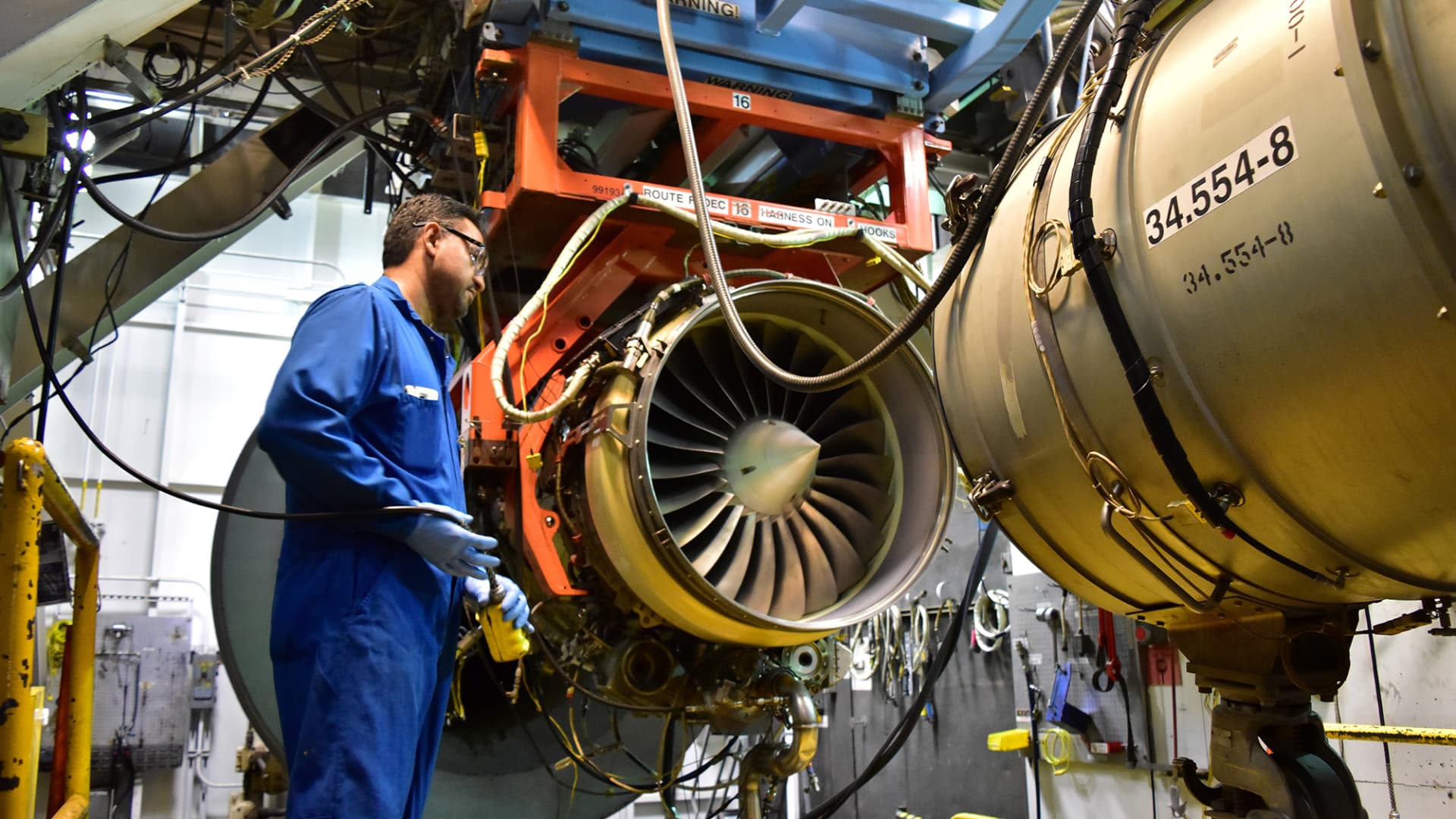
Wall Street’s scorching rally off its wartime lows back to new highs faces a big test this week: a jam-packed earnings calendar. The list of companies reporting stretches from linchpins of the AI trade like Club name GE Vernova to battleground software stocks such as ServiceNow to companies with their pulse on the industrial economy like steelmaker Cleveland-Cliffs and copper miner Freeport-McMoRan . Don’t forget Intel , which is at the center of the AI compute shortage, or Elon Musk’s Tesla . Both of those reports are always talkers. The market will look to these earnings reports for insights into what the Iran war meant for businesses and economic activity over the past six-plus weeks. But, just as important, investors want to understand the outlook from here. Over the weekend, Iran re-closed the Strait of Hormuz after a brief reopening that sent stocks soaring on Friday. President Donald Trump , while again threatening infrastructure bombing, said Sunday he dispatched U.S. negotiators to Pakistan for talks with Iranian officials on Monday. Stocks held up better than expected during the Iran war sell-off, which bottomed on March 30 , in large part because investors were betting that many companies could still grow earnings this year. That’s why this earnings season carries such weight. As quarterly results and forward guidance from management teams continue rolling in, we will find out whether that was the right bet to make. In a busy week ahead, the one thing that should matter most to us is the six Club names reporting. Here’s a closer look at what we’re watching (all revenue and earnings-per-share estimates are from LSEG). Capital One kicks off the action Tuesday night. This report can essentially be broken up into buckets. The first is everything related to the health of the consumer. That includes Capital One’s credit metrics, such as its net charge-off rate and reserve builds to cover potential loan defaults. It also includes CEO Richard Fairbank’s general commentary on spending trends. The second is all about progress on its acquisitions of credit-card issuer Discover and, in a recent surprise move, expense management startup Brex. Some of Capital One’s stock weakness this year is out of its control (namely, President Donald Trump ‘s credit card cap proposal and the economic concerns tied to the Iran war). But we won’t give any free passes on what Fairbank and his team can control. That means we need to see more tangible benefits of the blockbuster Discover deal, which closed 11 months ago, and get more clarity on the vision for Brex. On paper, Brex helps Capital One look even more like a mini American Express . But there are some questions about Brex’s competitive standing versus peers such as Ramp. The Brex deal also added additional execution risk on top of Discover. Revenue: $15.36 billion EPS: $4.55 Boeing is due out Wednesday morning, and we hope to see a cleaner report than the one that landed in January , when the aircraft maker unexpectedly booked a $565 million charge in its defense segment. Of course, hope is not a strategy , so we trimmed our position last week to protect against any disappointment this time around. Our two well-timed buys during the March sell-off gave us the cover to make the sale. With Boeing already releasing its first-quarter plane deliveries ahead of the quarter, one of the focuses on Wednesday will be on orders — both in its commercial and defense divisions — and the size of their backlogs. At the end of Q4, Boeing’s commercial backlog was over 6,100 planes, valued at a record $567 billion. The other main focus will be Boeing’s free cash flow performance because, at this point, it’s among the best ways to grade CEO Kelly Ortberg’s progress in fixing the troubled planemaker. Boeing has posted back-to-back years of outflows, but this year it’s guiding for positive free cash flow in the range of $1 billion to $3 billion. Revenue: $21.93 billion EPS: $0.83 GE Vernova reports alongside Boeing on Wednesday morning. Orders will also grab a lot of the attention, as the AI buildout drives demand for all things electrical. GE Vernova sits in the middle of the frenzied action because it makes both gas and wind turbines used to generate electricity and electrical grid equipment like transformers and switchgear. In the final three months of 2025, GE Vernova booked orders worth $22.2 billion, up 65% organically. For the first quarter, the consensus for new orders is $14.4 billion, according to Bank of America. GE Vernova’s total backlog ended last year at $150 billion, and the company will provide an updated figure on Wednesday, with additional color on where it stands for the gas turbine business specifically. CEO Scott Strazik made a convincing case last quarter that its pricing power will not collapse as more turbine production supply across the industry comes online. Nevertheless, GE Vernova’s operating profitability, both companywide and in the power segment, will remain under close scrutiny. Our ears will be open for any discussion of its nuclear business, too. Revenue: $9.18 billion EPS: $1.88 On Thursday, Honeywell reports before the bell. Propelled by an upbeat earnings report in January, the stock had been cruising to a series of record highs. Then the Iran war happened. Shares are off their war-driven lows, but it hasn’t been a trampoline bounce like we’ve seen in other stocks (we’re looking at you, Broadcom ). One thing possibly keeping a lid on shares: CEO Vimal Kapur saying at a mid-March conference that the company’s first-quarter revenue will be light due to issues shipping product to the Middle East. Kapur said it wasn’t going to impact its full-year outlook, but some investors may want to see the actual numbers — and see Honeywell reaffirm the guide once more — before they’re ready to put money to work. In general, industrials like Honeywell tend to be more sensitive to the economic whims because customers may delay orders if they’re feeling less certain in the trajectory of their own businesses. Another big box for Honeywell to check: confirm its long-awaited Aerospace spin-off is still on track for the third quarter. That’s the long-awaited catalyst that has kept us patient in this stock. As it gets closer, the “spin purgatory” overhang should dissipate bit by bit — just as DuPont has demonstrated since its two-way breakup last fall. Revenue: $9.3 billion EPS: $2.32 Joining Honeywell on Thursday’s docket is Dover , another industrial conglomerate. Unlike Honeywell, Dover has not announced plans to dramatically reshape its constellation of businesses, which spans from refrigerator doors to liquid cooling components for AI servers to car lifts at the autobody shop. But we would welcome any such announcement by Thursday. The company ended 2025 with some $2.7 billion in dry powder that could be deployed toward M & A. As Jim Cramer explained at our April Monthly Meeting, Dover is at risk of landing on the chopping block if we see a better opportunity. Dover isn’t a bad company, and order trends and organic growth are on track for a solid, accelerating 2026 — something we want to see reaffirmed Thursday. But ultimately, there are only so many stocks we can own. Dover needs to prove its worth. Revenue: $2 billion EPS: $2.26 The key metrics for Procter & Gamble on Friday morning are organic sales growth and profitability (both gross and operating margins). In the Tide parent’s January earnings report, its fiscal 2026 second quarter, P & G saw a 1 percentage point decline in volumes and a 1 point pricing benefit, leading to flat organic sales. Executives, however, were confident that stronger growth was ahead in the back half of its fiscal year — so, we want to see that come to fruition in the January-to-March numbers. The heightened focus on profitability follows the war-driven spike in oil and disruptions to petrochemical supplies, leading to higher plastic prices , too. Despite the Middle East situation calming down, investors will still want to know how P & G’s input costs are faring and what that means for its earnings outlook. Jim said on Friday’s Morning Meeting he wouldn’t buy any additional shares ahead of the release, though we are still optimistic that new CEO Shailesh Jejurikar can rejuvenate P & G and win back market share with fresh innovative products . P & G is our hedge against an economic downturn. Revenue: $20.54 billion EPS: $1.56 Week ahead Monday, April 20 Before the bell: Cleveland-Cliffs (CLF) After the bell: Alaska Air (ALK), Steel Dynamics (STLD), Zions Bancorp (ZION) Tuesday, April 21 Commerce Department’s Retail Sales Report at 8:30 a.m. ET National Association of Realtors’ Pending Home Sales Index at 10 a.m. ET Before the bell: UnitedHealth Group (UNH), GE Aerospace (GE), 3M (MMM), D.R. Horton (DHI), Danaher (DHR), Genuine Parts Company (GPC), RTX (RTX), Synchrony Financial (SYF), Atlantic Union Bankshares (AUB), Quest Diagnostics (DGX), Equifax (EFX), Forestar Group (FOR), Halliburton (HAL), MSCI (MSCI), Northrop Grumman (NOC) After the bell: Capital One Financial (COF), Intuitive Surgical (ISRG), EQT Corporation (EQT), Interactive Brokers Group (IBKR), United Airlines (UAL), W.R. Berkley (WRB), Chubb (CB) Wednesday, April 22 Before the bell: Boeing (BA), GE Vernova (GEV), Vertiv Holdings (VRT), AT & T (T), Elevance Health (ELV), Boston Scientific (BSX), Philip Morris International (PM), BankUnited (BKU), First BanCorp (FBP), Moody’s (MCO), TE Connectivity (TEL), Wabtec (WAB) After the bell: Tesla (TSLA), ServiceNow (NOW), IBM (IBM), Lam Research (LRCX), Texas Instruments (TXN), Hexcel (HXL), CSX (CSX), Pathward Financial (CASH), Century Communities (CCS), Kaiser Aluminum (KALU), Southwest Airlines (LUV), Molina Healthcare (MOH), Oceaneering International (OII), United Rentals (URI) Thursday, April 23 Initial Jobless Claims at 8:30 a.m. ET Kansas City Fed Manufacturing Index at 10 a.m. ET Before the bell: Honeywell (HON), Dover (DOV), Nokia (NOK), Blackstone (BX), Dow Chemical (DOW), Freeport-McMoRan (FCX), American Express (AXP), Keurig Dr Pepper (KDP), STMicroelectronics (STM), Texas Capital Bancshares (TCBI), American Airlines Group (AAL), Huntington Bancshares (HBAN), Infosys (INFY), Lockheed Martin (LMT), Comcast (CMCSA), Cemex (CX) After the bell: Intel (INTC), Baker Hughes (BKR) Friday, April 24 University of Michigan’s Consumer Sentiment Survey (final reading) at 10 a.m. ET Before the bell: Procter & Gamble (PG) , Charter Communications (CHTR), Western Union (WU), Apogee Enterprises (APOG), First Hawaiian (FHB), Flagstar Financial (FLG), Gentex (GNTX), HCA Healthcare (HCA), Norfolk Southern (NSC), SLB (SLB), Sensient Technologies (SXT) (See here for a full list of the stocks in Jim Cramer’s Charitable Trust.) As a subscriber to the CNBC Investing Club with Jim Cramer, you will receive a trade alert before Jim makes a trade. Jim waits 45 minutes after sending a trade alert before buying or selling a stock in his charitable trust’s portfolio. If Jim has talked about a stock on CNBC TV, he waits 72 hours after issuing the trade alert before executing the trade. THE ABOVE INVESTING CLUB INFORMATION IS SUBJECT TO OUR TERMS AND CONDITIONS AND PRIVACY POLICY , TOGETHER WITH OUR DISCLAIMER . NO FIDUCIARY OBLIGATION OR DUTY EXISTS, OR IS CREATED, BY VIRTUE OF YOUR RECEIPT OF ANY INFORMATION PROVIDED IN CONNECTION WITH THE INVESTING CLUB. NO SPECIFIC OUTCOME OR PROFIT IS GUARANTEED.