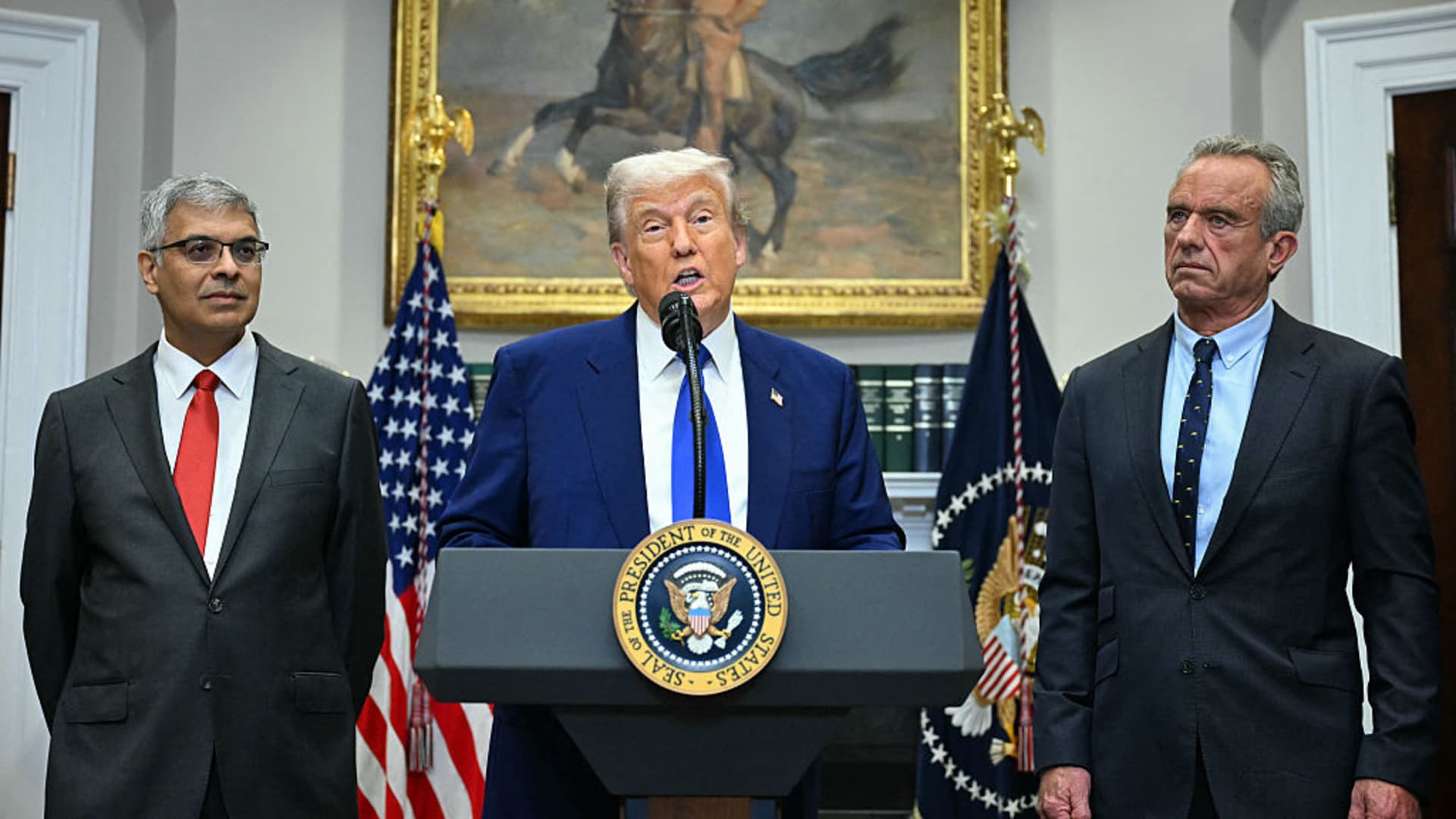




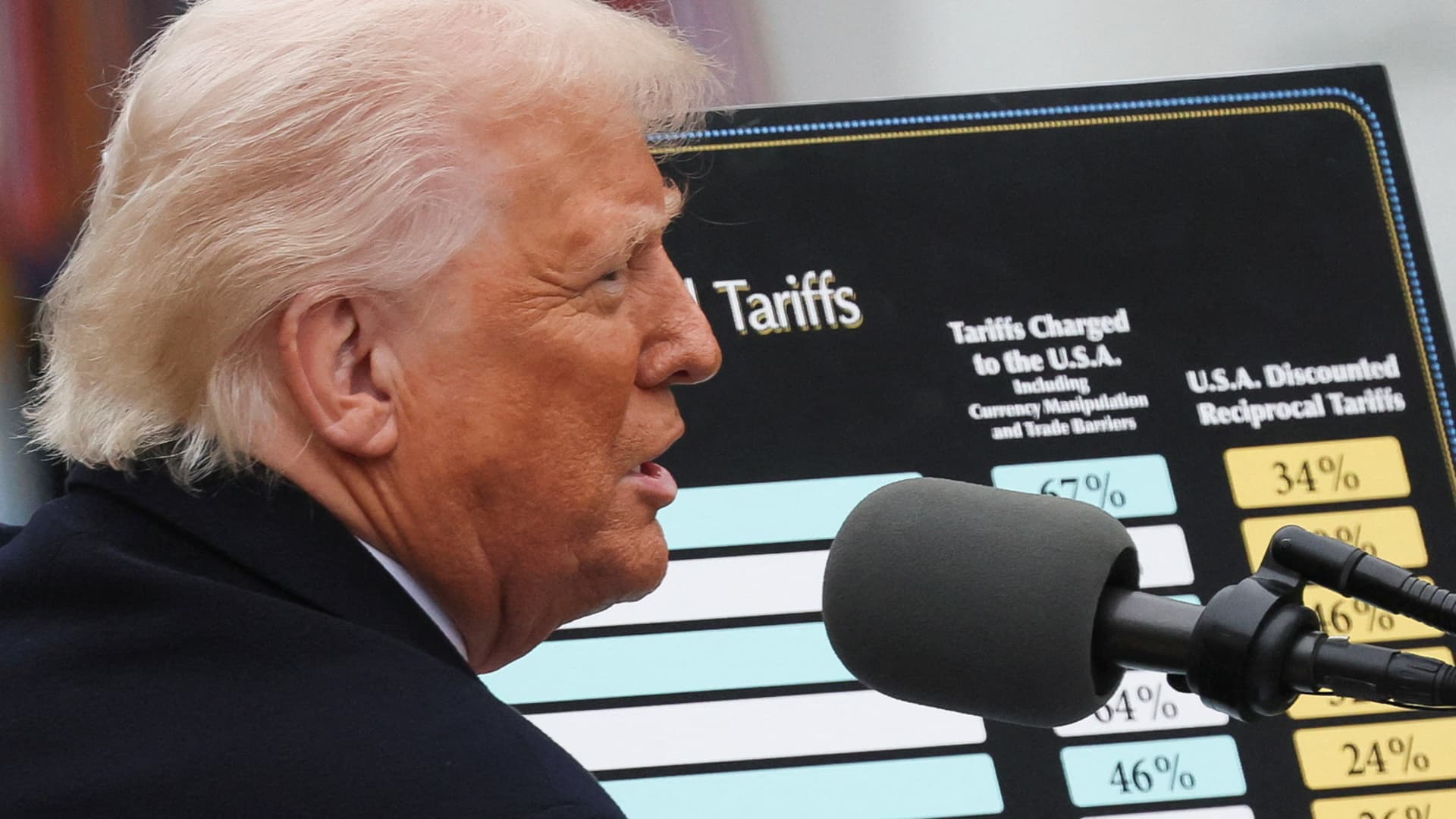

A year ago, on April 2, 2025, U.S. President Donald Trump appeared in the White House Rose Garden with an announcement that would become one of the defining policies of his second term.
The president unveiled a vast list of country-specific tariffs in what he dubbed his “liberation day” trade policies — a move that sparked panic and volatility in markets across the globe.
It included steep duties on imports from many trading partners, including 34% on Chinese goods, 20% on the EU and 46% on Vietnam.
The ensuing sell-off gripped various asset classes across the globe — but U.S. equities, Treasurys and the dollar all took a major hit in what would become the “Sell America” trade.
In the 12 months since “liberation day”, U.S. assets have seen further spates of volatility linked to Trump’s unpredictable policy mix — generating a number of trading trends from ABUSA (Anywhere But the USA) to the TACO (Trump Always Chickens Out) trade.
Some international markets, including the benchmark indexes of Brazil, the U.K. and Japan, have outperformed the S&P 500 in the year since Trump’s “liberation day” announcements, benefiting from investors — particularly those outside of the U.S. — looking to diversify away from an overreliance on American returns.
Washington has since struck a series of trade deals that reduced the tariff rates slapped on various key trading partners, such as the EU, the U.K., India and Switzerland.
But, in February, the tariff regime was struck down when the U.S. Supreme Court ruled it was illegal, with a judge later ordering the government to prepare to potentially pay billions of dollars in refunds to importers who paid the tariffs.
Last month, Trump launched Section 301 investigations into more than a dozen trading partners, including China, the EU, Japan, Switzerland and India, paving the way for the White House to impose import duties on those economies. It came after he imposed a 10% “universal” tariff on imports, which the administration has said will be raised to 15%.
In a note on Monday, Russ Mould, investment director at AJ Bell, said investors were continuing to reassess their exposure to the U.S..
“Tariffs and strong-arm trade tactics, challenges to the independence of the U.S. Federal Reserve and now military incursions in Latin America and the Middle East, as well as saber-rattling over Greenland, are combining with lofty American stock market valuations and a soaring Federal deficit and prompting investors to reassess the narrative of American exceptionalism,” he said.
Trump’s so-called reciprocal tariffs announced last April “took trade policy to a whole new level,” Mould added.
While he noted that neither stock nor bond markets welcomed the policy, Mould pointed out that markets rebounded quickly when Trump walked back parts of his tariff policy.

S&P 500
“However, investors do seem to have thought carefully about where to allocate capital in a post-liberation day world, and one where presidential social media posts carry heft politically, economically and militarily,” Mould said.
“The U.S. stock market may have bounced back strongly from the liberation day low, but it has not been the first destination of choice, as had been the case for most of the time since the conclusion of the Great Financial Crisis in 2009. In other words, it is no longer a case of America first and the rest nowhere.”
According to AJ Bell analysis, the Shanghai Composite, South Korea’s Kospi and Japan’s Nikkei 225 have all offered greater returns than all three major Wall Street averages since “liberation day,” with emerging markets having “led the charge.”
Last year, AJ Bell data pointed to a pickup in interest in global funds that exclude the U.S., with investors “deliberately excluding the U.S.” when they sought out new funds to invest in.
Daniel Casali, partner in investment strategy at London-based Evelyn Partners, told CNBC on Thursday that in sterling terms, the MSCI USA index has risen 14% since “liberation day” on April 2 last year — underperforming the MSCI All Country World Index, which is up 18%.
“This relative weakness in U.S. equities likely reflects the impact of President Donald Trump’s ‘America First’ policies, which have prompted Europe to ramp up defense and infrastructure spending as part of a broader fiscal stimulus,” he said. “Expectations that the U.S. growth premium over Europe will narrow have also supported European valuations relative to the more expensive U.S. market — particularly against the backdrop of increasingly erratic decision‑making from the White House.”
However, he added that while being underweight U.S. equities has been beneficial over the past year, it does not necessarily imply that the U.S. will underperform over the long term.
“The U.S. economy has a strong and consistent history of growing faster than other major developed economies, giving domestic companies greater scope to expand revenue,” he said, adding that the U.S. remains a leader in innovation.
“Ultimately, the key to investing is diversification — maintaining balanced exposure between U.S. equities and other global markets,” he said.

Nigel Green, CEO of deVere Group, told CNBC on Thursday that a year on from liberation day, the S&P “has still delivered” but the composition of flows has evolved.
While he noted that capital hasn’t exited the U.S., Green added that “the direction of incremental flows matters,” pointing to a noticeable increase in allocations to India, Japan and parts of Southeast Asia.
Green also highlighted flows from institutional investors looking to hedge against policy concentration risk in the U.S.
“Investors are no longer treating the US as a uniform opportunity; they’re picking sectors that align with policy tailwinds and avoiding those exposed to trade disruption,” he said.
“Liberation day accelerated a bifurcation in markets. On one side, companies aligned with domestic production, AI and energy security are attracting capital. On the other, globally exposed firms with complex supply chains are facing higher scrutiny and, in some cases, valuation compression.”
Green added that “U.S. exceptionalism is still intact, but it’s no longer automatic.”
“Allocators are running comparative analysis more rigorously; they’re looking at governance, policy clarity and currency risk across regions. The US remains central, but it now has to compete a lot harder for capital,” he told CNBC.
Dorian Carrell, head of multi-asset income at Schroders, highlighted uncertainty around the Iran war, strain in the private credit space and elevated AI capex as more recent developments driving a rethink among international investors.
“A year on from liberation day, what was once a synchronized, policy-driven environment is giving way to one shaped more by domestic priorities, geopolitical friction, and less predictable policy alignment,” he said.
Carrell said some data suggested “the opportunity set appears skewed to sectors and regions outside the U.S. market,” with Europe and Japan standing out from a pure valuation perspective.
“Going forward, concerns over private credit, equity market concentration, rapidly evolving business models and yield curve steepening all indicate that some diversification away for the U.S. is a sensible strategy,” he added. “While the U.S. still offers very attractive opportunities, we think a lot more uncertainty is discounted elsewhere.”