





James Vandall, 25, said his interest in becoming an electrician first sparked, so to say, when workers were recently redoing the wiring on the third floor of his home. “I asked them how I could go about getting into that trade,” he said.
Part of the appeal, he said, was working with his hands. “Initially, I really didn’t know what I wanted to do. I went to college and then left,” he said. “I sort of bounced around from job to job throughout the years until I eventually landed on trades.”
Vandall is now enrolled in Rosedale Technical College in Pittsburgh. After the 16-month program, the school’s job placement program typically puts students directly into a position in the field — an increasingly rare feat in today’s job market.
A potential jobs apocalypse
As advances in artificial intelligence reshape the workforce, fewer entry-level positions are available for college graduates. More large employers have announced massive job cuts, and some experts say this is the start of an AI-driven, white-collar recession or even a jobs apocalypse.
The fear is that as AI capabilities improve, companies will need fewer workers and white-collar layoffs will increase, creating a “negative feedback loop with no natural brake,” according to Citrini Research’s recent report.
At the same time, a shortage of skilled tradespeople, largely due to experienced workers aging out of the field, is not only boosting the number of job opportunities in some industries but also the pay.
Jobs in the skilled trades “are the underdog and so AI-proof,” said Monster career expert Vicki Salemi. “They require physical presence, and they are less likely to be fully automated or offshored,” she said. Further, “many have union membership, so there is job protection.”

Electricians, for example, rank among the highest-paying trade jobs in demand, according to the job site Indeed. “This is where the jobs are, and they pay well,” Salemi said.
The median annual salary for U.S. electricians was $62,350 in 2024, and employment in the profession is projected to grow 9% over a decade — much faster than the average for all occupations — according to the most recent occupational handbook from the U.S. Bureau of Labor Statistics.
More recent BLS data from 2025 shows that weekly median earnings for electricians are $1,376 — 14% higher than the national median.
The ‘retirement cliff’
Every year, more electricians retire than new ones enter the field.
“We have a large retirement cliff happening,” said Ian Andrews, vice president of labor relations at the National Electrical Contractors Association, a trade group representing the electrical contracting industry. “On the union side, we are losing about 20,000 electricians a year, and we have 80,000 openings,” he said. “The demand for skilled labor is at an all-time high.”
Major industries in this country “cannot find people” to fill roles, long-time politician and former Chicago Mayor Rahm Emanuel said during a discussion on career-driven pathways at the Brookings Institution in February. “Have a productive life in the trades that AI cannot destroy.”
According to Andrews, “you are working with your hands…it is not something that a computer can manually replace, so there is long-term stability that your office jobs no longer have.”
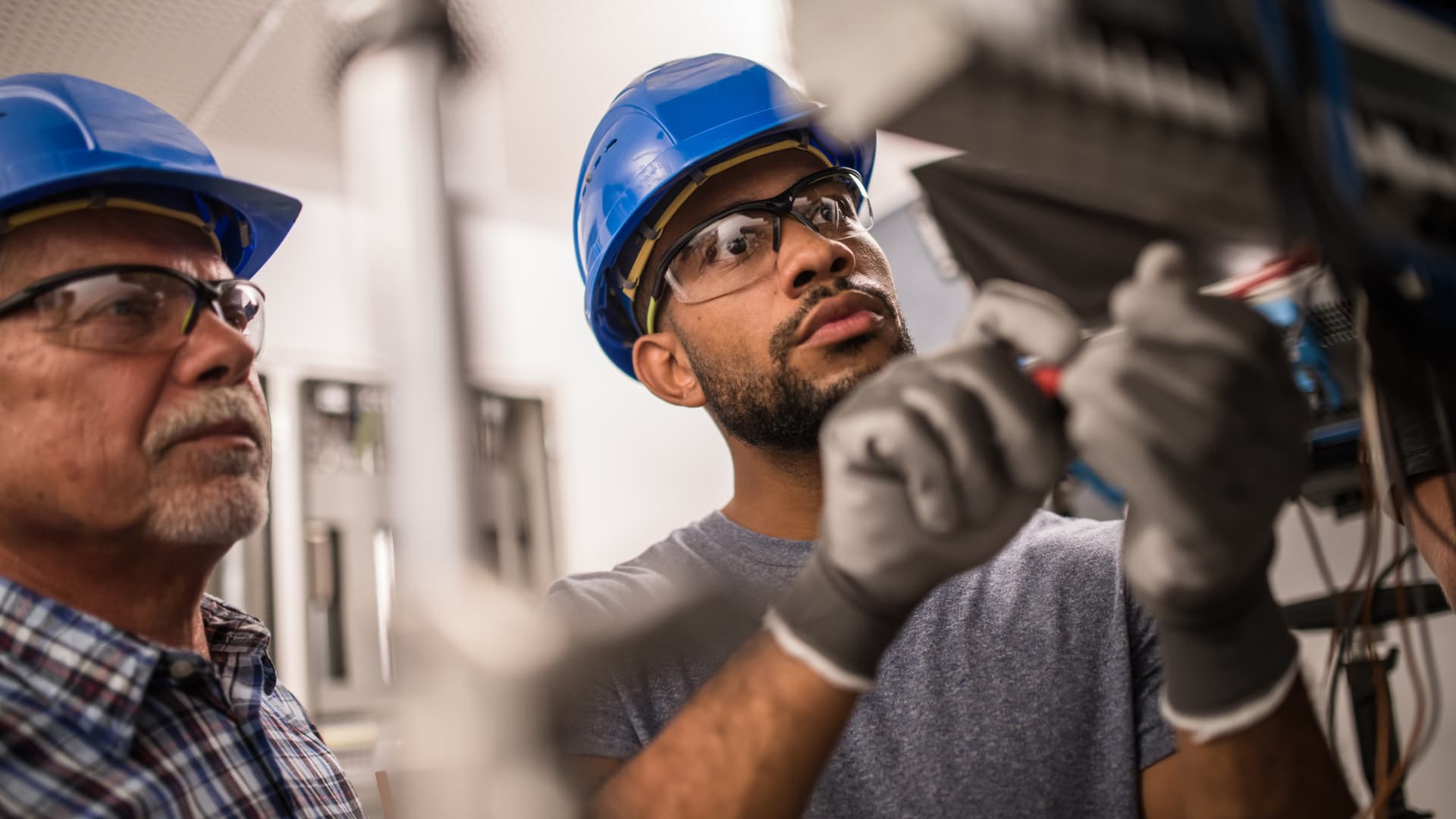
kadmy | iStock | Getty Images
Many younger workers are already on board. Applications to apprenticeship programs have jumped 70% since 2022, Andrews said.
At Rosedale Technical College, where students can also study automotive technology, diesel mechanics, carpentry, welding and other skilled trades, enrollment is up 36% in the last five years, according to the school.
“I think it’s a great opportunity, a great way to get your foot in the door, get started, get educated and feel completely prepared about what you’re getting into, especially something like electrical… you really need to know what you’re doing,” Vandall said of his trade school experience.
College costs are a major factor
In addition to providing students with a career-connected pathway to help address labor shortages, job training programs are also a lot less expensive than a four-year college.
The rising cost of higher education and the student loan debt that often goes along with it are significant factors driving more students toward short-term programs, research shows.
At four-year public colleges, in-state tuition and fees averaged $11,950 for the 2025-2026 academic year, while at four-year private schools, those costs averaged $45,000. Alternatively, at two-year public schools, tuition and fees averaged $4,150, according to the College Board.
Further, a growing number of states have introduced so-called promise programs, which typically offer college students two years of free tuition at participating state community colleges or other associate degree programs and vocational schools.

To be sure, college enrollment is still climbing, but largely driven by gains at community colleges and shorter-term credentialing programs, other data shows.
Enrollments in undergraduate certificate and associate degree programs both grew by about 2% in fall 2025, while enrollment in bachelor’s degree programs rose by less than 1%, according to the National Student Clearinghouse Research Center.
Community colleges now enroll 752,000 students in undergraduate certificate programs — a 28% jump from just four years ago.