




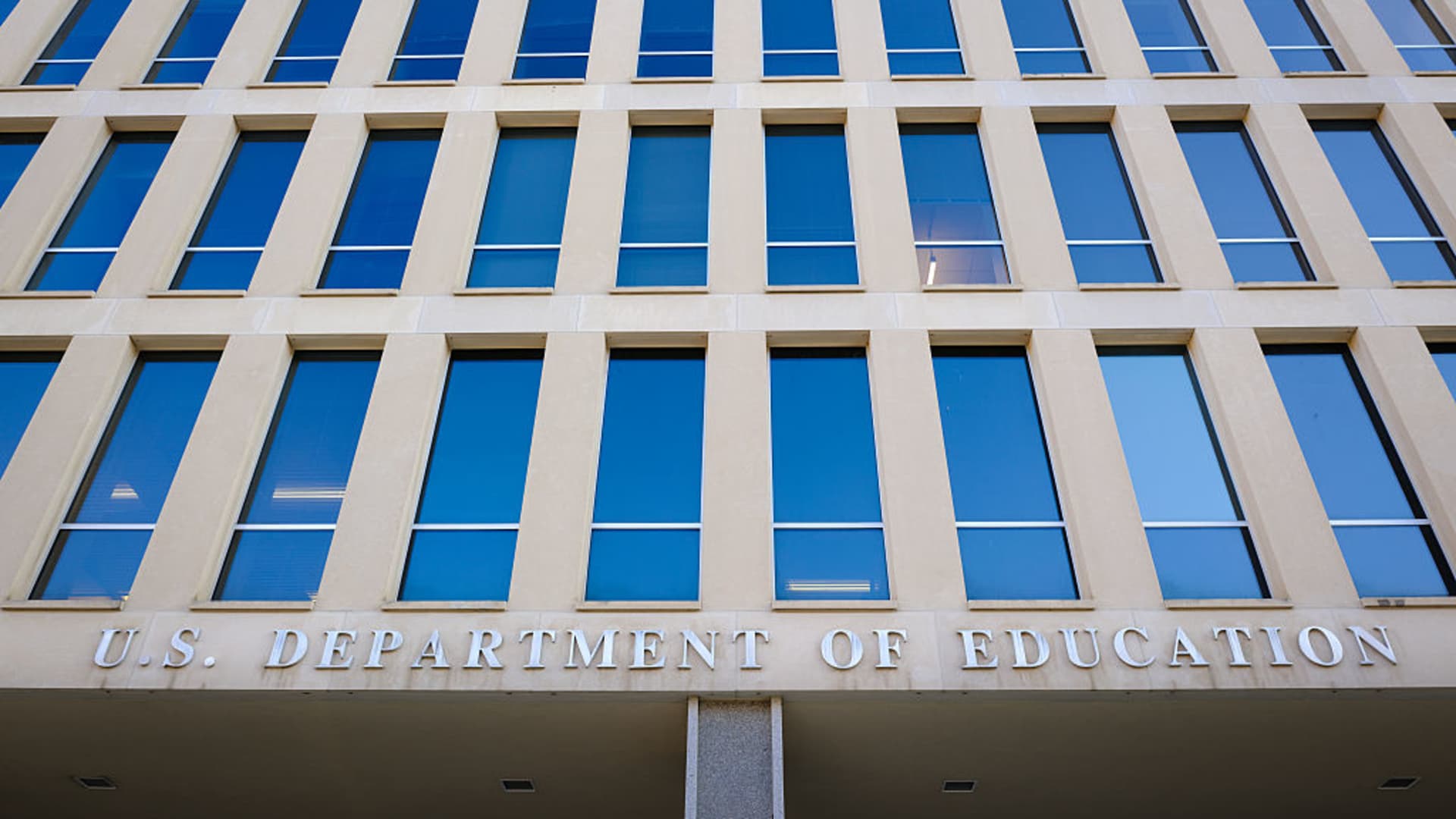
A sign marks the entrance to the U.S. Department of Education headquarters building on June 20, 2025, in Washington, DC.
J. David Ake | Getty Images News | Getty Images
A federal judge on Friday dismissed the Trump administration’s request to eliminate a student loan repayment plan that lowered monthly bills for millions of borrowers.
Judge John Ross of the U.S. District Court for the Eastern District of Missouri issued an order dismissing the multi-state lawsuit blocking the enactment of the Saving on a Valuable Education, or SAVE, federal student loan repayment plan.
The Trump administration’s failed bid to block the SAVE plan means that borrowers should have access to the program’s benefits, at least for now, consumer advocates said. Those include lower monthly payments and a faster timeline to forgiveness.
“As of today, not only is there no legal barrier to delivering those rights through the SAVE plan, but the Secretary has a legal obligation to do so,” said Winston Berkman-Breen, the legal director at Protect Borrowers.
The U.S. Department of Education did not immediately respond to a request for comment.
More than 7 million student loan borrowers remain enrolled in the SAVE plan, as of the fourth quarter, according to the Education Department.
Those borrowers were placed in forbearance during the legal challenges, meaning they didn’t owe monthly payments. Their loans have been accruing interest since August.
The court order may be a temporary reprieve, and it’s unclear how the Trump administration will respond. President Donald Trump’s “big beautiful bill” phases out the SAVE plan as of July 1, 2028.
How the SAVE plan works
The Biden administration introduced the SAVE plan in 2023, billing the program as “the most affordable repayment plan ever created.” But just as many of the SAVE plan’s benefits were taking effect, Republican-led legal challenges put the program on hold.
One of the hallmarks of SAVE is a faster timeline to forgiveness compared to other income-driven repayment plans, which typically offer forgiveness after 20 to 25 years.
Under the SAVE plan, borrowers who originally took out $12,000 or less are eligible to have their loans forgiven after 10 years of monthly payments. For every additional $1,000 borrowed above that amount, the repayment period increases by one year — up to 20 years for undergraduate loans and 25 years for graduate loans.
For example, an undergraduate borrower with a starting balance of $15,000 would need to make payments on SAVE for 13 years in order to qualify for loan forgiveness.
Another benefit of SAVE was lower payments than those under other IDR plans.
Monthly payments on SAVE were originally capped at 10% of discretionary income, and slated to drop to 5% of discretionary income in 2024. Borrowers with incomes at or below the federal poverty level would qualify for $0 monthly payments.
The SAVE plan also includes a cap on interest. Any interest that accrues above a borrower’s monthly payment is waived.
If $50 in interest accumulates on your loans in a month, but your payment is only $30, you won’t be charged the additional $20, for example. Borrowers who qualify for $0 monthly payments would not see additional interest charges on their debt.