





Ryan O’Hanlon

multiple authors
There’s a fun, instructive little story in Michael Lewis’s “Moneyball” that no one remembers because it doesn’t involve Billy Beane and so it was never recreated on a movie screen by Brad Pitt.
In the late 1970s or early ’80s, the Houston Astros began a study into what effect their team’s performance might have if they moved the outfield fence closer to home plate. They wanted to move the fence in because they thought it would lead to more home runs, and because fans love home runs, they thought they would sell more tickets. Except, given the types of hitters and pitchers on Houston’s roster, the study authors found, moving the fence in would actually do more harm to the Astros.
So, the decision makers in Houston looked at the data, and they decided… to order that the study never be made public. They had already decided to remove the fence and they only wanted data that could support their choice.
I was told a similar story about a professional football club by someone who has been working in the industry for over a decade. The team tasked him with preparing scouting reports for three different players. He went into detail about each player, and his conclusion for each was the same: You don’t want to sign any of these players. The club responded by asking him if he was able to send Positive Scouting reports for each player; They were already committed to signing them all.
In both stories, organizations wanted to use data, but not to make better decisions. They wanted it to justify the decisions they had already taken.
• Why might PL teams get a boost by not playing the Champions League?
• Premier League without set-piece goals: what would the table look like?
• 2026 World Cup team rankings: All 48 national teams
Now these may seem like stories from simpler times. Nearly every baseball team is being run with more advanced analytical models than the public has access to. And soccer data is everywhere now; Amazon is powering Bundesliga broadcasts and “expected goals” have become part of the common language for almost every English-language broadcaster.
Yet, while baseball teams have mostly moved on from using numbers to reiterate and justify their implicit biases, soccer clubs have not been able to do so. They are still not close. Don’t believe me? You just have to take a look at that team, AllegedlyWas considering telling his own fans that he had “redefined what a modern football club can be.”
In other words, you just have to look at Tottenham Hotspur.
What we know about how football works
Perhaps the core insight of the football analytics movement is something everyone already knows: the best team doesn’t always win.
This is essentially what the expected goals tell us. At almost any point in a given season, a team’s expected-goal differential is better predictor of future performance compared to any other top-level numbers such as shots, goals or points. If the best team always wins, then past wins will immediately tell us who the best teams are, and then those past wins will predict the future.
Instead, it appears that the best teams are those that score the greatest proportion of expected goals in their matches. If we simplify that idea beyond the abstraction of a constantly updating algorithm that assigns each attempt in a given match a specific conversion probability, then the best teams are simply the teams that create better chances than their opponents.
This is something that anyone who has played or watched the game for any length of time really understands on a deep level – whether they’re willing to admit it or not. But in accepting this, we are acknowledging that there is a larger amount of randomness inherent in the outcome of any given football match than there is a larger amount of randomness inherent in the outcome of a given football match than a person on the field is allowed to use his hands to kick a bouncing ball with a dislocated foot.
Now, the Premier League season is not that long, and there are 20 different team-level experiments each season. So over a decade, we get 200 different little experiments. And across these 200 different seasons, we would expect there to be some instances where randomness promotes, or penalizes, a team for the entire season.
This is what we see. Here is each Premier League season since 2010, arranged by how much a team underperformed or overperformed its xG differential:
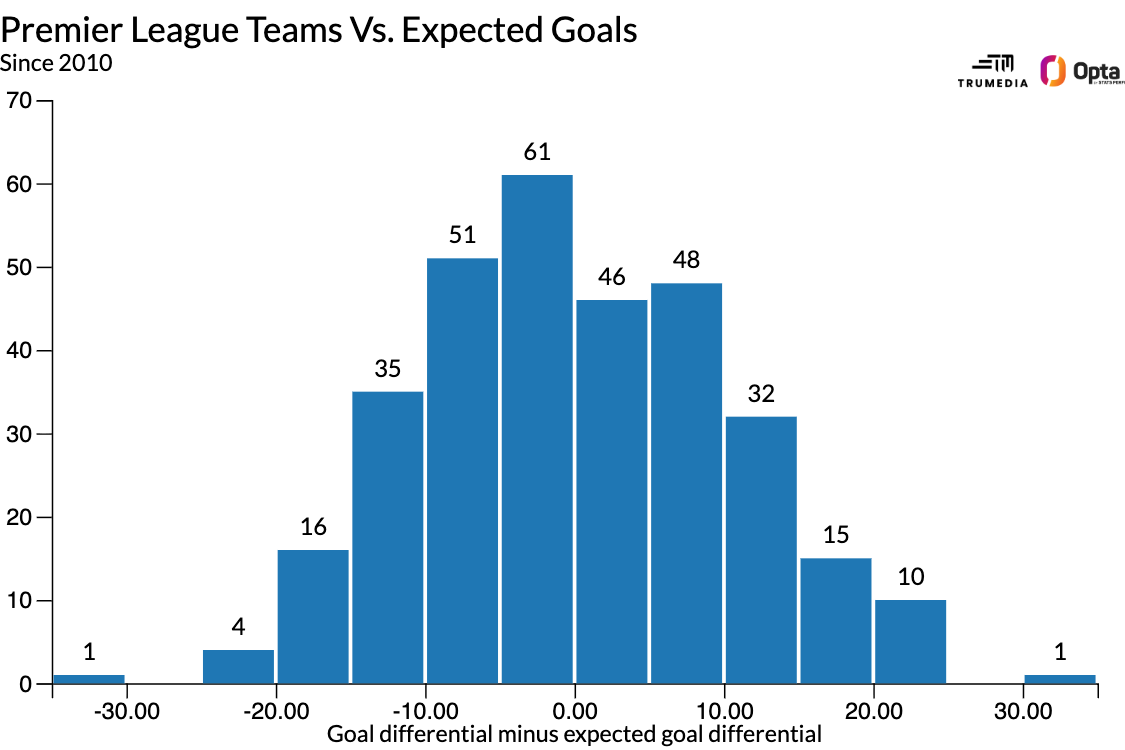
That team on the right is Tottenham in 2016–17. And if you had to choose someone to occupy the far left position, Tottenham would seem to be a very good choice in 2025-26, right? For one of the world’s 10 richest teams in a relegation battle with six games left in the season, surely “historically bad luck” has to play a part?
No. He is Sheffield United in 2023-24.
Tottenham are not lagging behind at all this season. Their goal differential (plus-11) is actually a little better than their xG differential (plus-15.13), but not by much.
So then, what does a team do with whom? Projected to be the ninth most valuable roster Have the World really become one of the worst teams in the Premier League? One possibility: you measure the things you are Thinking Matter – and not the things that really matter.
Tottenham’s key issue: they can’t pass
Typically, football is a complex, dynamic game where it is impossible to extract individual qualities from the interdependencies of roster construction, managerial instructions, and on-field interactions. But sometimes you get a team like Tottenham, where the diagnosis is very simple: these guys can’t pass.
But graduation gameThere is a team of people who watch every Premier League game and grade every pass made by a player on a minus-2 to plus-2 scale. Here’s how they describe the process:
For example, consider a centre-back passing the ball on the halfway line. An open teammate will get a 0 on a routine, non-pressing pass, as it meets the expectations of our expert grading team. An accurate, line-breaking pass under pressure will receive a positive grade. Conversely, an underhit pass to a teammate – even if completed – falling below the expected standard will receive a negative grade. This reflects our focus on evaluating performance rather than just results.
The grading process is guided by a detailed framework designed to reduce subjectivity and ensure consistency. Once the raw grades are collected, they go through several layers of quality control, including senior review of marked works, consistency checks, ongoing analysis and dedicated quality assurance processes.
Based on this process of evaluating passing, the five best passers for Tottenham in the Premier League season are ranked as follows:
1. Christian Romero: 19th
2. Mickey Van De Ven: 87th
3. Destiny Udogi: 152
4. Kevin Denso: 167
5. Mohammad Qudus: 186th
have to go through Fundamental skills in this game. The average Premier League team attempts 450 passes per game. And nothing comes close: In the same game, the average team attempts eight shots, passes the ball 18 times, tries to dodge defenders 18 times, attempts 16 tackles, and makes eight interceptions. If you can’t pass the ball, nothing else matters. It is the power at the core of the game that gives meaning to everything else.
So, how does one of the richest teams in the world – which claims to be the modern example of a football club – field a team with only two of the 150 best passers in its own league?
1:35
Will Tottenham be relegated from the Premier League?
Janusz Michalik debated Tottenham’s hopes of staying in the Premier League after the 1–0 defeat to Sunderland.
The rise of misanalysis
Over the past few years, a new set of numbers have emerged in the football world. Instead of quantifying the things that lead to wins, they quantify the things that scouts and coaches have always valued: Who’s bigger and who’s faster? Who is looking good? Who would be invincible if I could teach him how to play?
gradient and many companies like skillcornerNow introduce a series of physical metrics that show how often a player is running – in and out of possession, at top speed, at high speed, etc. I don’t blame any company for doing this; It’s good that these datasets exist. One of the things that has been missing from football data since the beginning is something that tells us what everyone else is doing with the ball. The average player has possession of the ball, at most, for only a few minutes per game, and most soccer data is only quantifying that short snapshot of time. It’s not close to telling us everything, but it is telling us the most important things.
When used correctly, this off-ball, physical data can be incredibly powerful. If you’re running a team and you can figure out how to combine these physical metrics to win and score goals, you’ve created a new, much more holistic understanding of a player’s value, and you’ll be way ahead of anyone who is just using passing and shots to measure performance. But it’s really hard, and because it’s really hard, it’s not really happening.
Instead, a source who has worked with several Champions League clubs told me, physical metrics are simply allowing clubs to confirm their own biases — the same biases we’ve been talking about in this battle between scouts and statistics since we wrote “Moneyball.” Except, now we have new data that says the scouts were right.
How else to explain what happened to Spurs?
Tottenham has a roster full of explosive athletes who can run. Using his physical metrics, the gradient created an “athleticism” score that is a combo of stamina, explosiveness and speed that adjusts for position and size. This is on a 1-100 scale. Tottenham have seven players rated 90 or above and five of them – Wilson Odobert, Lucas Bergvall, Archie Gray, Dominic Solanke, Conor Gallagher – were contracted in October 2023 after Johan Lang became the club’s technical director. The first four were four outfield players who were signed during Lang’s first summer in charge.
You can’t build a roster that can’t pass unless you systematically focus on a set of alternative player attributes that create an institutional blind spot. Considering that Romero – by far their best passer – was signed in 2021, and James Madison, who was injured throughout the season but is easily their other best passer and was signed in the summer of 2023, the ignorance of what really matters becomes even more glaring.
One of the more memorable storylines from “Moneyball” is the one where Billy Beane is arguing with his scouts, who are paying attention to how big a guy’s butt is, what kind of face he has, or whether his girlfriend is attractive. Bean comes back again and again to the question, “But can he kill?” Eventually he becomes angry, and yells to everyone in the room, “I repeat: We are not selling jeans here.”
I’ve heard it suggested that having someone in your club who understands the data and gives them a real voice is valuable simply because they’ll keep you from doing all those other things, by reminding you to keep the main thing, the main thing. But can he kill? However, at Spurs, it seems that a new set of numbers may have made the club think that they were actually in the business of selling jeans. What they really needed – and what could save them from being demoted – was someone who kept asking a simple question:
But can he pass?


