

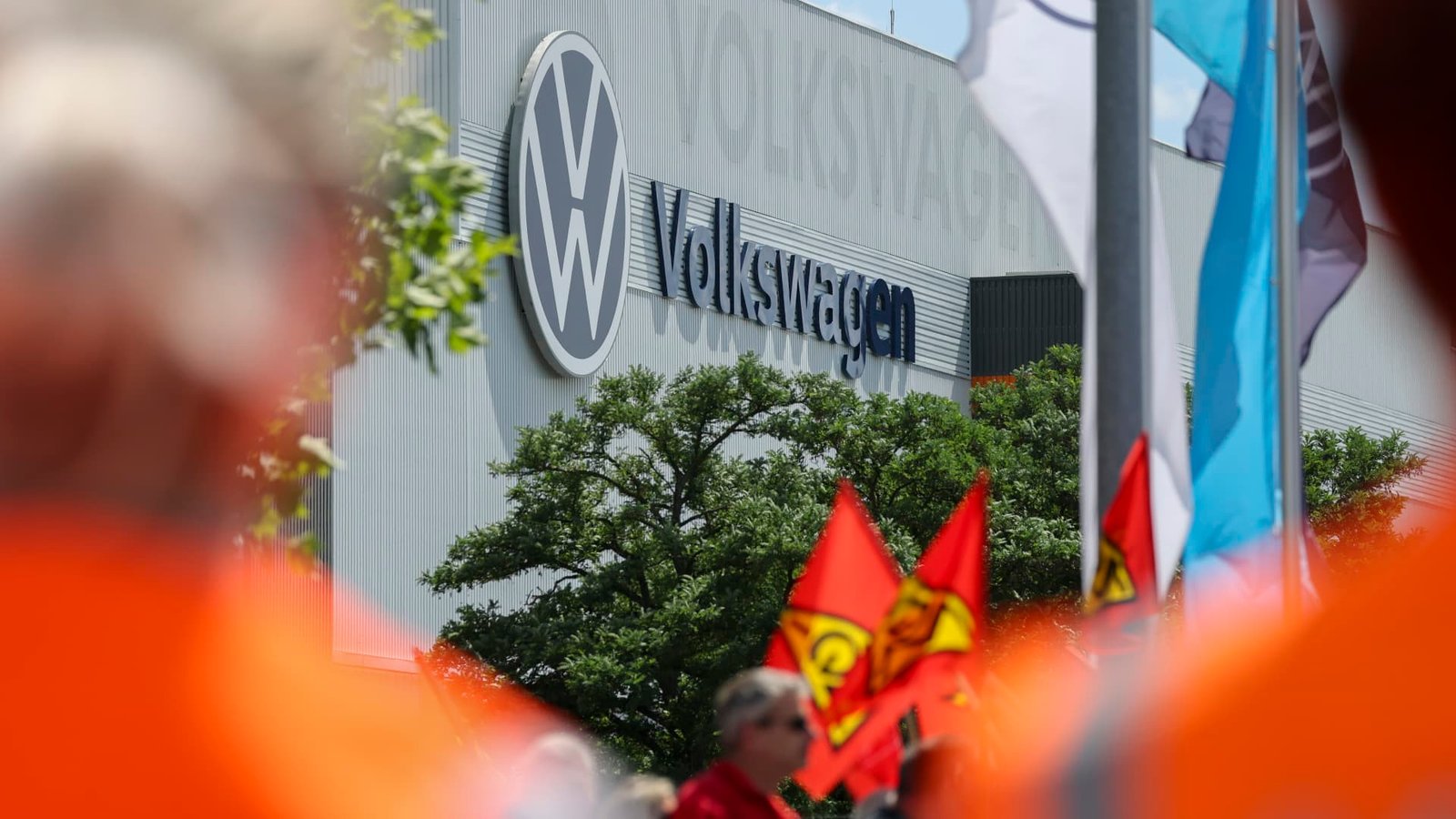
Volkswagen employees are taking part in an information and protest event organized by IG Metall in front of the VW plant in Zwickau.
Picture Alliance | Picture Alliance | Getty Images
Volkswagen shares jumped on Friday after it announced plans to slash a further 50,000 jobs as part of a historic transformation plan amid intensifying tariff pressures and competition from China.
Europe’s biggest carmaker said Thursday that its supervisory board had approved its Future Plan 2030, comprising 12 initiatives that would result in the “most strategically profound transformation program” in the group’s 89-year history.
This includes cutting around 50,000 positions, including management roles, it said, citing global competition, changing demands, and technological shifts. It also said it plans to streamline its leadership with a flatter hierarchy. It adds to 50,000 job cuts that were already approved, bringing the total job reductions to 100,000.
Volkswagen topped the Stoxx 600 on Friday and was up 5.8% shortly after the opening bell. It’s down 21% since the beginning of the year.

Volkswagen’s shares from the beginning of the year.
The company will also simplify its model portfolio by 50% by 2035, with a smaller product lineup as well as considering alternative uses for four of its German plants where future production had not yet been secured from 2031 to 2034.
“We are taking responsibility for our entire workforce, for our partners and for industrial jobs worldwide,” Volkswagen’s CEO Oliver Blume said. “Over the coming years, we will invest a three-figure billion sum to make our iconic brands even more attractive, stronger and more competitive.”
Volkswagen has dealt with slumping profits over the past year with tariff pressures among the factors weighing on earnings. It reported tariff expenses of 2.9 billion euros ($3.4 billion) for the full year of 2025.

Two years ago, the German carmaker was paying 2.5% tariffs on vehicles from Europe, but that has since jumped to 15%, Blume said in August.
“Our cars are becoming more expensive and therefore increasingly difficult to sell – not because they have got worse, but because the rules of the game have changed,” he said at the time.
Additionally, Volkswagen has faced fierce competition from Chinese rivals as domestic manufacturers such as BYD and Geely gained ground in electric vehicles and challenged its longstanding position in the market.
The car maker’s restructuring plan reflects broader pressures facing Europe’s auto sector, including Chinese overcapacity and much lower-priced imports, said Kevin Thozet, a member of the Investment Committee at Carmignac.
“Europe is therefore importing not only Chinese cars, but Chinese price deflation,” Thozet said Friday.
Europe also has an “overcapacity problem of its own,” he added, with Volkswagen particularly exposed because some of its German plants were built around first-generation electric sedans for which demand has weakened.
“China has too many cars. Europe has too many factories. And both problems are colliding,” Thozet said.
‘Better-than-feared outcome’
Analysts were expecting Volkswagen’s shares to rise on the news. The announcement served as a “major surprise,” but also represents that the company is capable of executing difficult decisions, Deutsche Bank analysts said on Friday.
“The unanimous approval of Volkswagen’s Zukunftsplan 2030 last night is, in our view, a fundamental breakthrough and a much better-than-feared outcome,” they said.
“Virtually every single one of the numerous investors we spoke to over the last few days continued to view Volkswagen as simply ‘not fixable,’ and scepticism around the likelihood of a comprehensive agreement remained extremely high,” they added.
While the transformation does not solve Volkswagen’s challenges overnight, it’s a step in the right direction, marking a new phase for the company, they said.
They added that the outcome could have “broader implications” for the German auto industry, with other auto manufacturers taking similar steps to offset slower growth, excess capacity, international competition and pressure on returns.
“The December 2024 restructuring agreement arguably encouraged other manufacturers to pursue similarly difficult but necessary adjustments,” they added. “Today’s decision could create a similar halo effect.”