

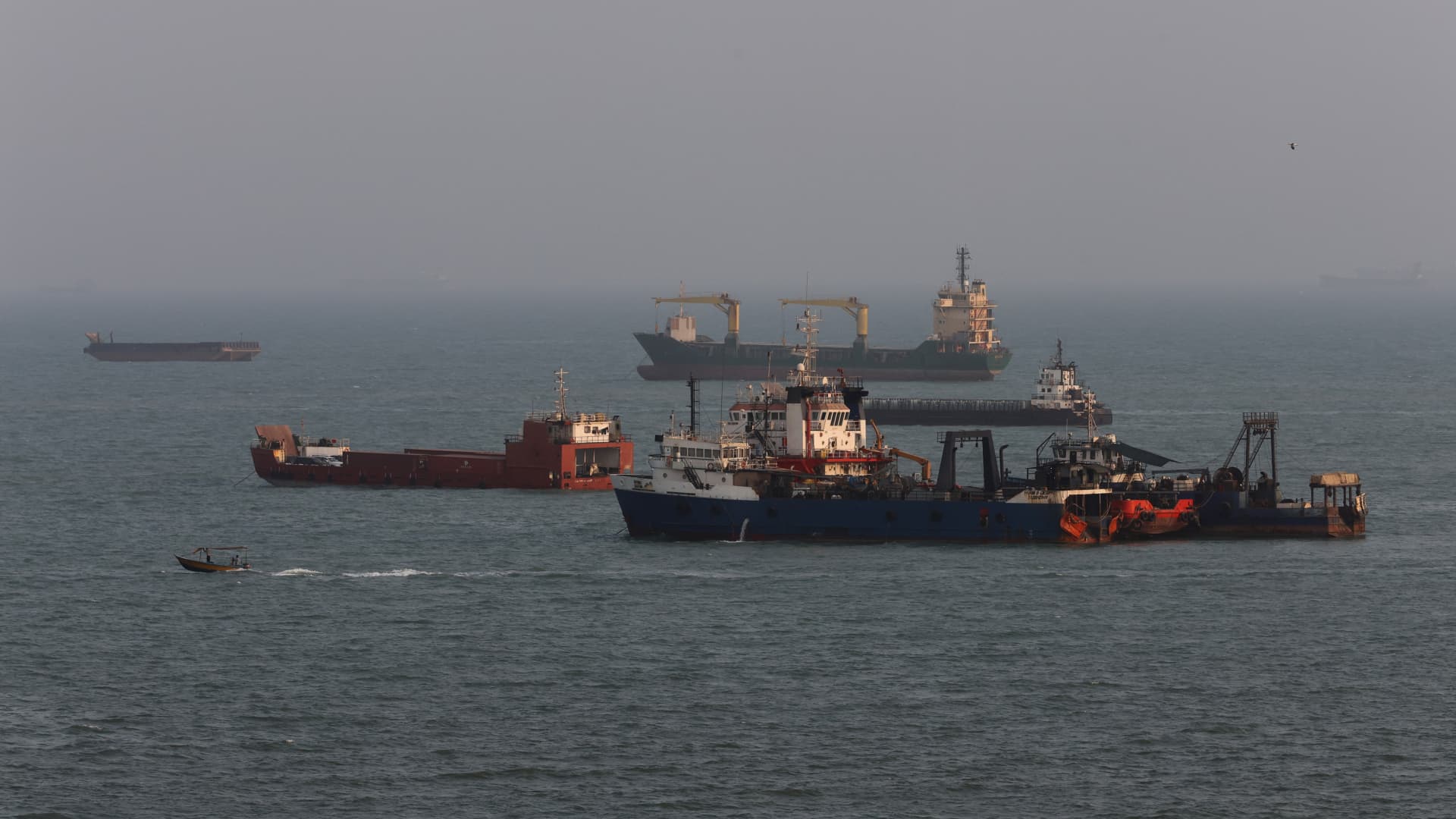
Ships are anchored in the Strait of Hormuz on August 10, 2026 off the coast of Bandar Abbas, Iran.
Ali Saeedi | Getty Images
Iranian authorities have pushed back on U.S. President Donald Trump’s repeated claims that Washington has “total control” over the Strait of Hormuz.
On Wednesday stateside, Iran’s Persian Gulf Strait Authority said in a post on X that “Claims and repeated posts by U.S. officials that the Strait of Hormuz is no longer blocked do not change the reality: the Strait of Hormuz remains blocked and will not be reopened until Iran’s conditions are accepted.”
Trump had said in a Truth Social post earlier that “The U.S.A. has total control over the Strait of Hormuz. I THINK WE WILL KEEP IT!”
While both sides continue to make contradictory claims, data from trade intelligence firm Kpler showed that ship traffic through the Hormuz waterway is near a 3-month low.
Vessel transits sat at a 5-day average of around 13 on Tuesday, nearly the lowest level since May 12, according to a CNBC analysis of data provided by the trade intelligence firm Kpler. This includes ships of all types, from cargo vessels to oil tankers.
Traffic is about 90% lower than the daily average of 130 ships that transited Hormuz before the U.S. and Israel attacked Iran on Feb. 28.
Both Washington and Tehran have hardened their negotiating stances, asking for “reparations” from the other side, among other demands.
Iran’s Supreme National Security Council laid out sweeping demands over the weekend for reopening the Strait of Hormuz, including an end to the U.S. naval blockade, sanctions relief, American troop withdrawals and war reparations.
‘Confusion and bewilderment’
The developments come as Mohammad Reza Naqdi, a top advisor to the commander of Iran’s Islamic Revolutionary Guard Corps, told PBS in an interview on Tuesday stateside that “victory is on our side” and that “we have also seen how the American military is weaker than what we perceived.”
He pointed to what he described as Washington’s shifting objectives over the course of the conflict, including wanting to invade Kharg Island and opening the Strait of Hormuz.
“We saw confusion and bewilderment in America. It became a war without a strategy. Every two or three days, they announced a new objective … They mobilized their battleships. Everything they tried, we can show how we were victorious.”
When asked if the plan was to drag the conflict out until Trump leaves office, Naqdi said the goal was for Iran to “attain deterrence.”
As such, he said that one way was to prolong the conflict and cause attrition, so if anyone wants to attack Iran, there will be a cost.
— CNBC’s Spencer Kimball and Deena Zaidi contributed to this report.