

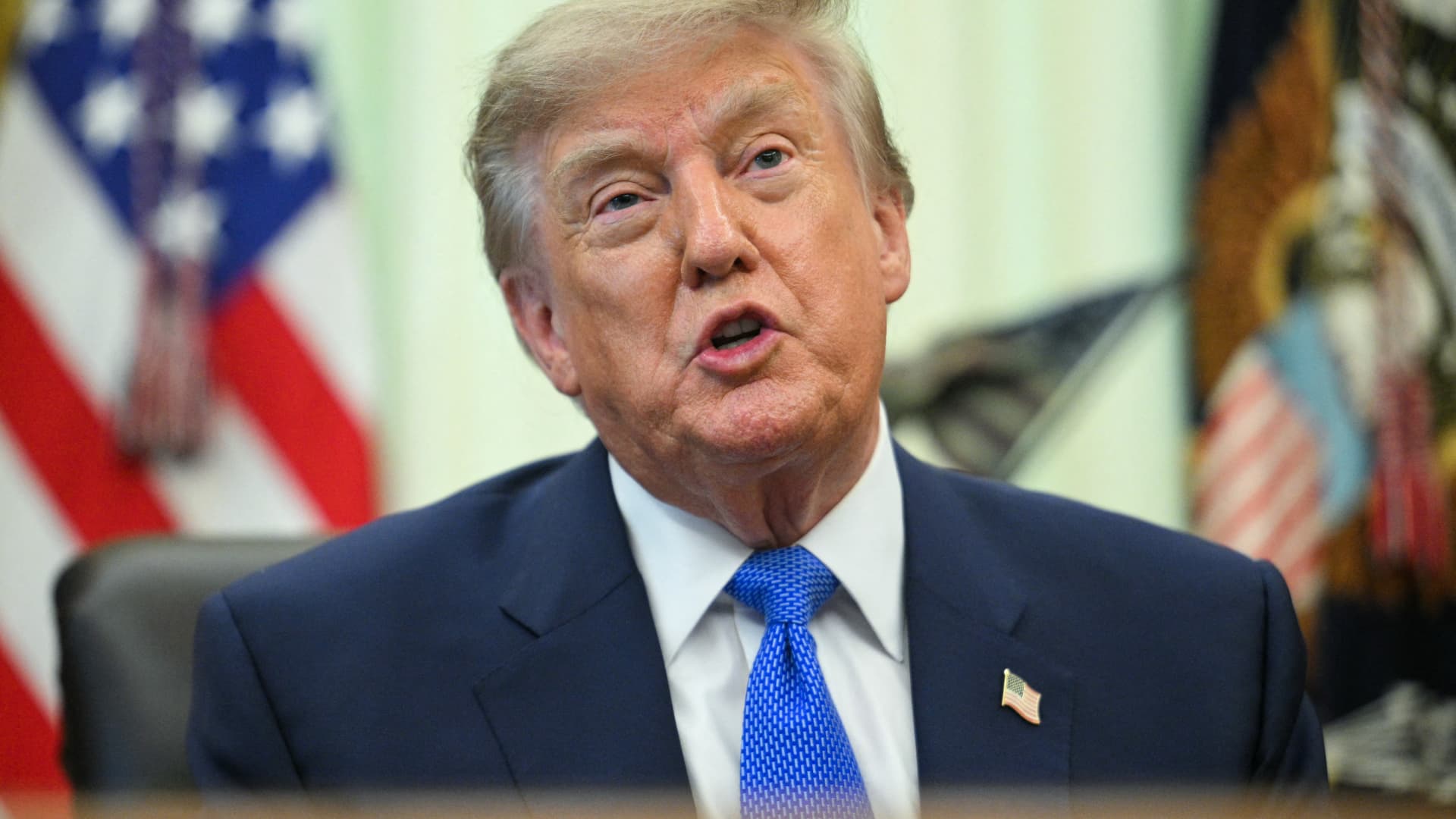
US President Donald Trump speaks before signing an executive order calling for more research and flexibility on vaccines, in the Oval Office of the White House in Washington, DC, on August 10, 2026.
Jim Watson | Afp | Getty Images
President Donald Trump said Monday the U.S. Navy had swept the Strait of Hormuz clear of mines and now holds “100%” control of the waterway, with reparations emerging as the latest flashpoint between Washington and Tehran.
Speaking to reporters in the Oval Office, Trump said the U.S. Navy now has full control of the waterway. “It’s open now,” he said, adding that the U.S. was “the only one that has control of the Strait of Hormuz right now.”
He described the U.S. posture as a “steel wall” and said sporadic Iranian mine-laying hasn’t changed that. “They will, on occasion, drop a mine, and we find the mine,” he said. The U.S. has maintained a naval blockade of Iranian ports since mid-April.
Iranian officials have insisted that the Strait of Hormuz would remain closed until the U.S. agrees to its demands including lifting their naval blockade, while its discussions with Oman over a shipping arrangement would not lead to the waterway being fully reopened.
In an attempt at turning the tables on Iran, Trump in a Truth Social post early Tuesday stateside said Tehran’s demand for war-damage reimbursements gave him “an interesting idea” — that Iran should instead compensate the U.S. for the people killed or wounded in roadside bombings and other attacks linked to Iran, as well as Iranian protestors that he said have been killed over the past 50 years by the country’s regime.
Trump’s reparations demand has introduced a new sticking point after Iran laid out its own conditions for reopening the strait on Saturday, a vital waterway that carried roughly a fifth of the world’s oil before the war.
Mohammad Bagher Zolghadr, secretary of Iran’s Supreme National Security Council, said Saturday the strait won’t reopen until Washington lifts its naval blockade and sanctions, withdraws American forces from the region, pays war reparations and releases frozen Iranian assets. The council also called for an end to U.S. attacks on Iran’s regional allies.
Trump has signaled that he was prepared to let the mounting economic distress take its toll on Iran rather than launch further military strikes.
Iran’s foreign ministry on Tuesday pushed back on the economic front. The spokesman Esmaeil Baqaei responded to the U.S. Treasury Secretary Scott Bessent’s claims that U.S. sanctions were “suffocating” Iran.
He said that Washington opts for sanctions whenever diplomacy fails and escalates them when they don’t work — a pattern he said has become less a “policy” than a “compulsive addiction.”
The impasse leaves Washington treating its naval presence as a permanent fixture guaranteeing access, while Tehran treats that same presence as the primary obstacle to normalizing traffic. Iran has insisted that it would not reopen the Strait of Hormuz as long as the U.S. continues to blockade its ports.
Energy supply disruptions remain a key market concern, with tanker traffic through the strait still subdued, said Lloyd Chan, senior currency analyst at MUFG Bank in Singapore, noting that Brent prices remain way above above pre-conflict levels.
While periodic flare-ups remain possible, a full-blown regional war is still not the base case, Chan added.
Oil prices rallied on Monday on the hardening rhetoric, reversing a brief retreat last week. West Texas Intermediate crude for September climbed about 5% to settle near $82.13 a barrel, while Brent crude rose by a similar margin to around $87.72. Oil was slightly higher Tuesday in Asia trading.