


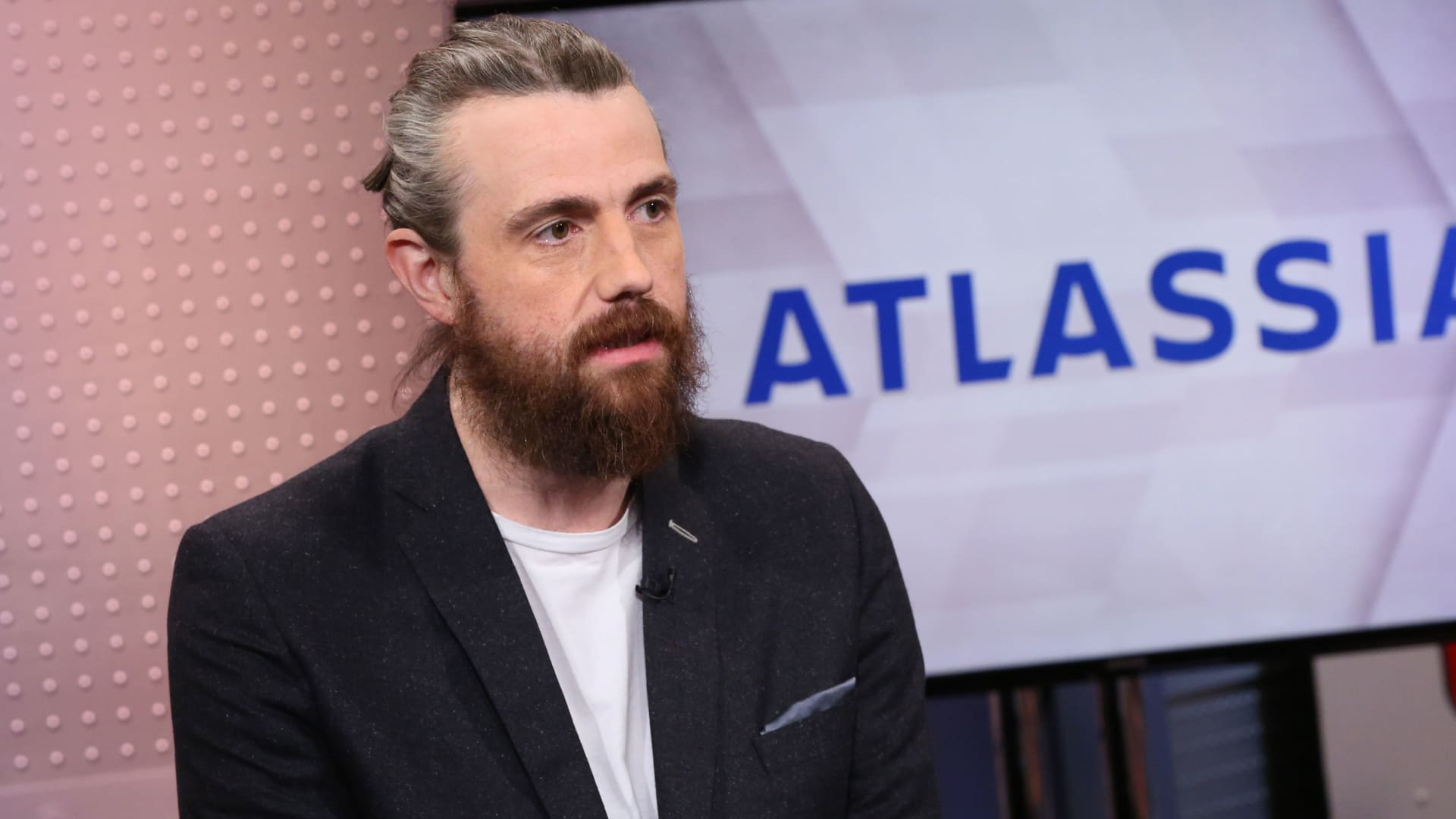
Michael Cannon-Brookes, co-CEO of Atlassian.
Scott Mlyn | CNBC
The “SaaSpocalypse” was raging this week. Then it got a reprieve.
The pennies-on-the-dollar acquisition of one-time highflyer Airtable, followed by plunges in HubSpot, Datadog and Figma on earnings reports, all served to underscore investor concerns that artificial intelligence models are eating away at the value of costly software products.
“I do think that companies are going to continue to use these coding agents to build functionality to maybe act as a little bit of pressure on renewals,” said Matt Hedberg, a software analyst at RBC Capital Markets.
But by the end of the week, Wall Street was reminded that there’s still juice left in an industry that, not long ago, was viewed as driving innovation and was trading at hefty market multiples.
Twilio, a provider of cloud-based communications software, and Atlassian, which sells collaboration tools, each saw pops of well over 20% on Friday after reporting quarterly results. Cloudflare, which helps protect websites from cyber attacks, gained 5.6%.
Box CEO Aaron Levie, who’s been evangelizing cloud software since he started his file-sharing company more than two decades ago, was particularly impressed with Atlassian, which reported its most profitable quarter since 2021.
“Huge Atlassian quarterly beat,” Levie wrote on X. “There was a misplaced thesis over the past 6 months that somehow agents would be bad for certain software categories. There’s definitely truth in this in some areas, but many were parsing this poorly.”
Levie’s reaction reflects a level of nuance that’s not always apparent in the sell-it-all trade. Salesforce CEO Marc Benioff has spent months trying to convince investors that his company’s longstanding software for sales, marketing and customer service won’t be vibe-coded away. Salesforce has lost more than 40% of its value since the end of 2024 despite accelerating revenue growth and consistent margins.
Salesforce and its software peers have been under pressure, less because of their current growth rates and more because of the increasingly popular view that tools like OpenAI’s Codex and Anthropic’s Claude Code will slowly — and then rapidly — hollow out their economics.
The iShares Expanded Tech-Software Sector ETF plummeted 24% in the first quarter, its worst performance since 2008. However, it’s since rebounded sharply and is now down just 3% for the year, while the Nasdaq is up 15%.
‘Pencils down’
RBC’s Hedberg said sentiment was so bad in the first quarter that clients didn’t even want to discuss software.
“People were pencils down in the space,” he said. “They just didn’t feel like it was worth their time to meet with software companies back then, and that was even high-quality companies.”
That attitude has become a big problem for venture-backed software companies that raised money at hefty valuations in the pre-AI era and are now trying to figure out what’s next for them. There haven’t been any notable SaaS IPOs this year, and 86% of private deal value in the first half of 2026 went to AI companies, according to PitchBook data.
Concerns were amplified on Tuesday, when Italian software buyout firm Bending Spoons said it had agreed to buy workflow management startup Airtable for less than $1.3 billion. At its peak in 2021, Airtable was valued at nearly $12 billion.
Bending Spoons, which held its own IPO in July, owns brands including AOL, Evernote and Vimeo, and now has a market cap of $28 billion.

Two days after the Airtable deal, HubSpot had its worst day on the market in a decade, sliding 19% and bringing its loss for the past year to over 50%. Datadog, which sells monitoring software, also sank 19% on Thursday, the steepest slump since its IPO in 2019. Still, the stock has been an outperformer, climbing 72% this year.
Datadog said its biggest AI client, which analysts suspect is OpenAI, has cut usage since June.
“There’s these reminders that we’re not out of it,” Hedberg said. “Everything’s not smooth sailing.”
The mood improved after the close on Thursday, thanks to stronger reports from Atlassian, Twilio and Cloudflare. Atlassian CEO Mike Cannon-Brookes credited his company’s research and development teams for working hard to give customers “the best quality at the best price and the best speed.”
The report came five months after Atlassian slashed 10% of its workforce, or 1,600 jobs, which Cannon-Brookes said at the time was necessary to “self-fund further investment in AI and enterprise sales, while strengthening our financial profile.”
Atlassian’s 35% surge on Friday marked its best day since the company went public in 2015. It’s still down 8% this year after losing one-third of its value in 2025.
Rishi Jaluria, another RBC analyst, said some of the pop for Atlassian is likely attributable to short covering, meaning that investors who bet against the stock by borrowing shares and selling them are now buying them back.
“Everyone says Atlassian is going to get crushed by Claude Code and OpenAI Codex, and so they’re done,” said Jaluria, who doesn’t cover the company. “Any proof point that says, oh wait, this company isn’t dead, is going to result in a short squeeze.”
WATCH: We do not think AI will kill ‘SaaS’ but slow decay is bad enough: CLSA