


An aerial view shows a former eel fishing boat covered in dried mud among on low water among the banks of the river Rhine near Neuss, western Germany, on July 30, 2026, as the water level in the Rhine is falling to a record low following exceptionally hot weather.
Ina Fassbender | Afp | Getty Images
The drought in Europe is so severe that it is jeopardizing countries’ economic growth and forcing them to take extreme measures like blowing up riverbeds.
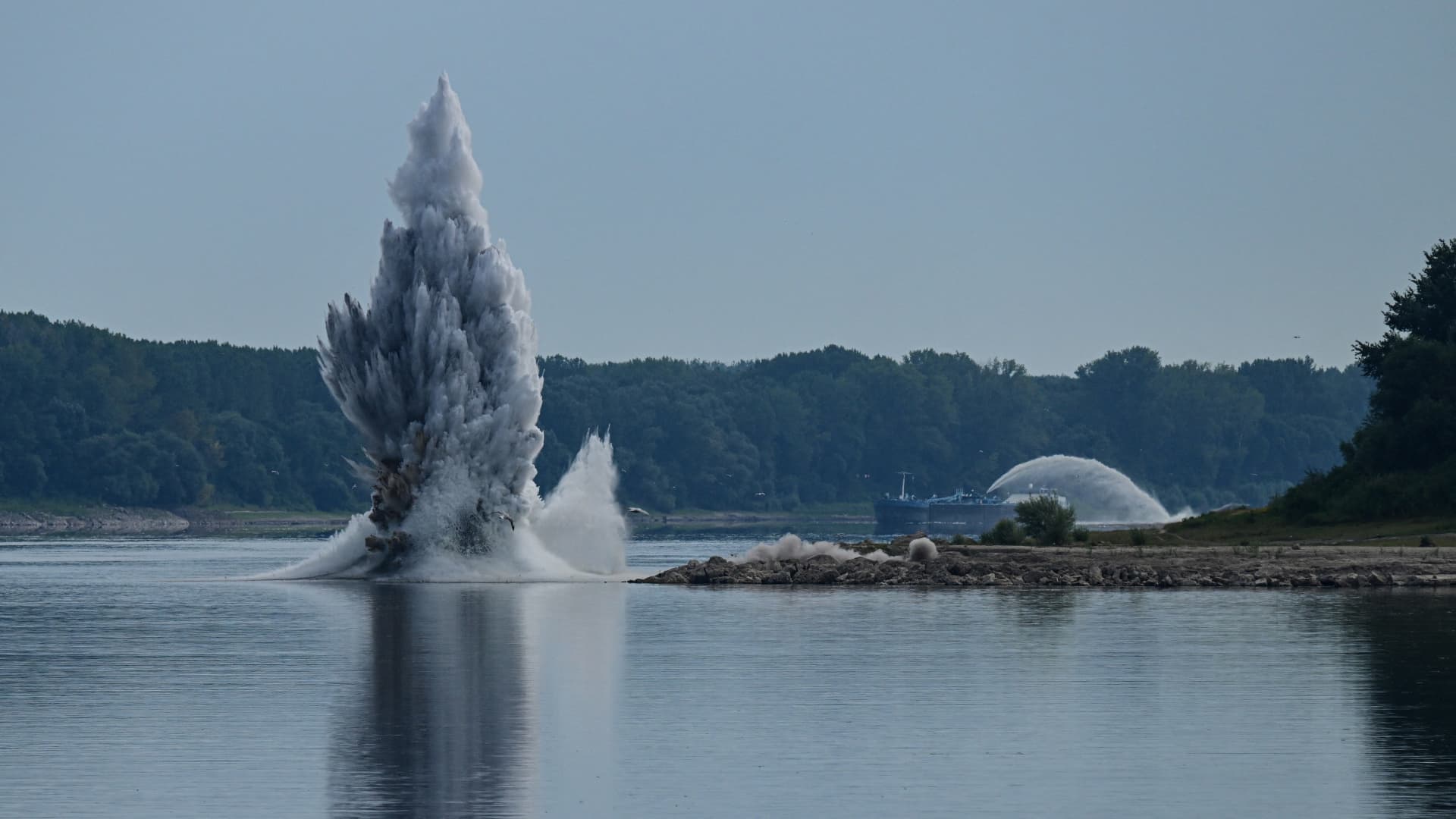
Gripped by a summer of weather extremes, Romania recently shut down its sole working nuclear reactor cooled by the Danube for the first time, with Bucharest even deploying naval forces to carry out underwater detonations to improve water flow.
Images published Monday showed the Romanian navy blasting rocks in controlled explosions in Izvoarele village as part of a push to divert a higher volume of water toward the cooling systems of the Cernavoda Nuclear Power Plant.
Low water levels on the Danube have also threatened to close Hungary’s Paks nuclear plant, which supplies around 40% of the country’s electricity, and forced Serbia to cut hydropower generation.
Why low Rhine levels threaten Germany’s economy
In Germany, the water levels on the Rhine River, a crucial waterway in Europe’s economic heartland, have fallen to their lowest levels in nearly 150 years, posing a risk to the German economy and further disrupting supply chains.
The water level at Kaub, a key choke point for vessels transiting to southern Germany and Switzerland, fell to 24 centimeters on Monday and Tuesday, reflecting its lowest level since records began in 1880, with forecasts of even lower levels toward the end of this week, according to official data compiled by ETH Zurich.

That’s far below the critical level of 78 centimeters at the Kaub gauge for navigation on the Rhine. Transport is still possible below this threshold, but cargo barges must be less heavily loaded, and freight transport costs and low-water surcharges rise sharply.
“Major rivers like the Rhine and Danube are critical trade corridors and sources of water for industry and energy generation, so when water levels fall, the effects extend far beyond the waterways themselves,” Liz Saccoccia, water security lead at the World Resources Institute, told CNBC by email.
A controlled underwater explosion is pictured on the riverbed of the Danube River in Izvoarele village, on August 3, 2026. The blast aimed at deepening the channel and diverting a higher volume of water toward the cooling systems of the Cernavoda Nuclear Power Plant.
Daniel Mihailescu | Afp | Getty Images
“We’re already seeing that happen. Nuclear plants in Hungary, Romania and France, along with hydropower facilities in Serbia, have already had to reduce electricity generation because there isn’t enough water for cooling or driving turbines, increasing the risk of blackouts and costly electricity imports,” Saccoccia said.
“Along the Danube, low water levels have prevented farmers from shipping their crops and stopped cruise ships from reaching ports such as Budapest. These are early examples of how increasingly unreliable water supplies can ripple through the economy, affecting trade, energy security, supply chains and local businesses,” she added.
What low water levels mean for freight and supply chains
The issue shines a light on a critically important environmental issue: water scarcity.
The issue is especially acute across southern Europe, where around 30% of the population is known to be situated in areas with permanent water stress: when water demand exceeds the available supply.
In economic terms, the effects of low water levels on the Rhine could be enough to dampen German gross domestic product (GDP) by up to 0.2 percent in the third quarter, according to Stefan Kooths, professor of economics at the Kiel Institute for the World Economy (IfW).

“Since water levels are unlikely to rise sharply back above the critical threshold in early August, transport capacity is likely to remain affected by the low water levels for some time in the coming month as well,” Kooths told CNBC by email.
“The loss in value added can be roughly estimated at 1 to 2 billion euros ($1.15 billion to $2.3 billion) in the third quarter,” he added.
How climate change is increasing Europe’s drought risk
Felix Schmidt, senior economist at the private German bank Berenberg, said companies in Europe’s traditional growth engine had likely not been caught by surprise by the Rhine’s low water levels because climate change means this has become a recurring challenge.
Businesses have prepared by either stocking up on inventories or diverting the transport of some goods via rail or road, although Schmidt acknowledged that freight rates were currently going “through the roof,” exacerbating inflationary worries.
“Given that Germany is growing very little, obviously, if we grow 0.1 instead of 0.2 then this means we lose half of the growth, if you want to frame it like that,” Schmidt told CNBC in a phone interview.
The German economy expanded by 0.2% in the second quarter, compared to the previous three-month period. That followed an upwardly revised 0.4% quarter-on-quarter increase in the first quarter.
A view of the Paks Power Plant from the Danube embankment in the town across the river on July 31, 2026 in Dunaszentbenedek, Hungary.
Janos Kummer | Getty Images News | Getty Images
Schmidt described drying rivers as just one expression of Germany’s economic struggle amid the intensifying climate crisis.
“Water levels are obviously one thing but we had this heat wave in Germany a couple of weeks back, impacting big parts of northern Europe, which brings down productivity. You have infrastructure which gets destroyed by the heat. You have energy supply, which is affected, like the nuclear plants being shut down in Hungary, France and Switzerland,” Schmidt said.
“You also have the catastrophic development like the fires sweeping now in southern Europe … So, it’s affecting the economy in many, many ways,” he added.