

SWANSEA, WALES – FEBRUARY 24: Swansea City AFC club co-owner Snoop Dogg walks around the pitch prior to the Sky Bet Championship match between Swansea City and Preston North End at the Swansea.com Stadium on February 24, 2026 in Swansea, Wales. (Photo by Athena Pictures/Getty Images)
Athena Pictures | Getty Images Sport | Getty Images
As the dust settles after the FIFA World Cup, soccer fans’ attention turns to the start of Europe’s domestic league seasons. The English Premier League — by some distance the most popular soccer league in the world — kicks off once again on August 21 with champions Arsenal launching their title defense.
Growing American interest in the league is evident not just in broadcast viewing figures and social media hype — but increasingly in boardrooms, too. English soccer clubs, or football clubs, per the sport’s more common global name, have become hot commodities for ultra-rich and institutional ownership over the years. What began with the Glazer family’s takeover of Manchester United in 2005 has proliferated to American control of 11 of the 20 current Premier League sides.
Further down the pyramid league system, smaller clubs have also attracted the interest of American celebrities. From Ryan Reynolds and Rob McElhenney’s fairy tale acquisition of a fifth-tier Welsh team captured by the “Welcome to Wrexham” TV series in 2020, to Snoop Dogg’s investment in second-division side Swansea City this year, the appetite for collaborations with U.S. pop culture figures is only growing.
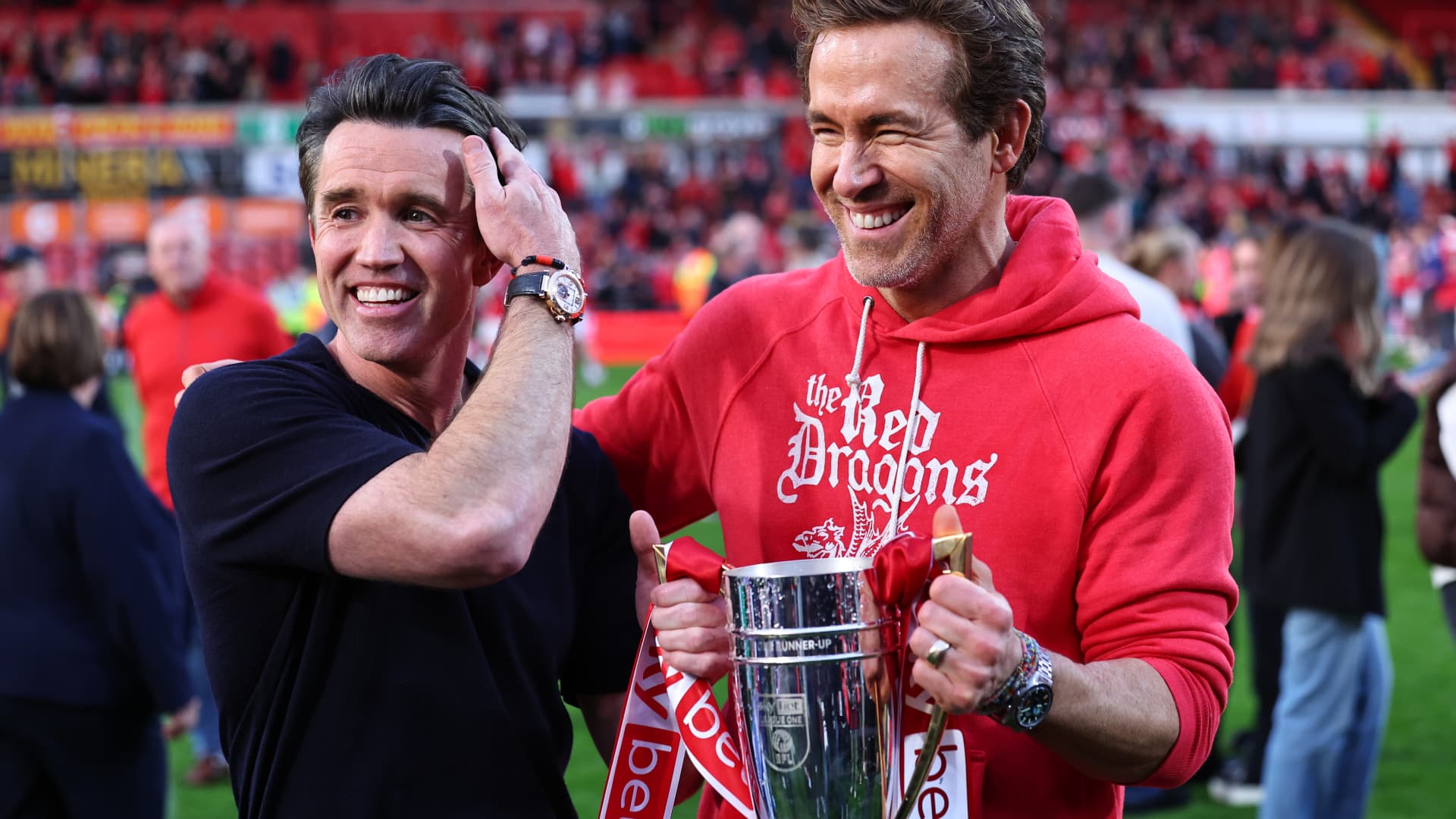
WREXHAM, WALES – APRIL 26: Ryan Reynolds and Rob McElhenney co owners of Wrexham with the trophy during the Sky Bet League One match between Wrexham AFC and Charlton Athletic FC at Racecourse Ground on April 26, 2025 in Wrexham, Wales. (Photo by Robbie Jay Barratt – AMA/Getty Images)
Robbie Jay Barratt – Ama | Getty Images Sport | Getty Images
Inefficiencies
In October 2010, John W Henry’s Fenway Sports Group saw an opportunity. They could rescue Liverpool Football Club from the brink of administration for a cut-price fee of £300 million.
Almost 16 years later, the Boston-based group is poised to net an enormous return on investment after FSG confirmed it is in talks with a syndicate of investors, led by British-Indian entrepreneur Amit Bhatia, to offload a significant minority stake in the club.
The deal is believed to value Liverpool at $6 billion and is the culmination of a remarkable turnaround effort that saw the club restored to its former glory, winning two Premier League trophies and one European Champions League title under FSG’s tenure as its financial backer.
It is the inefficiencies of British and European football clubs’ day-to-day operations that particularly excite American businesspeople, sports finance analysts told CNBC.
Clubs are traditionally run with fans in mind, and typically, most are loss-making entities. Revenue maximization has rarely been the priority of British teams. Just eight Premier League clubs reported an operating profit in the 2024/25 season, with the league racking up combined pre-tax losses of £948 million ($1.26 billion), according to Deloitte.
Losses are partially driven by an inefficient system of income channels that new owners can optimize. But owners must be careful not to take commercialization too far, or risk alienating supporters, Deloitte warns.
“Frustrations among this group at the top-end of the game are building and in future many more may decide to vote with their feet, and step away from the live game,” the researchers wrote in its 2026 football finance review.
Growing revenues do not necessarily translate into stellar returns for public shareholders, however, as the share prices of listed clubs Manchester United and Juventus highlight. Manchester United shares are up just 30% over the past five years and are yet to surpass 2018 highs. Juventus shares are down almost 70% over the same period.

Buyer beware: Europe’s largest listed soccer clubs, Manchester United and Juventus, have struggled for stock market form
Scarcity
Scarcity creates value, and there are only a few dozen elite football clubs in the world, many of which date their foundations back to the late 1800s.
“Football clubs are a rare asset, and arguably the ones in the UK are the rarest with the oldest histories attached to them,” Amber Pinto, partner at sports investment agency Pinto Capital, told CNBC. “Live sport is also one of the only things that can’t really be replaced by artificial intelligence. There is simply no way to replicate it online.”
That’s not to mention just how lucrative the rewards for success in the English Premier League can be.
TV revenues have traditionally been a critical source of funding for all clubs competing in the top division.
In the U.K., broadcast rights are sold to several providers, including Sky Sports, TNT Sports and, more recently, streaming competitors such as Amazon Prime.
The proceeds are then divided between the 20 Premier League teams, with 50% split equally between them, 25% divided up depending on final league position, and 25% split based on the eventual number of televised matches each team plays.
In the 2024-25 season, Premier League clubs pocketed over £3.3 billion in TV revenues, according to Deloitte – 50% of their total income.
Soccer’s ‘deal cycle’
As with any asset class, valuations are key. In the case of Liverpool, its global reach and strong brand are the reasons behind the club commanding such a price, according to Kieran Maguire, associate professor in football finance at the University of Liverpool.
“The $6 billion figure is not overly frothy in today’s market, rather it is indicative of the scarcity of elite football clubs and the willingness of multi-billionaires to invest in them,” he told CNBC on Wednesday.
For Pinto Capital, the deals cycle is “maturing” after a red-hot market in previous years. Ryan Reynolds’ Wrexham story – the poster example of American ownership of a smaller U.K. club – has proved one of several catalysts for the sport to become an asset class of its own.
“The deal cycle has become slightly longer and more complex,” Pinto added. “There is a football regulator for the first time, significant institutional players involved from finance and media, and football is now seen as an exportable, global product, for example Wrexham.”
“This is supported by a wider asset exposure across wealth. Years ago, ultra-high-net-worths, family offices and fund managers wouldn’t have looked at a specific sport allocation, but now it is very much on the agenda.”