


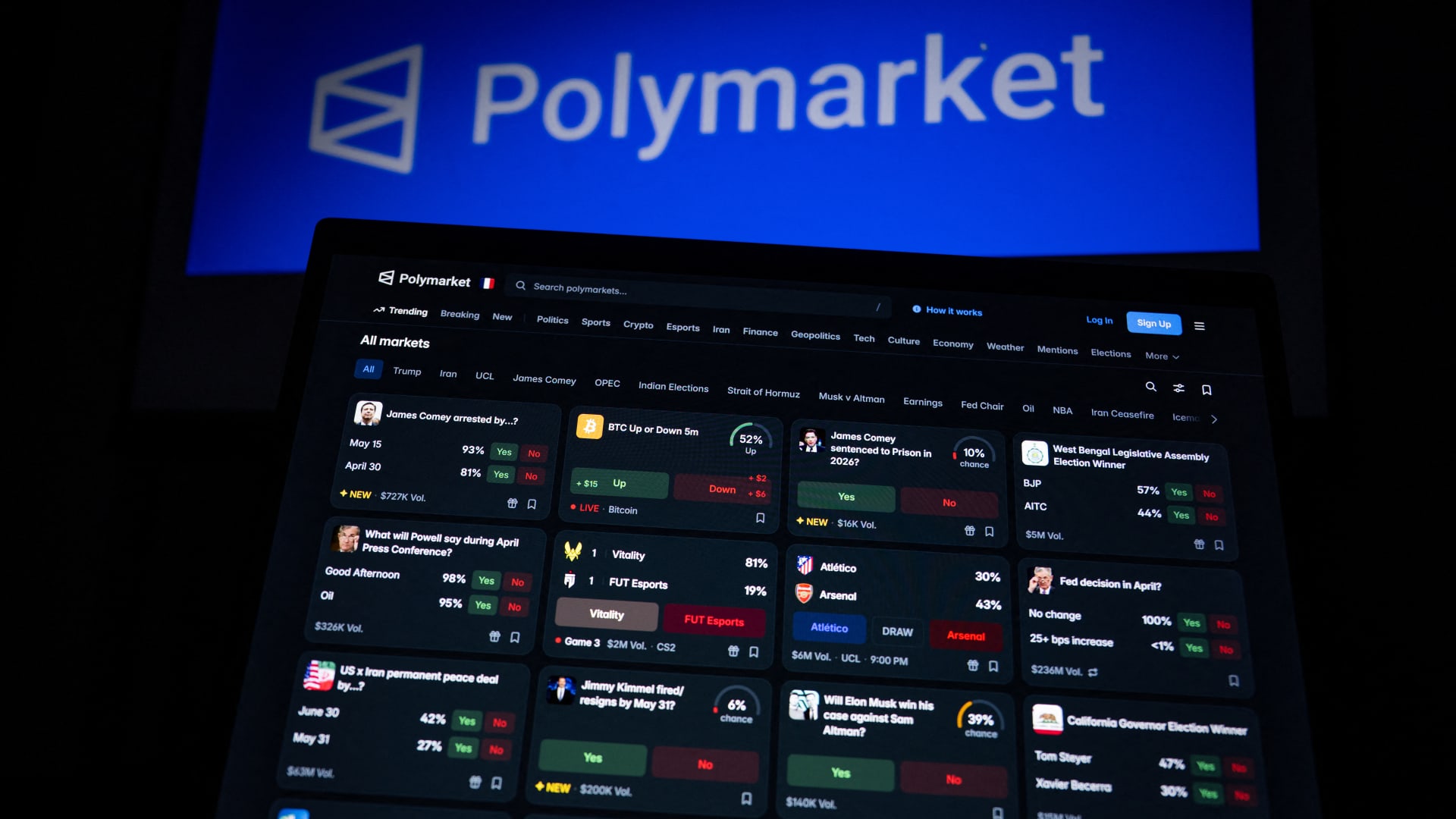

The Commodity Futures Trading Commission has been the lead regulator on event contract exchanges for over 30 years after it issued a 1992 ruling on the Iowa Electronic Markets, widely recognized as the first prediction market.
Now, as prediction markets are booming, legal experts increasingly speculate the CFTC’s sibling agency — the U.S. Securities and Exchange Commission — will have a role to play soon in this novel asset class.
“The CFTC has come out saying that they have jurisdiction over the event contracts, but there’s also some that seem like they’re more in the SEC’s realm,” said Joe Zales, a partner at King and Spalding.
This question isn’t just a hypothetical: it’s one that the two agencies are currently sifting through.
Last month, the SEC and CFTC issued a joint request for public comment regarding updating, clarifying and harmonizing certain definitions and issues. Included in the topics they’re reviewing are definitions related to swaps — the derivative that event contracts are classified as — along with the treatment of “novel or emerging products.”
Omar Marques | Lightrocket | Getty Images
A spokesperson for prediction market platform Polymarket confirmed to CNBC that the company has engaged with both the CFTC and SEC regarding definitional frameworks for prediction market products. Rival platform Kalshi declined to comment if it has interacted with the agencies or not on this matter.
Some companies are already using the SEC as the launching pad for their event contracts. CBOE in a filing is seeking to operate in the SEC’s regulatory orbit for creating binary options contracts on key performance indicators for a slew of major companies.
Jurisdictional questions existing between the SEC and CFTC aren’t new, especially when it’s about emerging asset classes. But while the two agencies have been in a similar position before, that doesn’t provide much direction on this issue.
“This is really a jump ball,” said Jeff Le Riche, a partner at Husch Blackwell and a former chief trial attorney at the CFTC. “Nobody knows how it’s going to turn out.”
The SEC’s potential
Why the SEC may have a role in regulating prediction markets — despite not having one at the moment — is thanks to the 2010 Dodd-Frank law. The law says that while the CFTC typically regulates swaps, the SEC has jurisdiction over securities-based swaps.
Securities-based swaps are financial contracts that have ties to a singular security. If an event contract asks questions about a publicly traded company, that may look more like a securities-based swap rather than a traditional one.
The seal of the U.S. Securities and Exchange Commission (SEC) is seen at their headquarters in Washington, D.C., U.S.
Andrew Kelly | Reuters
An easy example of this, according to legal experts, is a contract that asks traders, “Will Nvidia stock end the month up more than 5%?” That has a direct link to a publicly traded stock and the resolution of the prediction market depends on the shares’ performance.
But where it gets more complicated is that securities-based swaps also are defined as financial contracts that directly affect a company’s financial statements or conditions.
“The problem is that what ‘directly affects’ means has really been an open question,” said Sarah Razaq Sallis, also a partner at Husch Blackwell. “That ambiguity is exactly what’s being tested now in real time.”
Take, for example, a contract on when Apple will release its new iPhone model. That isn’t directly tied to the company’s share price, but when it may launch a highly anticipated product could impact Apple’s stock.
Whether that contract would be a securities-based swap or not will decide how large of a role the SEC potentially will play.
The SEC declined a request to comment from CNBC, while the CFTC didn’t respond to one.
A complicated history
If the SEC and CFTC split the work on prediction markets, it’s by no means unprecedented.
In the options market, the CFTC regulates futures contract-based options, while the SEC regulates those tied to securities.
But despite examples of the two working together, the sibling agencies have a decades-long rivalry on who is in charge of what.
The Commodity Futures Trading Commission headquarters in Washington, Dec. 23, 2022.
Ting Shen | Bloomberg | Getty Images
“These agencies have been at each other’s throat jurisdictionally,” said Jerome Tomas, a partner at Baker McKenzie and a former SEC employee. Most recently, the SEC and CFTC — before their harmonization efforts this year — clashed on who had jurisdictional control over cryptocurrencies.
That’s not to mention the two agencies work differently. The SEC is much larger, and has a longer history, while the CFTC is smaller and younger.
“The two agencies, while similar structurally, have very different approaches to regulation,” said Le Riche. “The way the rules are written at the CFTC and the way the rules are written at the SEC are fundamentally different approaches.”
In March, the two agencies announced they agreed to a memorandum of understanding to establish clear regulatory definitions and jurisdictional boundaries, along with coordinating on oversight and increasing data sharing. Experts are now watching for whether the two agencies will be able to work seamlessly together despite past regulatory battles.
“I think that they’re trying to make sure that they’re not stepping on each other’s toes or trying to duplicate work,” said Yelena Kotlarsky, a partner at King and Spalding.
This is a convenient time for two Republican-dominated agencies to cooperate, said Aaron Klein, a senior fellow at think tank Brookings Institution. Both agencies require a five-person commission board but currently have vacant positions.
Michael Selig, President Donald Trump’s nominee to lead the Commodity Futures Trading Commission speaks during a Senate Agriculture, Nutrition, and Forestry Committee hearing on Capitol Hill on Nov. 19, 2025 in Washington, DC.
Andrew Harnik | Getty Images
Only three out of five commissioners at the SEC are currently seated and all of them are Republican. Meanwhile CFTC Chairman Michael Selig, also a Republican, is the only sitting member of the typically five-member board. Selig previously served as a chief counsel for the SEC’s Crypto Task Force and was a senior advisor to SEC Chairman Paul Atkins.
“I think this is the easiest time for these two agencies to get on the same page,” Klein said.
More clarity, tighter protocols
Legal experts broadly say though that the SEC will likely take on a more supportive role in regulating prediction markets, while the CFTC retains its primary one. That may be welcome news for the very platforms who previously had to interact with one federal agency.
If the two agencies can avoid repeating past regulatory disagreements and provide clear definitions, the harmonization will be a benefit for prediction markets, said Peter Chan, a Baker McKenzie partner and former SEC employee.
Kalshi is the largest regulated prediction market in the U.S., while Polymarket derives much of its volume from its international exchange. Polymarket’s U.S. platform became available for domestic traders in May.
The Polymarket spokesperson added that the company is worried about potential duplicative or conflicting compliance requirements that could harm innovation. For that reason, it is encouraged by the agencies’ willingness to work together to create efficient and harmonious structures.
Kalshi and Polymarket.
Gabby Jones | Bloomberg | Martin Lelievre | Getty Images
Troy Dixon, co-head of global markets at Tradeweb Markets — a market infrastructure company that has a partnership with Kalshi — said getting clarification from the two agencies is critical for institutions who are looking to trade on prediction markets. Gaining Wall Street adoption has been a key priority for prediction market platforms of late.
“To the extent that the SEC actually chimes in, and there’s some sort of broad co-working between the two agencies… it expedites it pretty substantially,” Dixon said about institutional adoption.
Zales expects the SEC’s involvement can mean tighter protections for traders, including a more cumbersome account opening process on the prediction market platforms.
Despite the murky legal landscape, Chan believes the agencies should not rush to harmonize too quickly. Instead, he said the agencies should take the necessary time to understand the markets and products offered on event contract exchanges.
“I think what is required is not necessarily real time rule making, but I think it requires real-time learning,” Chan said.
Disclosure: CNBC and Kalshi have a commercial relationship that includes customer acquisition and a minority investment.