

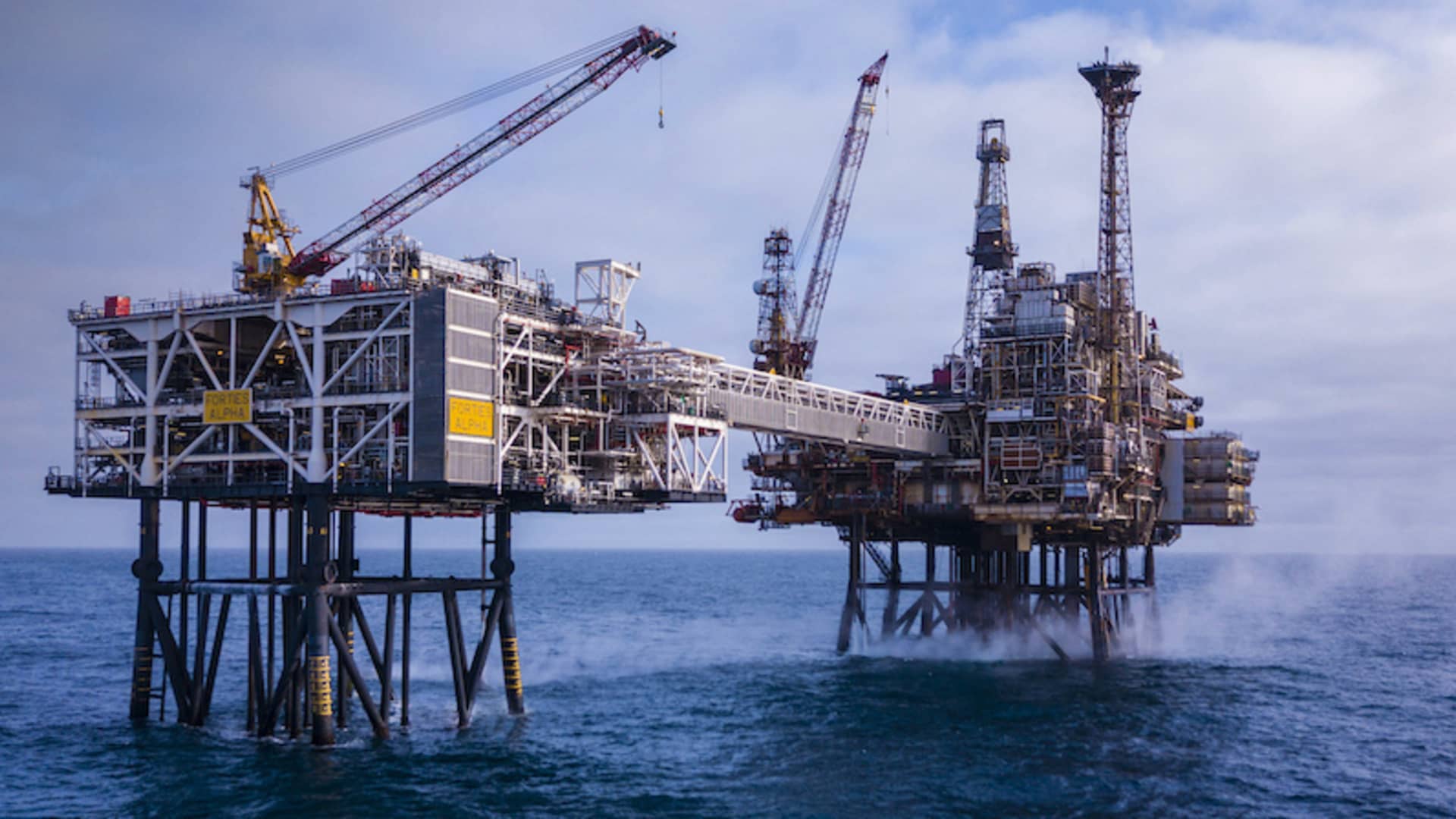
APA Corporation’s Forties Alpha oil platform in the North Sea.
Courtesy: APA Corporation
Oil prices climbed Monday after U.S. President Donald Trump threatened renewed military action against Iran, raising concerns about the durability of a fragile interim peace agreement reached last week.
Trump made the threat on Sunday, even as Vice President JD Vance met Iranian officials in Switzerland for the first talks under the interim accord. The meeting was overshadowed by Tehran’s announcement that it had once again closed the Strait of Hormuz, a key route for global oil shipments.
International benchmark Brent crude futures for August jumped 1.23% to $81.56 a barrel. U.S. West Texas Intermediate futures for July jumped 3.04% to $78.93 per barrel.

The discussions at the Swiss resort of Bürgenstock marked the first negotiations since Washington and Tehran signed a memorandum of understanding last week to end their conflict and extend a shaky ceasefire for at least 60 days.
The accord called for the reopening of the Strait of Hormuz and a halt to hostilities across the region, including in Lebanon. Iran, however, accused Washington of failing to ensure a ceasefire there and said the latest talks would focus only on implementing the memorandum rather than broader issues such as its nuclear program.
According to Quantum Strategy’s David Roche, Middle East oil supply is currently close to prewar levels once crude held in storage and aboard tankers is included. However, he warned in a report on Monday that the apparent abundance reflects inventory liquidation rather than a recovery in production, leaving the market vulnerable once those stockpiles are depleted.
While oil prices rallied on renewed tensions in the Middle East, Goldman Sachs noted that sustained supply shocks could ultimately accelerate the shift toward electric vehicles, eroding long-term crude demand and adding to downside risks for oil prices.