


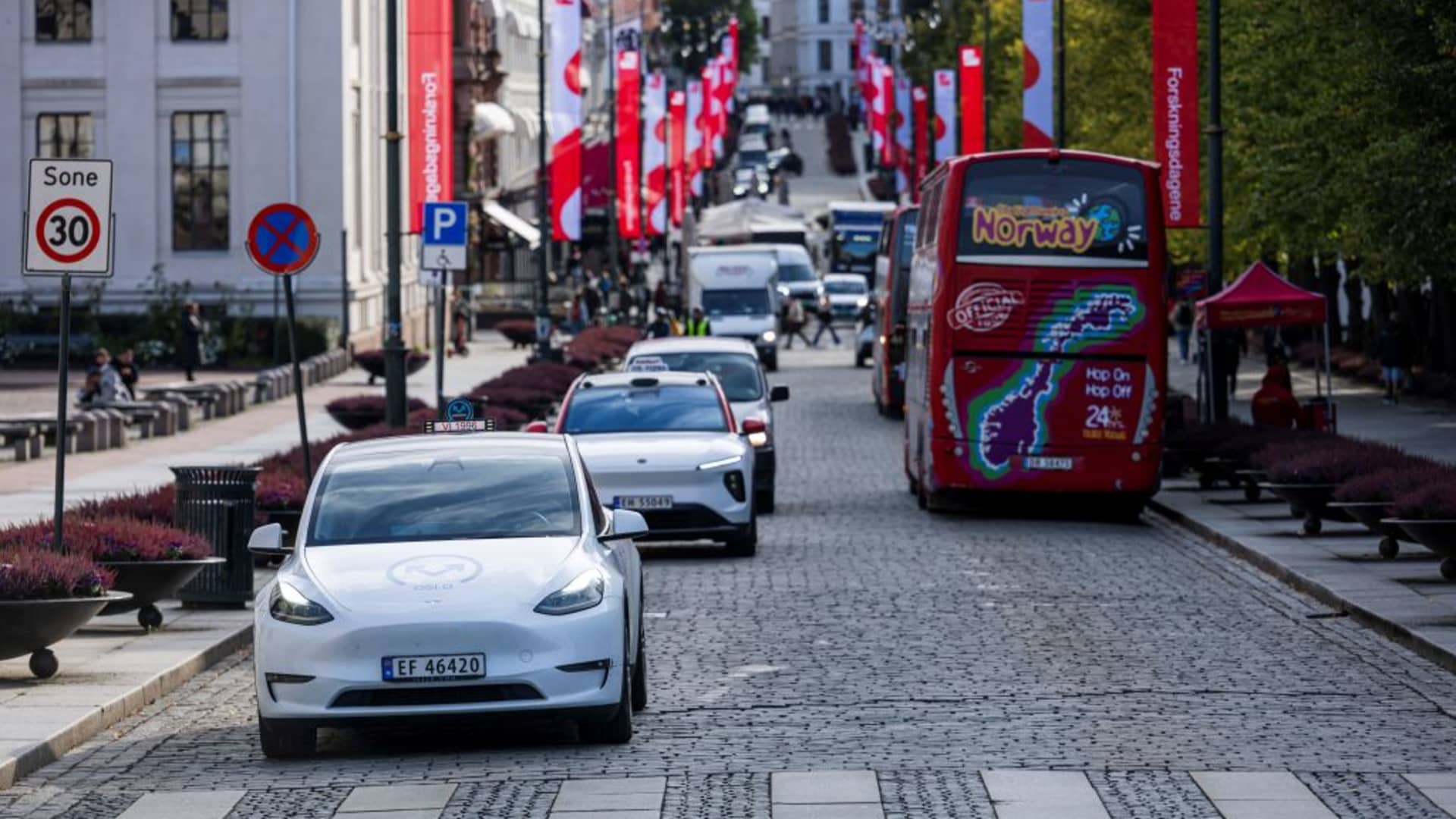
Oslo Taxi’s Tesla model Y (L) and the NIO ET5 electric vehicle from Nio Inc, a Chinese multinational electric car manufacturer, drive through the Norwegian capital Oslo, on Sept. 27, 2024.
Jonathan Nackstrand | Afp | Getty Images
OSLO, Norway — Electric vehicles are pretty much everywhere you look in Norway.
The wealthy Nordic country, which is known for its massive oil and gas reserves in the North Sea, has long been blazing a trail in the transition away from internal combustion engine (ICE) cars.
A steady stream of measures to support the uptake of EVs, from tax exemptions to reduced fees, has now put the country on the cusp of completely erasing gasoline and diesel vehicles from its new car market.
For some of the country’s major cities, about 30% of all passenger cars on the roads are now fully electric, according to Norway’s EV Association (NEVA), which represents electric car owners in the country. The rate in capital city Oslo, meanwhile, is as high as 40%.
It is perhaps no surprise then that standing at a crosswalk in Oslo’s city center means waiting for a near-constant stream of fully electric models to come to a stop.
“It is very visible. And I think some people don’t even really realize how good this is because it has happened quite fast,” Christina Bu, secretary general of NEVA, told CNBC during an interview at the association’s office in Oslo.
“The air is cleaner, it is quieter, and this is a change that hasn’t really cost consumers that much. They actually love driving an EV and it works quite well,” Bu said.
Norway’s sales of EVs have increased from less than 1% of total auto sales in 2010 to 88.9% last year — and this trend doesn’t show any sign of slowing.
Data published by the Norwegian Public Roads Administration, which is responsible for the country’s national road network, found that EVs accounted for more than 93% of the new cars sold in 2025 so far.
Cars that pollute are taxed out of business in Norway.
Christina Bu
Secretary general of Norway’s EV Association
By comparison, electric vehicle sales accounted for 15.4% of the total European Union market share in the first few months of 2025. Norway is not a member of the EU.
Stateside, the share of new passenger EV sales hit 10% in 2023, according to the Rocky Mountain Institute, up from 1% adoption as recently as 2017.
Tax incentives and public infrastructure
Norway’s State Secretary in the Ministry of Transport Cecilie Knibe Kroglund said the country’s success in transitioning away from combustion cars has been driven by long-term and consistent policymaking.
“We have a lot of tax incentives and user incentives, which are the most important things, and also infrastructure, of course,” Kroglund said during an interview in Oslo.
Tesla superchargers in Eidfjord village centre, these superchargers produce up to 150KW during vehicle charging.
Ucg | Universal Images Group | Getty Images
Some of Norway’s EV incentives include a VAT exemption, discounts on road and parking taxes and access to bus lanes. The government has also heavily invested in public charging infrastructure, and many Norwegian households are able to charge their cars at home.
The lack of an automaker lobby in Norway is also thought to have benefited the country’s EV adoption rate over the years.
NEVA’s Bu said last week that the country of about 5.5 million people achieved a new electric milestone of 10,000 fast chargers nationwide. The roll-out of these charging stations has not been consistent across the country, however, with far more installed in the south compared to the far north.
Nonetheless, the ever-growing number of fast-charging stations has defied concerns from critics who had previously warned that the power grid may not be able to cope.
“Norway has had strong policies for many years. It’s not just about tax exemptions [for EVs] but also higher and higher taxes on internal combustion engine cars. So, the last three years or so, the general purchase taxes have doubled – and it was already very high,” NEVA’s Bu said.
“Cars that pollute are taxed out of business in Norway,” she added.
Oslo Taxi’s NIO ET5 electric vehicle from Nio Inc, a Chinese multinational electric car manufacturer, drives through the Norwegian capital Oslo, on September 27, 2024.
Jonathan Nackstrand | Afp | Getty Images
Norway’s journey to becoming a global leader in EV adoption has not been without its critics, however.
Some lawmakers have raised concerns about the fairness of its EV incentives, saying they can disproportionately benefit higher-income individuals and potentially come at the expense of other, more sustainable transportation options, such as walking and cycling.
Norway, which is aiming for carbon neutrality by 2030, has also faced questions about its role in tackling the climate crisis. The country’s economy is heavily reliant on fossil fuel revenues, creating something of a contradiction with its stated green ambitions. The burning of fossil fuels such as coal, oil and gas is the chief driver of the climate crisis.
What’s next?
Looking ahead, Kroglund said the country plans to fully transition to electric city buses in 2025, while making heavy-duty vehicles 75% renewable by the end of the decade.
“We have to acknowledge that transport has a role in climate change. I think 30% of pollution comes from the transport sector, so we had to do something,” Kroglund said.
“We have to move forward on other parts of the transport sector, like city buses. We have good numbers on that too, but the next level is heavy-duty vehicles,” she added.