


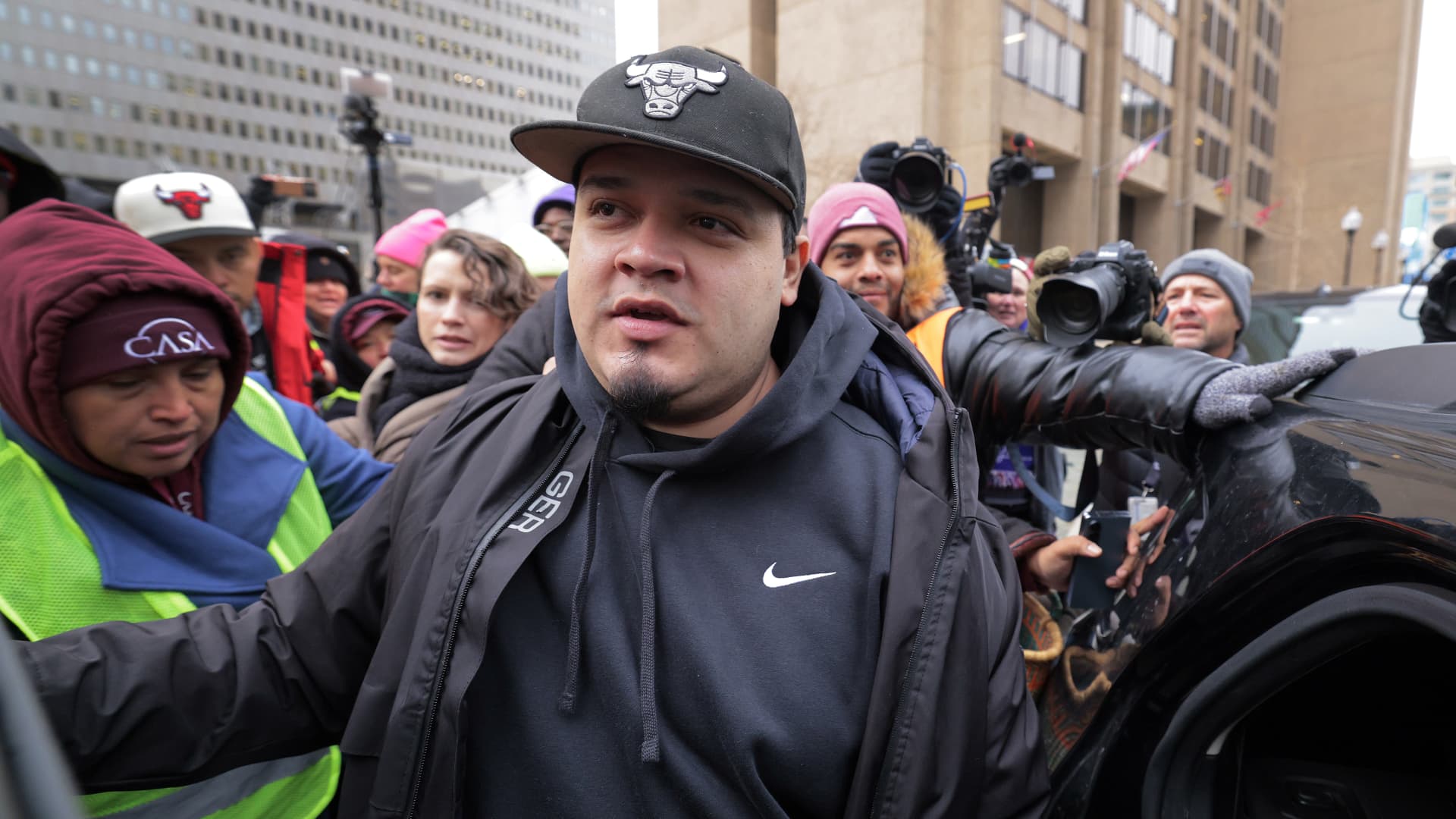
Kilmar Abrego Garcia leaves a check-in at the U.S. Immigration and Customs Enforcement Baltimore Field Office the day after a federal judge ordered his release from a detention in Pennsylvania, on Dec. 12, 2025 in Baltimore, Maryland.
Chip Somodevilla | Getty Images
A federal judge in Tennessee on Friday dismissed human smuggling charges against Kilmar Abrego Garcia, a Salvadoran migrant whose mistaken deportation by the Trump administration became a flashpoint in President Donald Trump’s broader immigration crackdown.
U.S. District Judge Waverly Crenshaw ruled that the Justice Department’s prosecution of Abrego Garcia was “vindictive,” finding that the government would not have brought the case had he not challenged his deportation.
“Then-Attorney General Robert H. Jackson warned his fellow prosecutors long ago of the danger of picking the person first and the crime second,” Crenshaw wrote at the top of the 32-page ruling. “That is the situation here.”
The DOJ plans to appeal, saying in a statement that “another activist judge has placed politics above public safety. The judge’s order is wrong and dangerous, and we will appeal.”
Crenshaw said the record showed that the government closed its investigation into a November 2022 Tennessee traffic stop after Abrego Garcia was removed from the U.S., only to reopen it after he sued the Trump administration over his removal to El Salvador.
“Kilmar Abrego Garcia is a victim of a politicized, vindictive White House and its lawyers at what used to be an independent Justice Department,” Abrego Garcia’s legal team told MS NOW. “As this Administration continually chips away at our democracy, we remain grateful for an independent judiciary that will dispassionately apply binding precedent to the facts.”
The decision marks a major legal win for Abrego Garcia, who was deported to El Salvador in March 2025 despite a prior court order barring the U.S. government from sending him there because he could face persecution.
The Trump administration later brought Abrego Garcia back to the U.S. in June 2025 after the Supreme Court ordered officials to facilitate his return. But prosecutors first secured a criminal indictment accusing him of human smuggling.
Abrego Garcia pleaded not guilty and argued the charges were retaliation for his fight to return to the U.S. Crenshaw agreed, handing the Justice Department a setback in a closely watched Trump immigration case.
In his ruling, Crenshaw said the record did “not explain the Government’s change in position to remove Abrego and not prosecute him to then prosecute and not remove him,” adding that a “retaliatory taint” kicked off the renewed investigation.
The judge also scrutinized the role of senior Justice Department officials, writing that statements by then-Deputy Attorney General Todd Blanche, who is now acting attorney general, and actions by Associate Deputy Attorney General Aakash Singh raised questions about the decision to reopen the investigation and seek an indictment.
“The objective credible evidence shows that Main Justice was involved in the investigation before McGuire,” Crenshaw wrote, referring to Robert McGuire, the U.S. attorney who led the prosecution.
Crenshaw added that Singh’s involvement “touched on everything from the timing of the indictment to the substance of the potential charges.”
Without bringing up Abrego Garcia, Trump continued to defend the aggressive immigration policies that have made the case a flashpoint at a campaign appearance in Suffern, N.Y., where is was speaking shortly after the charges were dropped.
“Illegal aliens are all over the place, people are getting shot left and right,” Trump said on stage.
The White House deferred to the DOJ’s statement.