

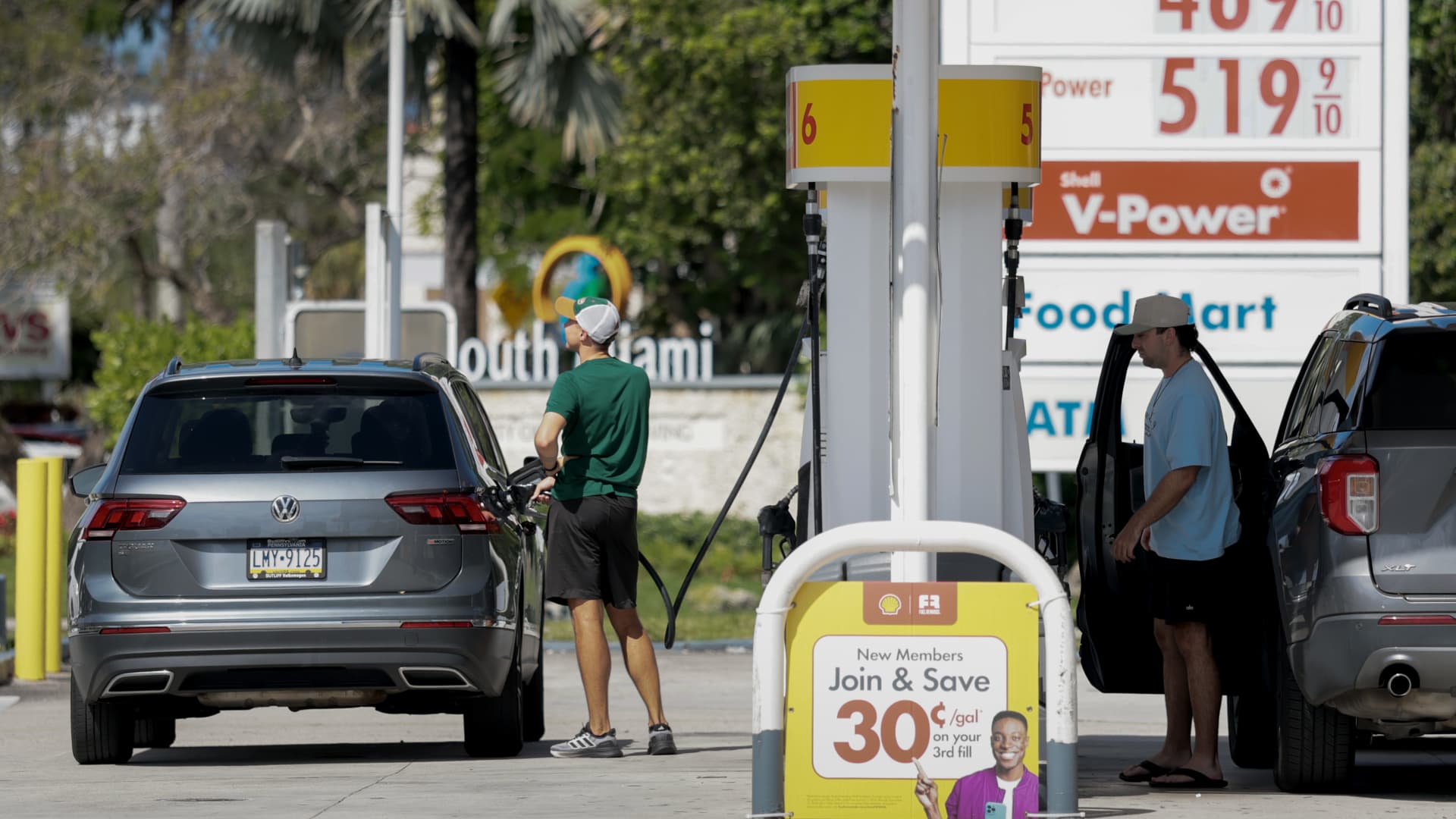
Fuel prices are displayed on a sign as customers fill their vehicles at a gas station on April 13, 2026 in Miami, Florida.
Joe Raedle | Getty Images
Inflation jumped in April to the highest level in nearly three years as surging gas prices due to the Iran war pushed up the cost of many consumer goods.
The consumer price index, a key inflation measure, rose 3.8% in April from a year earlier, the U.S. Bureau of Labor Statistics reported Tuesday. That’s up from 3.3% in March.
The April data paints a clearer picture of the financial fallout for consumers after, at that point, more than a month of conflict in the Middle East.
“American households are going to continue to struggle trying to manage through this, and that’s going to be the case for the foreseeable future,” said Mark Zandi, chief economist at Moody’s.
High oil prices create a ‘double squeeze’
Earlier this week, President Donald Trump rejected Iran’s latest proposal to end the war, sending oil futures higher.
Iran has continued to restrict energy supplies through the Strait of Hormuz, a waterway used to transport about a fifth of the world’s oil. “It’s like the aorta artery in your body,” said Brian Bethune, an economics professor at Boston College. “When that is choked down, it is the whole global economy that is affected.”
Oil prices — as measured by Brent crude oil, a global price benchmark — spiked to $118 per barrel by the end of April from roughly $70 per barrel before the conflict began. Prices remain above $107 a barrel as of early Tuesday.
Products refined from oil, such as gasoline and jet fuel, have risen sharply, too.
Gas prices soared about 50% since the war with Iran began on Feb. 28 and are up 28.4% over the year, according to the CPI data.
Consumers paid a national average of $4.50 per gallon as of Tuesday, according to AAA — up from about $3.14 a year ago.
Airline fares also rose 20.7% over the past 12 months, according to the CPI data.
The sudden and steep rise is an example of how the cost of jet fuel is being passed directly to travelers, said certified financial planner Stephen Kates, a financial analyst at Bankrate.
“Consumers are currently trapped in a ‘double squeeze,’ wrestling with both the acute pain of the gasoline price spike and the slow rise in other core budget items,” Kates said. “Households will find it harder to shift budget dollars from one category to another when most major categories are becoming more expensive at the same time.”
The Iran war’s effect on food prices
As the conflict persists, the oil shock has put upward pressure on food prices, as well, economists said.
For example, an increase in diesel prices affects the transportation costs of trucking food to grocery stores, according to Boston College’s Bethune.
“It takes some time for the fuel surcharges that are built into these contracts to work their way through the system,” Bethune said.
Additionally, fertilizer is another key export through the Strait of Hormuz, threatening to raise prices for farmers.
A customer shops for beef at a grocery store on April 6, 2026 in Los Angeles, California.
Justin Sullivan | Getty Images
“You can see the pass-through gaining momentum,” Zandi said.
Food prices increased 3.2% over the last year, according to the CPI data.
“For most families, what matters most is the cost of a gallon of unleaded gas and a pound of beef, and both are up quite a lot,” Zandi said. Beef prices rose 14.8% year over year, according to the CPI data.
Inflation may unwind slowly
Economists say that the inflationary effects of the war could take weeks or months to unwind.
Even if more oil tankers get through the Strait of Hormuz, it may be a while before the whole supply chain starts working again, Bethune said.
“If we get some resolution, optimistically, within the next few weeks, it then might be two months for things to start to normalize,” Bethune said.
“The pessimistic scenario is at least double that or even longer — that could be six to nine months to get back to where we were in January or February,” he said.
The Fed under pressure
The latest inflation reading only reinforces expectations that the Federal Reserve will keep interest rates unchanged for a while — doing little to ease consumers’ current affordability challenges.
“The Federal Reserve, soon to be led by Kevin Warsh, is in a very difficult position because it cannot ignore an annual inflation rate climbing back toward 4%,” said Bankrate’s Kates.
“The trajectory of inflation will not immediately reverse, even if geopolitical tensions ease, making it highly unlikely that we will see any interest rate cuts this year,” he said.