

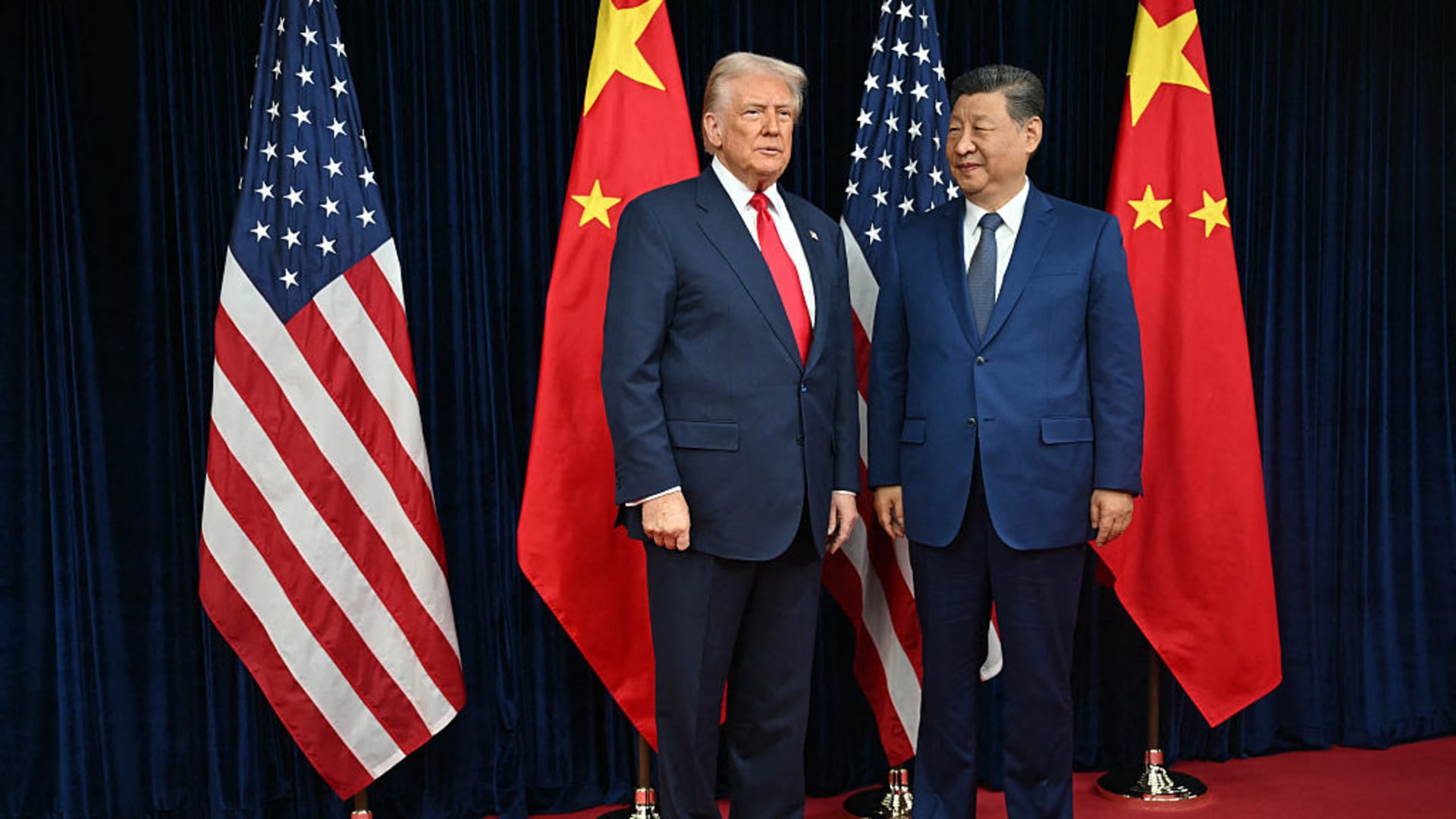

Treasury Secretary Scott Bessent said Monday that the meeting between President Donald Trump and Chinese Leader Xi Jinping could be delayed for logistical reasons. Bessent spoke during an appearance on CNBC’s “Squawk Box.”
Trump suggested on Sunday that the summit could be delayed as the U.S. pressures China to help reopen the Strait of Hormuz. Bessent walked those comments back on Monday, arguing the summit would be delayed if Trump chooses to stay in Washington to coordinate the war effort in Iran.
“If the meetings are delayed, it wouldn’t be delayed because the president demanded that China police the Strait of Hormuz,” Bessent said in an interview with CNBC’s Brian Sullivan in Paris. “If the meeting, for some reason, is rescheduled, it would be rescheduled because of logistics.”
“It would be a decision the president made as commander in chief to stay in the White House or to stay in the United States while this war is being prosecuted,” he said.
The comments also indicate that the White House is anticipating the war — which Trump initially said would last for days — will be an ongoing concern a month after it began.
The Trump-Xi meeting is scheduled to take place in China as the U.S. president carries out an assault on Iran that has largely shuttered the Strait of Hormuz and sent global oil prices soaring. The strait carries roughly 20% of the world’s oil, and has remained largely impassible during the war.
The China visit, scheduled for March 31-April 2, would be the first for a U.S. president since Trump went to the country in 2017. The president met with Xi in South Korea five months ago, where the two sides agreed to a temporary truce in a trade war that saw tariffs between the world’s two largest economies briefly soar to triple-digit figures.
Trump said Sunday on Air Force One that other countries should help the U.S. unlock the Strait of Hormuz for shipping. He singled out China in those remarks.
“Why are we maintaining the Hormuz Strait when it’s really there for China and many other countries? Why aren’t they doing it?” he said.
The U.S. and China have built up pressure ahead of the summit. The Trump administration announced last week that it was opening new trade investigations into China and more than a dozen other countries after its initial tariff tool was found unlawful by the Supreme Court — wiping out swaths of the president’s levies.
The investigation is taking place under Section 301 of the Trade Act of 1974, which allows the U.S. to impose tariffs on countries it has found to engage in unfair trade practices.
China said it would respond to the U.S. investigations, which it said were “extremely unilateral, arbitrary and discriminatory.”
The U.S. and China also continue to tangle over artificial intelligence, with Washington seeking to limit Beijing’s access to advanced U.S. chips and other goods. China has frequently been on the receiving end of Trump’s tariffs during his two terms in the White House.
Bessent was in Paris meeting with his Chinese counterparts. The Treasury chief said those meetings went well and urged the markets not to react negatively should the Trump-Xi summit be postponed.
“We had a very good two days here,” he said. “We’ll be issuing a statement in the next few days, and we’ll be reaffirming the stability in the relationship between the first and second largest economies in the world.”