

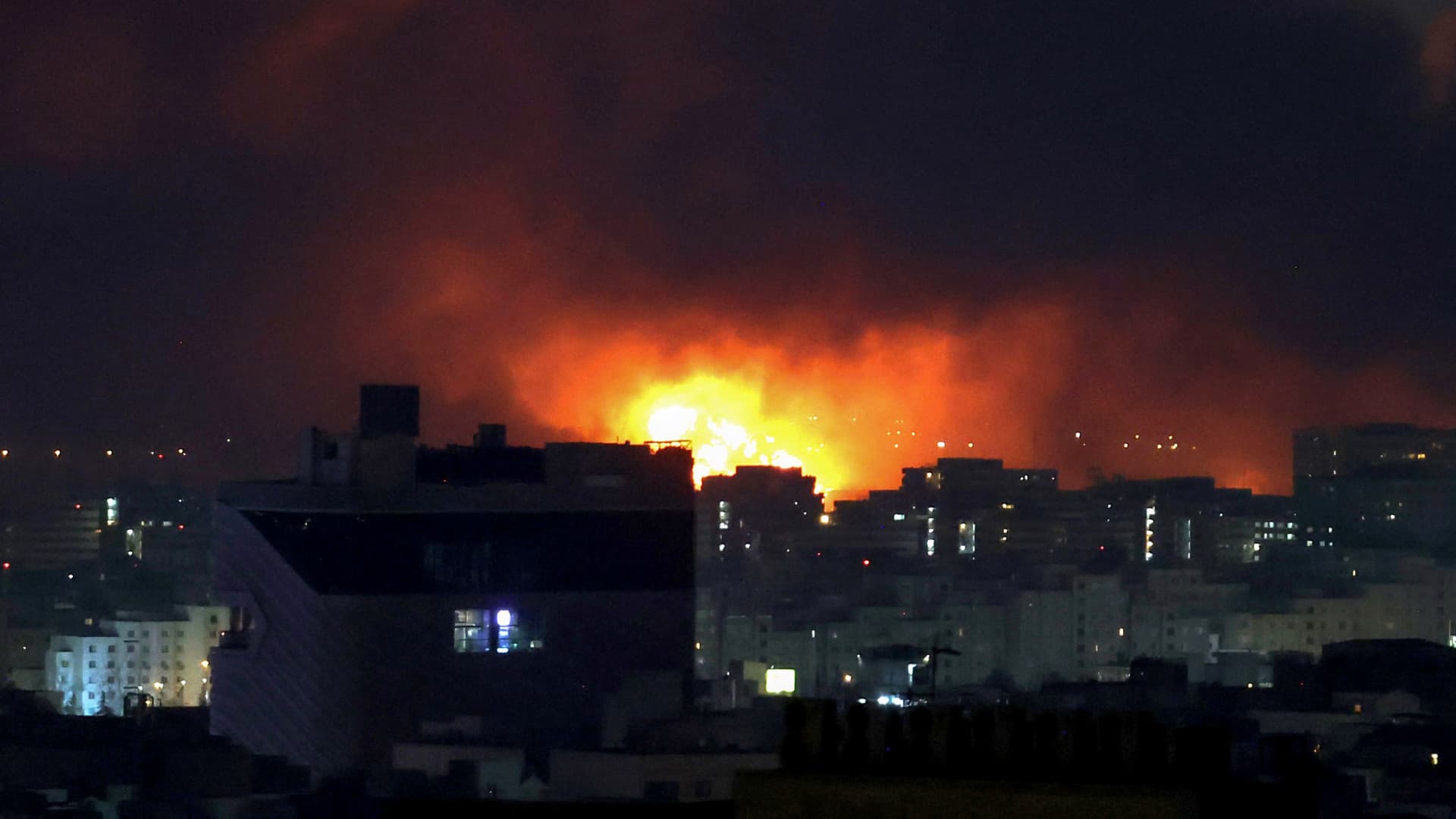
Smoke and fire rise from the site of airstrikes at Mehrabad International Airport in Tehran on March 7, 2026. (Photo by ATTA KENARE / AFP via Getty Images)
Atta Kenare | Afp | Getty Images
U.S. and Israeli airstrikes on Iran continued on Saturday, one week after they launched their joint campaign to rid Tehran of its nuclear and ballistic missile capabilities while also pushing for regime change.
Tehran’s energy-rich neighbors in the Gulf said they intercepted more missiles and drones headed for their airspace from Iran as the country’s president reportedly apologized for the attacks.
“U.S. forces have struck over 3,000 targets in the first week of Operation Epic Fury, and we are not slowing down,” U.S. Central Command said in a post on X.
President Donald Trump on Friday demanded unconditional surrender from Iran, raising fears of a prolonged war that could wreak havoc on the global oil and gas market. The war has already brought traffic in the Strait of Hormuz, a critical shipping route for energy supplies, to a near standstill.
Israel’s military said “another wave of attacks in Tehran has been completed”.
“Within the framework of these attacks, Air Force fighter jets launched approximately 230 munitions toward several military sites of the regime,” the Israel Defense Forces said in a Farsi post on X.
The targets included the Central Military University of the Islamic Revolutionary Guard Corps, a missile storage site and an underground site for storing and producing ballistic missiles, the IDF said.
The strikes involved more than 80 Israeli fighter jets, the IDF said in a separate post.
“These strikes degrade the Iranian regime’s ability to fire at Israeli civilians,” the IDF said.
Gulf region under threat
Countries in the region said they launched air defenses to fend off Iranian attacks.
Saudi Arabia’s Ministry of Defense reported the “interception and destruction of a drone east of Riyadh city”.
The United Arab Emirates, Saudi Arabia’s neighbor to the north, said its air defenses responded to “incoming missile and drone threats from Iran.”
“The [Ministry of Defense] asserts that the sounds heard are the result of the Air Defence systems intercepting missiles and drones,” the UAE said.
The country’s biggest city, Dubai, issued an alert urging residents to seek immediate shelter in secure buildings and stay away from windows, doors and open areas.
Dubai-based airline Emirates said it suspended all flights to and from the city.
Iran’s president Masoud Pezeshkian reportedly said the U.S.’ demand for an unconditional surrender is a “dream that they should take to their grave”.
Pezeshkian made the statement in a prerecorded address aired by state television, The Associated Press reported.
He also apologized for Iran’s attacks on regional countries, insisting that Tehran would halt them and suggested miscommunication in the ranks caused them, the AP said.
U.S. crude oil on Friday posted its biggest weekly gain in futures trading history, as the escalating war in the Middle East has triggered a major disruption to global fuel supplies.
U.S. crude soared 35.63% for the biggest weekly gain in the history of the futures contract dating back to 1983. Brent jumped about 28% for its biggest weekly gain since April 2020.
West Texas Intermediate futures surged 12.21%, or $9.89, to close at $90.90 per barrel. Global benchmark Brent rallied 8.52%, or $7.28, to settle at $92.69 per barrel.