


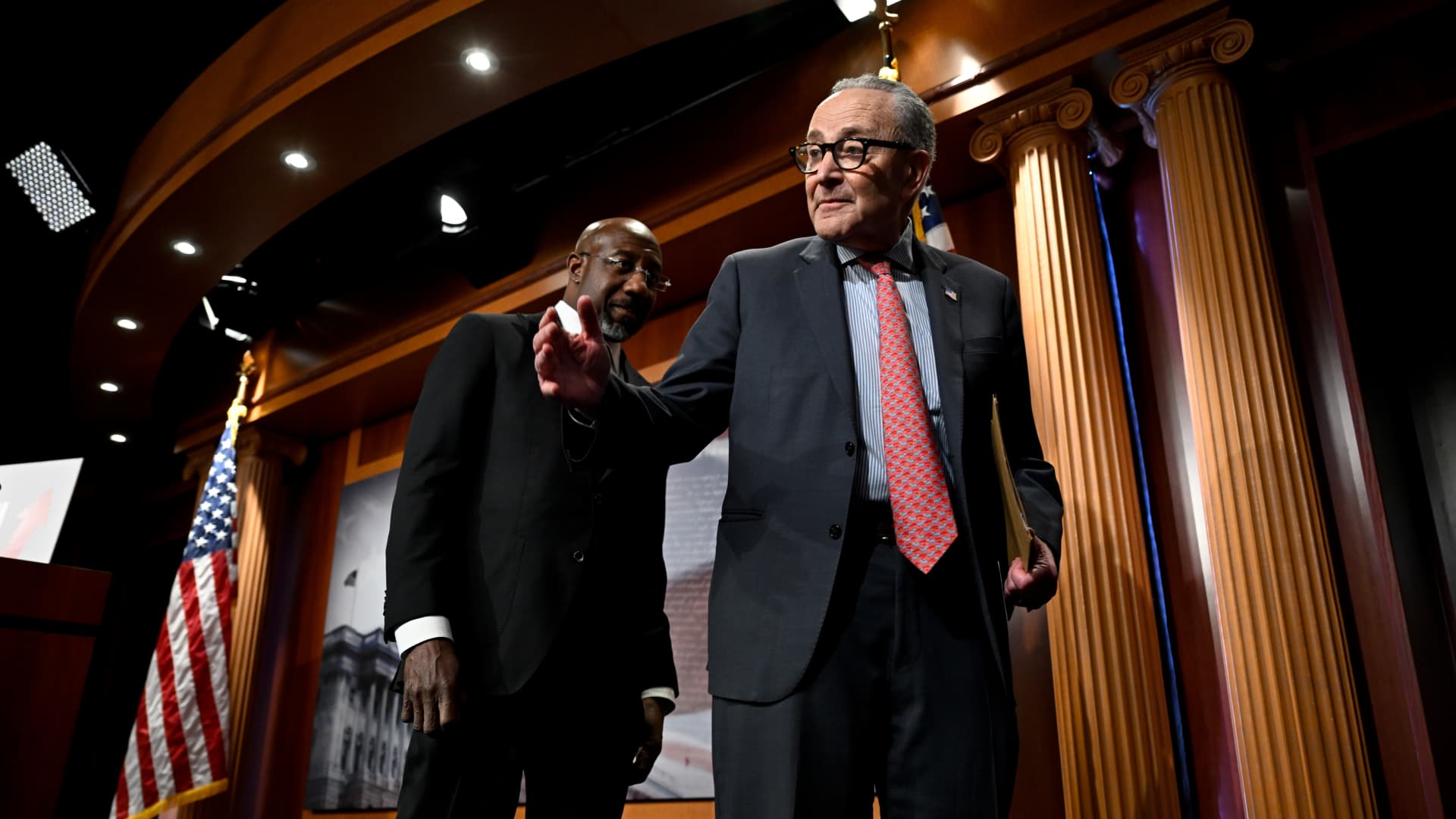
Senate Minority Leader Chuck Schumer, a Democrat from New York, right, and Sen. Raphael Warnock, a Democrat from Georgia, depart following a news conference at the Capitol on Dec. 11, 2025. The Senate rejected a Republican plan to replace expiring Obamacare subsidies with federally funded health savings accounts, teeing up a vote later in the day on a Democratic bill to extend the tax credits.
Daniel Heuer/Bloomberg via Getty Images
Democrats and Republicans seem to be at an impasse over whether and how to extend enhanced premium subsidies for health insurance bought on the Affordable Care Act marketplace, as a key enrollment deadline to secure coverage fast approaches. Policy experts say affordability is at the epicenter of that fight.
The political squabbling appears to be a sort of “proxy debate” over the high and rising costs of health insurance and health care in the U.S., said John Graves, a professor of health policy and medicine at Vanderbilt University.
“The beating heart of this debate is, where are we as a country in terms of how we should help people afford their health insurance?” Graves said.
Senate fails to advance health legislation
Two dueling health measures failed in the Senate on Thursday, making it increasingly likely that enhanced subsidies would expire at year’s end as scheduled and that health care will be a key political talking point ahead of next year’s midterm elections.
ACA enrollment has increased nationwide since 2020 but has been concentrated in states that President Donald Trump carried in the 2024 election, accounting for 88% of the enrollment increase during those five years, according to KFF, a nonpartisan health policy research group. Enrollment has tripled in Texas, Mississippi, West Virginia, Louisiana, Georgia and Tennessee, it said.
Democrats proposed a three-year extension to the enhanced subsidies, which lower insurance premiums for ACA enrollees.
About 22 million people, roughly 92% of total enrollees, received those subsidies in 2025. KFF estimates subsidy recipients’ premiums would more than double in 2026 without the subsidies.

Republicans proposed a plan that would scrap the enhanced subsidies and instead issue payments of up to $1,500 in consumers’ health savings accounts.
Both measures failed to garner enough votes, though four Republicans (Senators Susan Collins of Maine, Josh Hawley of Missouri, and Lisa Murkowski and Dan Sullivan of Alaska) voted in favor of the Democrats’ plan.
“It is hard to see how a bill can come together — and pass — by this time next week, which is when Congress is set to leave for the year,” Chris Krueger, a strategist at Washington Research Group, which provides policy analysis for investors, wrote in a research note Thursday.
“So we will start 2026 with the threat of a government shutdown at the end of January having failed to address the core issue of the 43-day shutdown: the ACA subsidies/credits,” he added.
24 million people have ACA health insurance
The ACA, also known as Obamacare, set up a marketplace for private health insurance as a sort of last resort for those who can’t buy it elsewhere, perhaps via an employer or a public plan like Medicaid or Medicare.
About 24 million people bought insurance on the ACA marketplace in 2025, including small-business owners, early retirees, gig workers, freelancers and others
That share is small relative to other channels.
About 68 million people were covered by Medicare Parts A and/or B in 2024, and 82 million by Medicaid and the Children’s Health Insurance Program, according to the Centers for Medicare & Medicaid Services.
Most people get insurance through an employer.
About 154 million people under age 65 had employer-sponsored health coverage in 2025, according to KFF.
Employees also get health subsidies, tax breaks
Workers with employer-sponsored health insurance generally get subsidized coverage, similar to ACA enrollees who receive premium tax credits, said Gerard Anderson, a professor of health policy and management at the Johns Hopkins Bloomberg School of Public Health.
The average annual premium for employer-sponsored family coverage totaled about $27,000 in 2025, according to KFF. This is coverage for a family of four.
But workers don’t pay the full sum. They contributed just $6,850 — about 25% — toward the total premium, according to KFF. Employers subsidized the rest, paying about $20,000, on average.
By comparison, if the enhanced ACA subsidies expire next year, the average family of four earning $130,000 would pay the full, unsubsidized premium for marketplace coverage.
Their annual insurance premiums would jump to about $23,900, more than double the subsidized cost of $11,050 — an increase of almost $12,900, according to the Center on Budget and Policy Priorities.
“If we put the ACA people in the same boat as most of us, then the enhanced subsidies make a lot of sense,” Anderson said. “They make it so it’s very much like [those] that have private insurance through our employer.”

Most workers with employer-sponsored coverage get another subsidy, too.
The federal government typically excludes workers’ health premiums from their taxable income and payroll tax. That applies to about 90% of workers enrolled in employment-based coverage, according to 2022 data from the Congressional Budget Office.
It’s among the federal government’s largest tax expenditures, according to the CBO. The tax break will cost the federal government $3.9 trillion over the next decade, and $5.9 trillion when also accounting for lost payroll taxes, according to an October analysis from the Tax Foundation.
Extending the current ACA enhanced premium tax credits for a decade is estimated to cost about $350 billion, from 2026 to 2035. That’s in addition to the $1 trillion of premium tax credits over the next decade, according to the Tax Foundation.
Why ACA enhanced subsidies are like a ‘social contract’
ACA subsidies, also known as premium tax credits, have been available since 2014, in the early days of Obamacare.
Congress offered enhanced subsidies starting in 2021 during the Biden administration as part of a Covid-19 relief package. Democrats extended them the following year through 2025.
The enhanced subsidies became available to more households and capped out-of-pocket premiums at 8.5% of household income. Previously, recipients’ out-of-pocket costs were capped at about 9.5% of income.
“The United States during the pandemic temporarily entered, essentially, a social contract,” Graves said. “And that contract says, through the design of these enhanced subsidies, that no American should have to pay more than a certain percentage of their income for their health insurance.”
President Joe Biden holds out his pen to Sen. Joe Manchin, D-W.V., as Senate Majority Leader Chuck Schumer, D-N.Y., and U.S. House Majority Whip James Clyburn, D-S.C., look on after Biden signed “The Inflation Reduction Act of 2022” into law during a ceremony in the State Dining Room of the White House in Washington, Aug. 16, 2022.
Leah Millis | Reuters
Households earning more than 400% of the federal poverty line — about $62,600 for a single person or $128,600 for a family of four — weren’t previously eligible for any assistance. The enhanced subsidies offered aid to these mid and higher earners for the first time.
Allowing the subsidies to expire would expose families to the “full force” of premiums, said Nick Fabrizio, a health policy expert and associate teaching professor in Cornell University’s Jeb E. Brooks School of Public Policy.
Premiums vary broadly due to factors like age, income and geography.
The average person would see their annual out-of-pocket premiums jump to about $1,900 in 2026 from nearly $900 in 2025 if enhanced subsidies disappear, according to KFF.
Those over 400% of the poverty line would lose access to premium tax credits entirely. In other words, they’d pay the full, unsubsidized premium.
“They’ll have to fund it [if the government doesn’t], and they don’t have the money to fund it,” Fabrizio said.
Consumers have a Dec. 15 deadline to pick an ACA marketplace health plan to ensure their coverage starts at the beginning of 2026. Anyone who enrolls between Dec. 16 and Jan. 15 wouldn’t see their coverage start until February.
Why ACA enhanced subsidies are a ‘Catch 22’
Fabrizio said extending the subsidies is “necessary” to shield people from sharply higher premiums next year, since there’s little time for Congress to craft and adopt an alternative plan.
However, Fabrizio also said that such a move would be “incomplete” since it wouldn’t do anything to address structural issues in the health-care system that will continue to cause prices to rise quickly.
“We’re really in a Catch 22,” he said. “It’s like putting a Band-Aid over a really large wound.”
The beating heart of this debate is, where are we as a country in terms of how we should help people afford their health insurance.
John Graves
professor of health policy and medicine at Vanderbilt University
Republicans’ idea to give money directly to consumers in the form of HSA payments is a “great” one intended to take power away from insurance companies, Fabrizio said. But that also has its shortfalls, he said.
For example, HSAs are only available to people with high-deductible health plans, which generally carry high up-front costs for consumers before their insurance pays for care.
“Many Americans can’t afford that,” Fabrizio said. “Also, it’s not well-suited for people with chronic conditions like diabetes, heart disease, cancer.”