



-

Dan Wetzel
Ideally, college basketball would have arranged itself so that teams would not add players from European pro leagues in the middle of the season.
Your roster, let’s say, November 1st, is your roster. Is that too much to ask? After all they have trade deadlines and signing windows in the NBA and NFL. How about this: Even if you enter the NBA Draft, you can’t play college ball.
Of course, ideally, the NCAA and college sports leadership – from conference commissioners to high-powered athletic directors to famous coaches – would have, at least by the late 2010s, recognized that change was inevitable and begun planning for it.
Instead, they whined, complained and, in a perpetual pursuit of control (especially money), kept losing arguments, fighting losing battles and allowing delusions to overtake them.
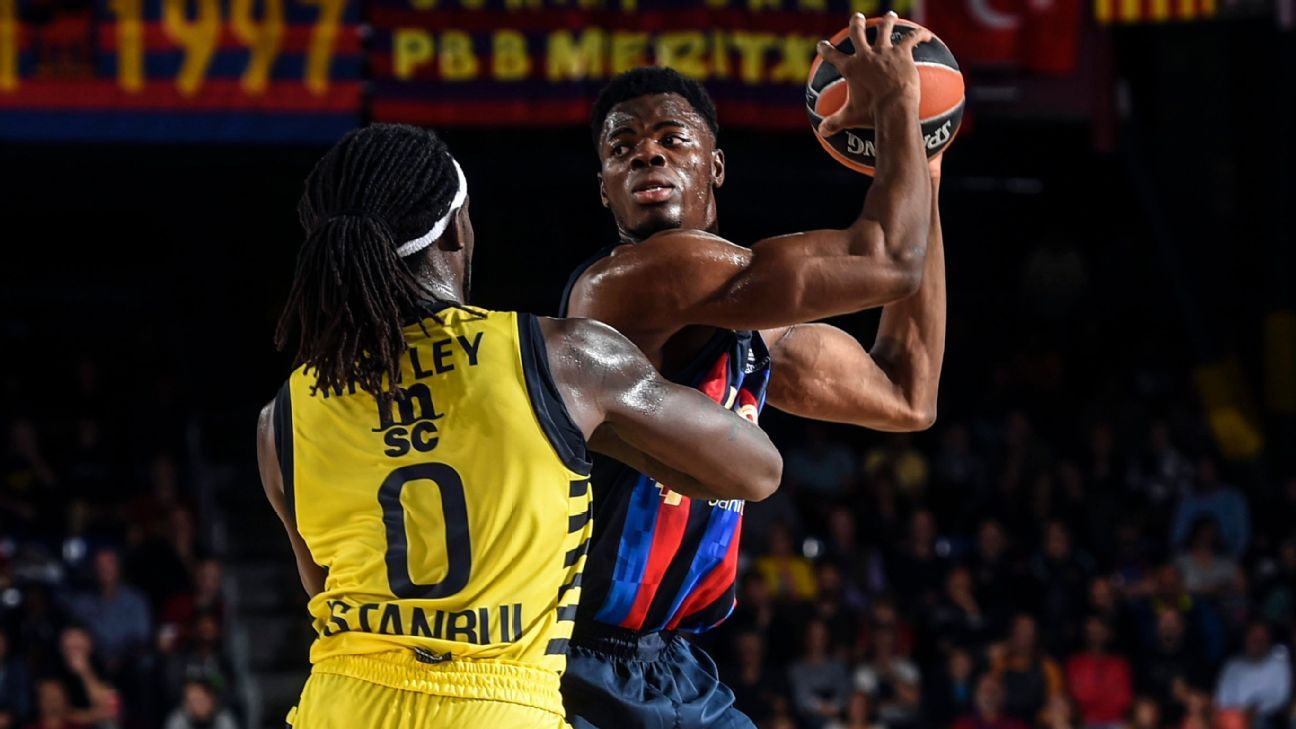
So Baylor got a stocking (and hoop) stuffer on Christmas Eve when it announced it had signed 21-year-old, 7-foot center James Nnaji. You may remember him as the 31st pick of the 2023 NBA Draft.
Detroit picked him up that night. He was later traded to Charlotte and then to the New York Knicks. Nnaji has never seen NBA minutes (besides the Summer League), but has been playing pro ball in Europe since 2020.
Somehow, Nanaji has four years of college eligibility left. sure why not? What is LeBron’s status?
Nnaji is expected to join the Bears on the court for Big 12 play next week.
“Santa Claus is delivering a mid-season takeover,” Connecticut coach Dan Hurley quipped on social media.
“I just know they told us he could play, so I’m happy,” Baylor coach Scott Drew said.
Don’t blame Drew. He didn’t make the rules. This is all absolutely legal. Drew has a responsibility to his players, not to mention his school, to surround them with the best talent. So he did the same.
Additionally, Baylor is not the only team to bring in professionals from Europe, even mid-season. Oklahoma just signed a Russian center. Others, including Dayton, BYU and Kansas State women’s hoops, have done the same.
It may be upsetting, but the world is not ending. Nnaji, who attracted everyone’s attention, has averaged only 3.4 points per game as a professional player. Set up with thought and structure, granting eligibility to guys like him isn’t an entirely bad idea either – college hockey is loaded with NHL draft picks.
Although done this way?
“This is crazy!!” Hurley wrote.
It definitely feels that way.
The blame lies with the “leadership” of college sports, which has spent the last few decades trying to hold on to amateurism, an outdated concept that was almost certainly doomed in the face of legal challenges.
The first came back in 2009, when former UCLA men’s basketball player Ed O’Bannon filed a lawsuit to argue that the NCAA was selling his name, image, and likeness in a video game (which they were, As a judge ruled in 2014). The writing was on the wall. Public sentiment rapidly turned against the NCAA.
Yet rather than accept the need for a new way of doing business, the NCAA became more entrenched. Instead of sharing the video game’s revenue, the game was canceled.
College sports took a tough stance, continuing to invest millions in ill-fated legal defenses, and afterward, Washington lobbyists happily cashed checks and sold pipes and dreamed that Congress would save them.
For example, the NCAA argued before the United States Supreme Court that the Sherman Antitrust Act should not apply to college athletics because if an athlete was ever compensated for anything, even cash prizes won through academic competitions or legitimate endorsement opportunities, fans would be outraged.
Apparently Caitlin Clark’s State Farm ad was not a marketing boon for women’s basketball, but an existential threat.
“This argument is circular and irrelevant,” Justice Brett Kavanaugh wrote in 2021, concurring in a 9–0 decision against the NCAA. “…Businesses anywhere in America cannot get away with agreeing to not pay their workers the fair market rate on the principle that their product is defined by not paying their workers the fair market rate.”
Since the courts were almost universally against them, the NCAA turned to Congress, seeking antitrust exemptions. Lobbyists were hired. The senators were felicitated. Some dog and pony show hearings were held.
None of the laws even came close to being passed. It was a complete and predictable waste of time and money.
O’Bannon just wanted a fair cut, but the NCAA has lost several eligibility fights due to its opposition to the Sherman Antitrust Act (which has been in existence since 1890), which has virtually changed the way the game is played.
In the simplest terms, the NCAA can’t stop anyone from making a living, which means it can hardly stop anyone from playing for them and thus – earning a living.
That reality opened the door to immediate eligibility for all transfers, allowing junior college seasons to no longer count, flooding rosters with graduate students in their mid-20s and, yes, even allowing a one-time NBA-drafted, twice-NBA-traded, European pro to join in January.
Instead of using outdated legal strategies and transparently pushing one-sided legislation, the NCAA should have recognized players as employees and then negotiated with a weak union. If necessary, she could ask Congress for a limited, common-sense, no-confidence motion that would have a bipartisan chance of passage.
Then maybe an agreement will be reached on the transfer portal or postdraft eligibility or whatever comes up.
“To me, there will be no solution until we do collective bargaining,” Drew said.
He’s right, but it’s also been obvious for years.
However, the old guard of college sports could not accept this. It was the old way, or no way.
So the lawyers and lobbyists got paid.
And college basketball received a midseason EuroLeague contract.