



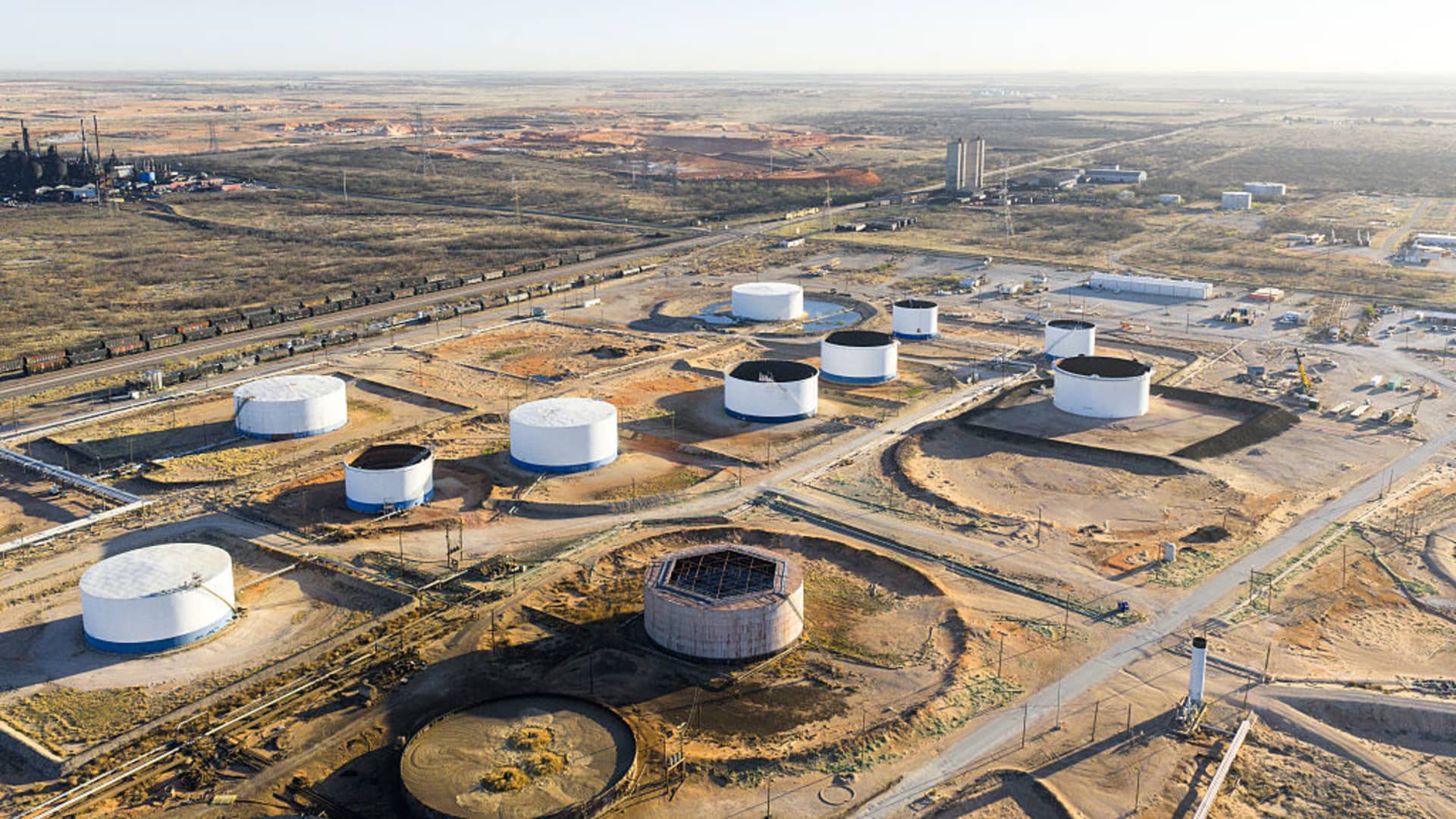
In an aerial view, oil storage tanks are seen at the Big Spring Refinery on March 19, 2026 in Big Spring, Texas.
Brandon Bell | Getty Images
Oil prices seesawed in volatile trading Monday as investors weighed the prospect of further escalation after President Donald Trump’s ultimatum demanding Tehran reopen the Strait of Hormuz or face strikes on its energy infrastructure.
Iran pushed back, saying that it would consider electric plants and water facilities in the region “legitimate targets” if its electrical grid were struck.
International benchmark Brent crude gained 0.23% to $112.42 per barrel, paring initial losses. U.S. West Texas Intermediate crude was up around 0.28% at $98.51 a barrel as of 2 p.m. ET.
Goldman Sachs sharply raised its oil price forecasts on Monday, expecting Brent to average $110 in March and April, up from a previously forecast of $98, or a 62% jump from the 2025 annual average. The bank also upgraded its WTI estimates to $98 in March and $105 in April.
“Assuming that Hormuz flows remain at 5% [of normal flows] through April 10, prices are likely to trend higher over that period,” Goldman analysts said, adding that governments’ recognition of the risks surrounding concentrated supply and limited spare domestic capacity could further lead to greater stockpiling and long-dated prices.
Should Hormuz flows remain at 5% for 10 weeks, daily Brent prices will likely exceed their 2008 record level, Goldman said. Brent crude hit about $147 per barrel in July 2008 before collapsing to around $40 within months as the global financial crisis crushed demand.

Oil prices fluctuated after U.S. President Donald Trump on Saturday threatened to “obliterate” Tehran’s power plants if it failed to fully reopen the Strait of Hormuz within 48 hours, a deadline that is set to expire on Monday in Washington.
Iran’s Parliament spokesperson Mohammad Baqer Qalibaf responded, saying that critical infrastructure and energy facilities in the Gulf region could be “irreversibly destroyed” should Iranian power plants be attacked.
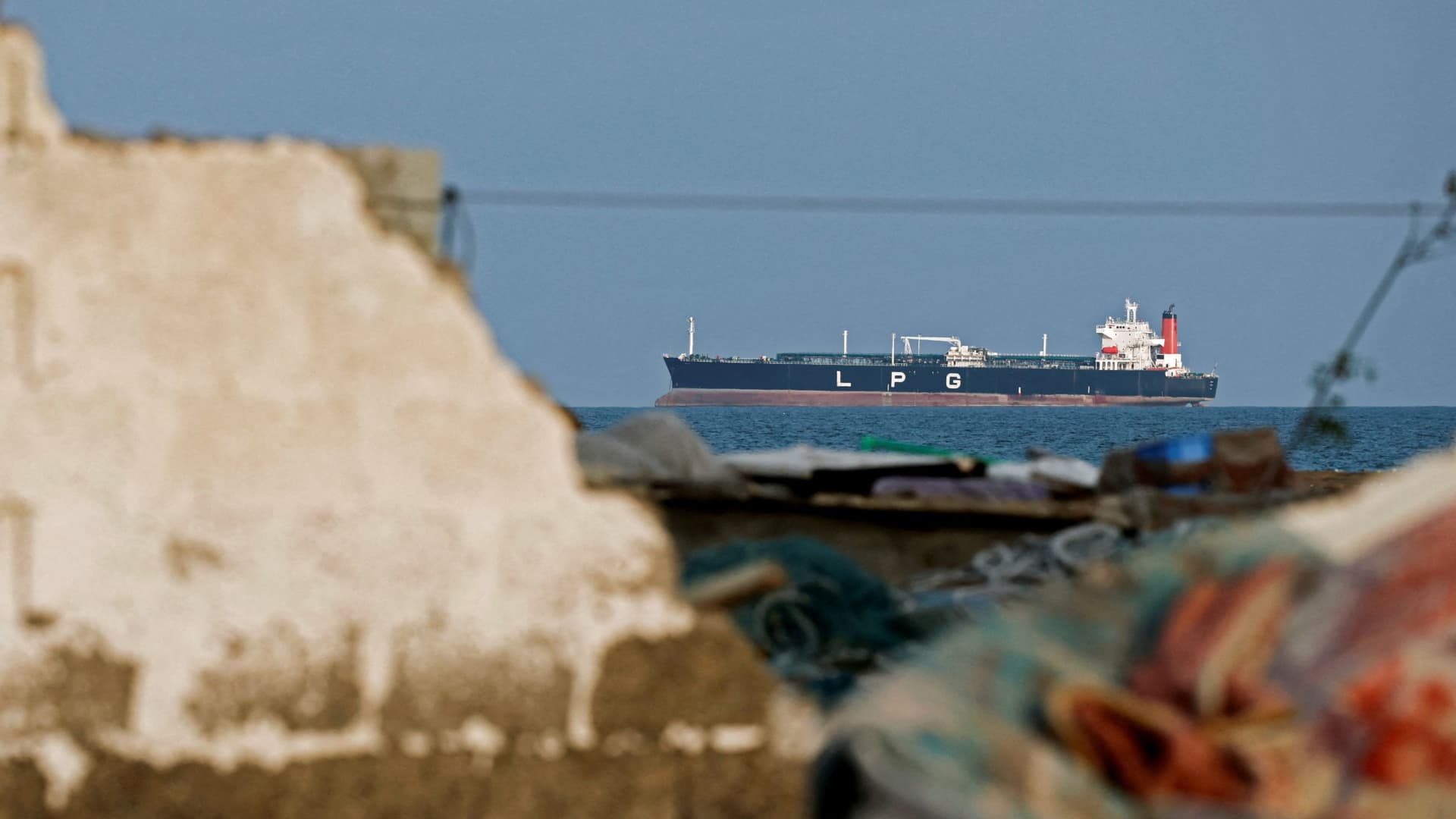
Iran has effectively closed the Strait of Hormuz to most shipping traffic since the U.S.-Israel launched strikes on the country on Feb. 28. The escalating Middle East conflict has sent oil prices soaring in recent weeks on fears of a deepening supply shock, fueling inflationary worries and weighing on growth.
The Strait of Hormuz, which normally handles roughly 20% of global oil supplies, remains largely blocked to commercial shipping.
Iranian state media on Sunday insisted that Tehran would allow safe passage through the strait for all shipping except vessels linked to “Iran’s enemies.”
U.S. natural gas prices were last seen 0.19% higher, trading at $3.101 per million British thermal units. Front-month Nymex RBOB gasoline for April delivery, meanwhile, rose 1.06% to $3.3211, hovering near the highest levels in four years.
Fatih Birol, the executive director of the International Energy Agency, warned Monday that the situation in the Middle East is “very severe” and far worse than the two oil shocks in the 1970s, as well as the impact of the Russia-Ukraine war on gas, put together.
IEA member nations on March 11 agreed to release a record 400 million barrels of oil from strategic stockpiles to address the supply disruption triggered by the Iran war.
The IEA chief said he had been consulting with governments in Asia and Europe on releasing more stockpiled oil “if necessary,” while stressing that the most important solution would be “opening the Hormuz Strait.”
Widening gap
The spread between crude benchmarks Brent and U.S. WTI exceeded $14 a barrel on Monday, the steepest price difference between the benchmarks for U.S. and international crude oil in years.
Gains in Brent crude have outpaced WTI since the war began, reflecting the seaborne benchmark’s greater sensitivity to geopolitical risk. WTI crude, however, stored at the landlocked Cushing, Oklahoma hub, tends to be more insulated from direct supply chain disruptions at sea.
That widening gap reflected the more imminent oil supply risk for countries outside the U.S., said Amrita Sen, founder and director of Market Intelligence at Energy Aspects.
“The U.S. is going to remain the most shielded of all the regions,” Sen said, as the country remains the world’s largest oil producer and the administration has started delivering shipments from its strategic petroleum reserves.
“There is going to be enough of a cushion for the U.S. not to really feel the impact of what’s going on in the Middle East,” Sen said.
The gap may also signal that the market is approaching “peak intensity of this oil crisis,” Chris Verrone, chief market strategist at Strategas Research, told CNBC’s “Squawk Box Asia” on Monday, as investors wagered on a longer conflict, keeping Brent crude prices elevated for longer.