





An old Soviet-era Lada car drives past a truck belonging to a private Cuban company (mipyme) parked in front of a gas station with an IsoTank of imported fuel in Havana on March 19, 2026.
Adalberto Roque | Afp | Getty Images
The U.S. Treasury Department has said Cuba won’t be allowed to take delivery of Russian crude, even as the fuel-starved island appears poised to receive two tankers carrying oil and gas.
In a general license published Thursday, the Treasury’s Office of Foreign Assets Control (OFAC) added Cuba to a list of countries that would be blocked from transactions involving the sale, delivery or offloading of crude or petroleum products that originate from Russia.
The U.S. had temporarily authorized the purchase of Russian oil stranded at sea last week, as part of an effort to stabilize energy markets during the U.S. and Israeli-led war on Iran. The short-term measure suspended sanctions that were first imposed on Moscow following its full-scale invasion of Ukraine.
The update comes as maritime intelligence providers have been tracking two tankers carrying Russian oil and gas heading toward Cuba.
Beset by blackouts and a worsening economic crisis under a U.S. oil blockade, the communist-run Caribbean island is currently facing its biggest test since the collapse of the Soviet Union. U.S. President Donald Trump said earlier in the week that he thinks he’ll have the “honor” of taking Havana in some form.
Russia, which has been allied to Cuba for decades, has sharply criticized the Trump administration’s fuel blockade and pledged to provide the country with “necessary support, including financial aid.”
The tanker Sea Horse is one of the vessels making its way to Cuba, according to maritime intelligence firm Windward. The Hong Kong-flagged ship is estimated to be carrying around 190,000 barrels of Russian gasoil and tracking suggests it could be set to deliver its cargo in the coming days.
The tanker has been engaged in deceptive shipping practices, an analysis published Wednesday by Windward found, including switching off its location transponders (or AIS “spoofing”) during oil transfer, and it lacks Western insurance, which Windward says indicates potential sanctions circumvention.
A second Russian-flagged oil tanker, the sanctioned Anatoly Kolodkin, is also thought to be on its way to Cuba carrying 730,000 barrels of crude oil, maritime analytics firm Kpler said Wednesday, according to AFP. CNBC has contacted Kpler and is awaiting a response.
The shipments represent an act of defiance to the U.S., given that Washington has threatened to impose tariffs on any country that supplies it with oil. The Kremlin has previously shrugged off Trump’s tariff threats, pointing out that Washington and Moscow “don’t have much trade right now.”
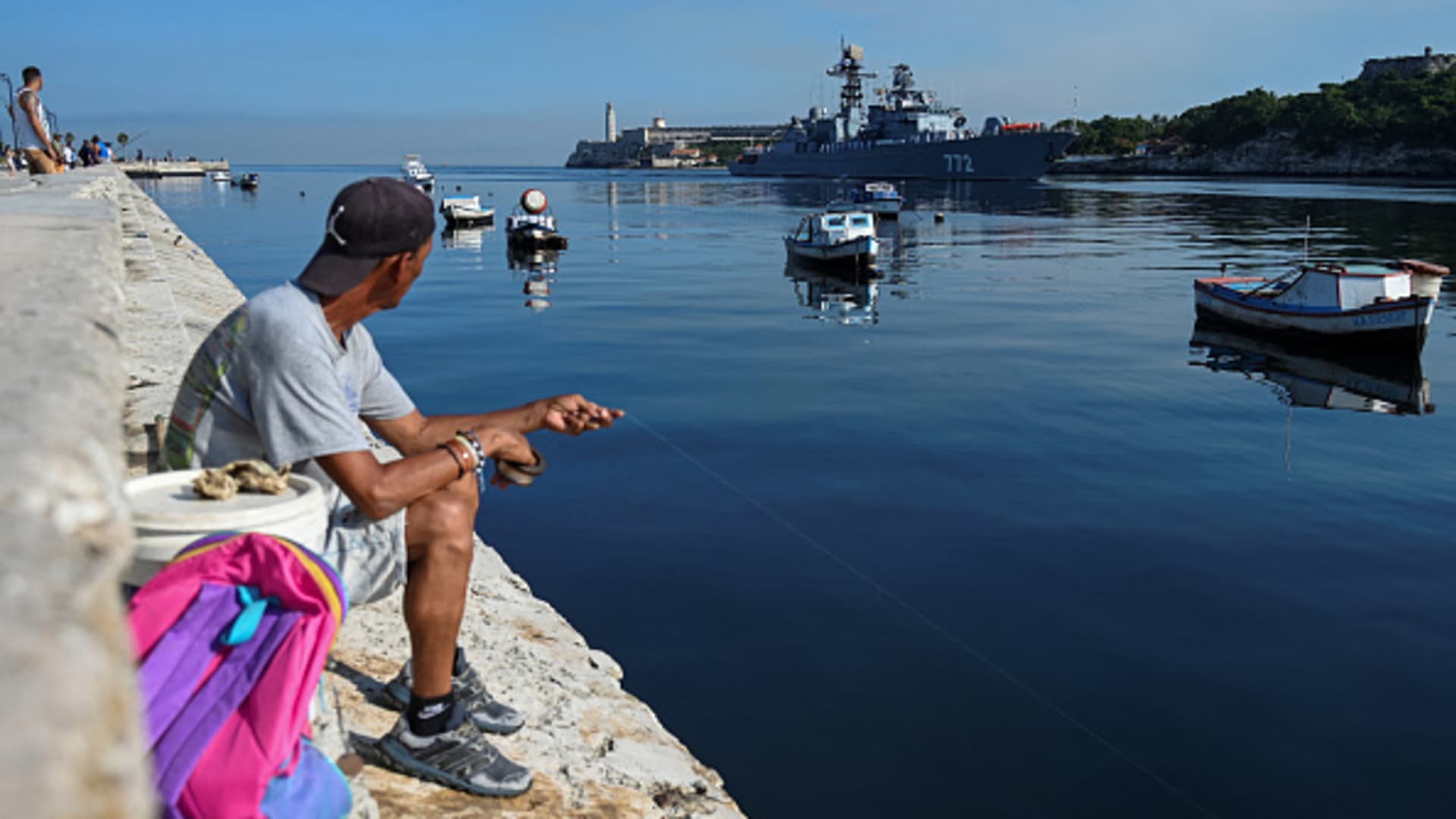
The Russian patrol vessel Neustrahimiy arrives at Havana harbor on July 27, 2024, as part of a fleet composed of the training ship Smolniy and the offshore oil tanker Yelnya. The Russian fleet will remain on the island from July 27-30.
Yamil Lage | Afp | Getty Images
Cuba had been heavily dependent on oil from Venezuela, but it has effectively been cut off since early January when the U.S. launched an extraordinary military operation to depose Venezuela President Nicolás Maduro.
The Trump administration has called Cuba’s government “an unusual and extraordinary threat” and suggested the U.S. could turn its sights to Cuba after the Iran war.
Cuba’s President Miguel Díaz-Canel on Wednesday lashed out at the “almost daily” threats from the U.S. and pledged to meet the Trump administration’s move to choke off the island’s fuel supplies with “unyielding resistance.”
— CNBC’s Lim Hui Jie contributed to this report.