



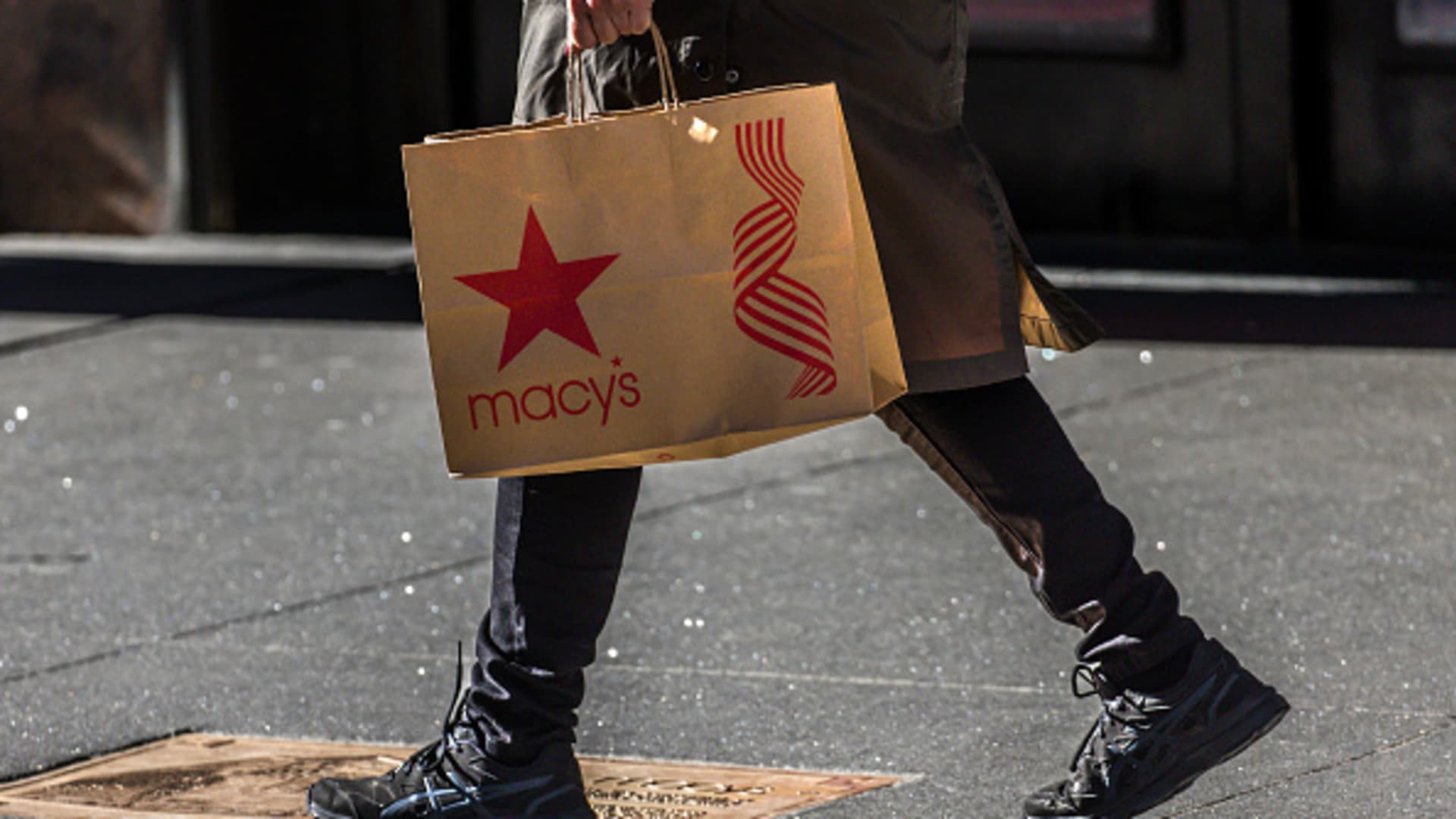
Macy’s on Wednesday gave a cautious outlook for the year ahead, despite beating Wall Street’s quarterly sales and profit expectations as its namesake brand showed signs of progress.
For the fiscal year, the company – which includes its namesake chain, higher-end department store Bloomingdale’s and beauty retailer Bluemercury – said it expects sales of between $21.4 billion and $21.65 billion and adjusted earnings per share of $1.90 to $2.10.
Both of those would represent a drop from this past fiscal year, when revenue totaled $21.8 billion and adjusted earnings per share were $2.15. Macy’s sales outlook roughly matched or exceeded analysts’ expectations of $21.42 billion, but its adjusted earnings guidance came in shy of Wall Street’s expectations of $2.17 per share for the year, according to LSEG.
Macy’s said it expects comparable sales, an industry metric that takes out short-term factors like store openings and closures, to range from a 0.5% decline to a 0.5% increase.
In an interview with CNBC, CEO Tony Spring said Macy’s results show that its strategy is working. All three of its brands grew in the fiscal year and holiday quarter. It marked the fourth consecutive quarter of Macy’s beating Wall Street’s sales guidance. And for the first time in three years, Macy’s returned to positive growth, with comparable sales increasing 1.5% for the full year.
Even in recent weeks, he said Macy’s shoppers have shown “continued resiliency” as they spend on fresh clothing and gravitate to newer brands and trendier items.
Yet, he said Macy’s and other retailers have new unknowns that make the year ahead harder to predict and caused the company to take a “prudent” approach with its outlook.
“Where will gas prices be the remainder of the year? How long will the conflict go on in the Middle East? Will the tariffs be refunded? Will other tariffs be enhanced or raised? Will the resilient consumer continue?” he said. “We’re not economists. The team is really focused on controlling what they can control.”
Macy’s said in a news release that its full-year guidance takes into account “macroeconomic and geopolitical factors that could influence discretionary spend.” It said the outlook anticipates a larger hit from tariffs in the first half of the year than the second half, with the first quarter “having the most meaningful impact.” It also includes the impact of investments that the company is making in revamping its stores, as well as the effect of fewer store closures.
Here’s how the department store operator performed during its fiscal fourth quarter, compared with what Wall Street was anticipating, based on a survey of analysts by LSEG:
- Earnings per share: $1.67 adjusted vs.$1.53 expected
- Revenue: $7.64 billion vs. $7.62 billion expected
Macy’s net income for the three-month period that ended Jan. 31 rose to $507 million, or $1.84 per share, compared with $342 million, or $1.21 per share, in the year-ago period. Adjusting for one-time items including impairment and restructuring costs, the retailer reported earnings per share of $1.67.
Sales fell from $7.77 billion in the year-ago quarter.
Macy’s is about two years into a three-year effort to strengthen its struggling namesake brand, lean into its better-performing and more luxury-focused chains Bloomingdale’s and Bluemercury and speed along the business’ supply chain and tech operations. That turnaround strategy has been led by Spring, who stepped into the company’s top role about two years ago.
As part of its plan, Macy’s said it would close about 150, or more than a quarter, of its namesake stores by early 2027.
Across the company, comparable sales for the fourth quarter grew 1.8% including owned and licensed merchandise and its third-party marketplace.
In the fourth quarter, comparable sales for the Macy’s namesake banner grew 0.4%. When including only the stores that Macy’s plans to keep open, comparable sales increased 0.6%. Comparable sales for Bloomingdale’s jumped 9.9%, and for Bluemercury grew 1.3%.
Led by Spring, the company has tried to address criticisms that its Macy’s department stores carried stale merchandise, relied on too thin of staffing and had disorganized shelves and displays that had driven shoppers to competitors.
While shuttering some of its namesake stores, the company pledged to invest in the approximately 350 Macy’s stores that will remain open. It has stepped up staffing, added new brands and sharpened its visual displays at a growing number of locations.
At the 125 locations where it has increased investment, sales outperformed the rest of the Macy’s chain, with comparable sales growth of 0.9%. The company said in a news release that it will expand that strategy to 75 additional stores, which will bring the total to 200 “reimagined” stores.
Shares of Macy’s closed on Tuesday at $16.92, bringing the company’s market value to $4.5 billion. As of Tuesday’s close, the company’s stock is up nearly 25% over the past year, outpacing the roughly 20% gains of the S&P 500 during the same period. Shares of Macy’s have fallen about 23% year to date, however.