



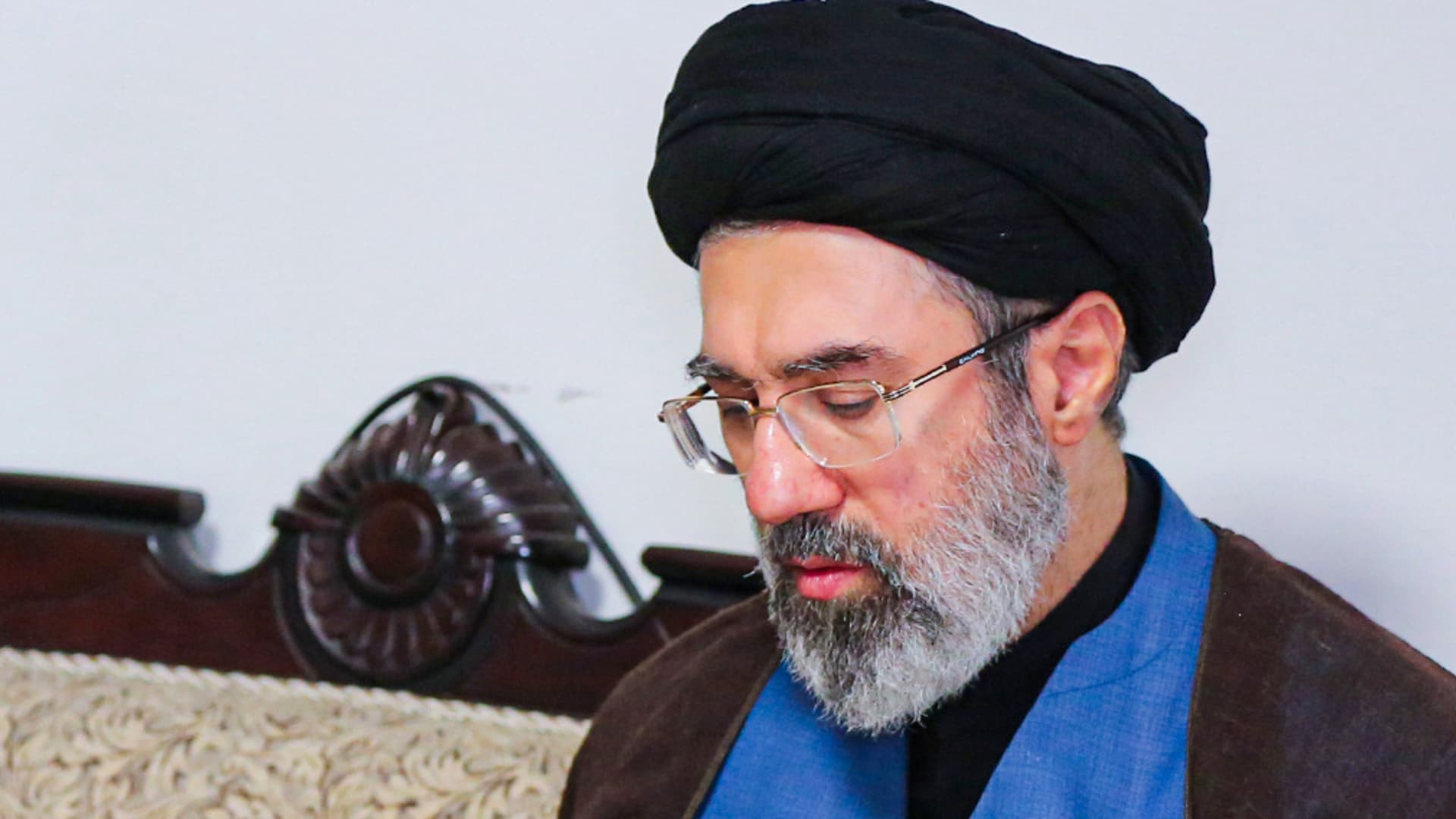
Iran appoints Mojtaba Khamenei as its new supreme leader.
Anadolu | Anadolu | Getty Images
The U.S. achieved a quick victory when its first strikes on Iran killed Ayatollah Ali Khamenei, the country’s supreme leader for nearly 37 years.
But news that the country had appointed Khamenei’s son, Mojtaba Khamenei, as his successor, along with Iran’s closure of the Strait of Hormuz, sent oil prices skyrocketing above $120 per barrel on Monday, their highest levels since 2022.
“The Iranians are showing defiance by choosing the son of Khamenei,” Michael Herzog, former Israeli Ambassador to the U.S., told CNBC on Tuesday. He added it showed there was “continuity, and the guy will probably be vengeful.”
U.S. President Donald Trump expressed his “disappointment” in the new supreme leader’s selection, telling Fox News: “I don’t believe he can live in peace.”

The country’s Ministry of Foreign Affairs spokesperson, Esmail Baghaei, told CNBC on Monday the country would unite around Mojtaba Khameini when asked about schisms in the country’s leadership.
The 56-year-old inherits the job of leading a country of over 90 million people in a war that has engulfed the Middle East.
Here are five things to know about him.
He’s more hardline than his father
Mojtaba Khamenei is more connected to the Islamic Republic’s political and security establishments than his father was.
Born in the religious city of Mashhad, he was just 10 when his father, a mainstream figure in the revolution alongside the country’s first ayatollah, Ruhollah Khomeini, overthrew the ruling shah and established the Islamic Republic in 1979.
The son joined the Islamic Revolutionary Guard Corps (IRGC), Iran’s most elite military institution, in the late 1980s, serving in the final years of the 1980-88 Iran‑Iraq war, a period that shaped his ties to Iran’s security elite.
After the war, Mojtaba Khamenei studied under prominent clerics in Qom. Despite years in the system, he does not hold a traditional religious rank.
He strengthened his connections with Iran’s clerical establishment and consolidated his position within conservative and hardline political networks through his marriage to Zahra Haddad Adel, the daughter of a senior conservative politician.
For decades, Mojtaba Khameini operated quietly in his father’s office, cultivating influence across the IRGC. Through his decades‑long entrenchment within Iran’s institutions, by many accounts stronger than his father’s in his own early rule, has shaped his reputation as a more hardline figure.
Mojtaba Khamenei has been identified as one of the leaders overseeing the 2009 Green Movement crackdown, when security forces brutally suppressed protestors who opposed President Mahmoud Ahmadinejad being declared the winner of the election, the largest demonstrations at that point since the revolution in 1979.
He has close ties with the IRGC
Mojtaba Khamenei has maintained close ties with the IRGC over the years.
The IRGC is seen as a fierce defender of the Islamic Republic and was formed by Iran’s first supreme leader, Ayatollah Ruhollah Khomeini, not long after the 1979 Revolution. It was further entrenched in the country’s system by his successor. It boasts expansive intelligence capabilities, business networks, and nearly 200,000 personnel.
His involvement in the IRGC during the Iran-Iraq war is central to his rise and allowed him to forge close relationships with members of the Guard and its internal networks. His wartime ties later evolved into a core power base within the security establishment.
Mojtaba Khamenei acted as a key figure inside his father’s office. He coordinated directly with IRGC commanders and intelligence units, managing sensitive security and political files.
Without the IRGC’s backing, Mojtaba Khamenei could not have ascended to succeed his father.
Airstrikes killed much of his family
Along with his father, Mojtaba Khamenei’s wife, son and mother were killed in airstrikes on Feb. 28, according to a statement by the Iranian government.
“You can imagine that this is not someone who’s going to be in any kind of conciliatory mood,” Jasmine El-Gamal, former Middle East Advisor at the U.S. Department of Defense and now CEO of Averos Strategies, told CNBC.
“The two sides continue to be quite far apart, and that’s why I say we’re going to continue to see more escalation from a military perspective over the next few days,” El-Gamal added.

He’s never held public office before
A billboard is displayed which features an image of Ayatollah Ali Khamenei on March 4, 2026 in Tehran, Iran.
Majid Saeedi | Getty Images
In 2005, he was accused by reformers of working with religious leaders and the IRGC to ensure the election of Ahmadinejad, the conservative candidate, as president. He faced similar claims in 2009.
A reformist candidate who ran in the elections at the time, Mahdi Karroubi, wrote a letter to Ali Khameini, then the ayatollah, saying his son had worked to support one of the candidates. Per an excerpt published by PBS, Karroubi said in the letter that Ali Khameini had said of his son: “He is his own man, not just my son.”
In 2024, when Iran’s Assembly of Experts met to discuss Ali Khamenei’s successor, the then-supreme leader said that his son should be excluded from consideration, the New York Times reported.
He reportedly has an international property empire
Despite being an image of religious piety and simplicity in Iran, Mojtaba Khamenei owns a property empire from the Middle East to Europe worth hundreds of millions, according to a year-long investigation by Bloomberg published in January.
His investments span over £100 million (around $134 million) and include luxury homes on The Bishops Avenue in London, more commonly known as “Billionaire’s Row,” per the Bloomberg report.
Other holdings include a villa in the famous Emirates Hills, also called the “Beverly Hills of Dubai,” as well as high-end European hotels from Frankfurt to Mallorca.
Many of the assets are not in his own name, but instead held through a web of intermediaries, offshore companies, and business associates, Bloomberg reported.