




-

juan thai
When the Miami Marlins With a bid to hold the NHL’s annual Winter Classic at their stadium, Longdepot Park, they knew they had to overcome a major hurdle in pitching the idea: Florida’s warm and sunny weather. Rather than ignore the obvious hurdle of hosting the league’s signature outdoor winter hockey event in the tropics, the team decided to work on the theme altogether and submitted a proposal titled “Miami Ice”, a play on the 1980s hit TV show “Miami Vice.”
“We’re not shy about the fact that it’s in South Florida. I think that’s what makes it unique and new,” said Anthony Favata, Marlins vice president of operations and events. “The vibrancy of the colors of South Beach, the palm trees, and this combination of warm weather with winter. So, we’re getting a lot of interest in it.”
The big question was whether South Florida’s mild weather and professional quality ice hockey could peacefully co-exist.
After years of discussions and multiple visits to LoanDepot Park, the league awarded the Marlins the 2026 Winter Classic, confident that engineers could build an outdoor hockey rink in sunny Miami, where the average temperature in January hovers around 70 degrees Fahrenheit.
Miami is expected to have the hottest temperature at puck drop at 8 p.m. ET in Winter Classic history, where all previous sites at puck drop had an average temperature of 33 degrees, but the league and the Marlins say they have a plan in place to ensure the ice will be ready on game day. The game will air on TNT.
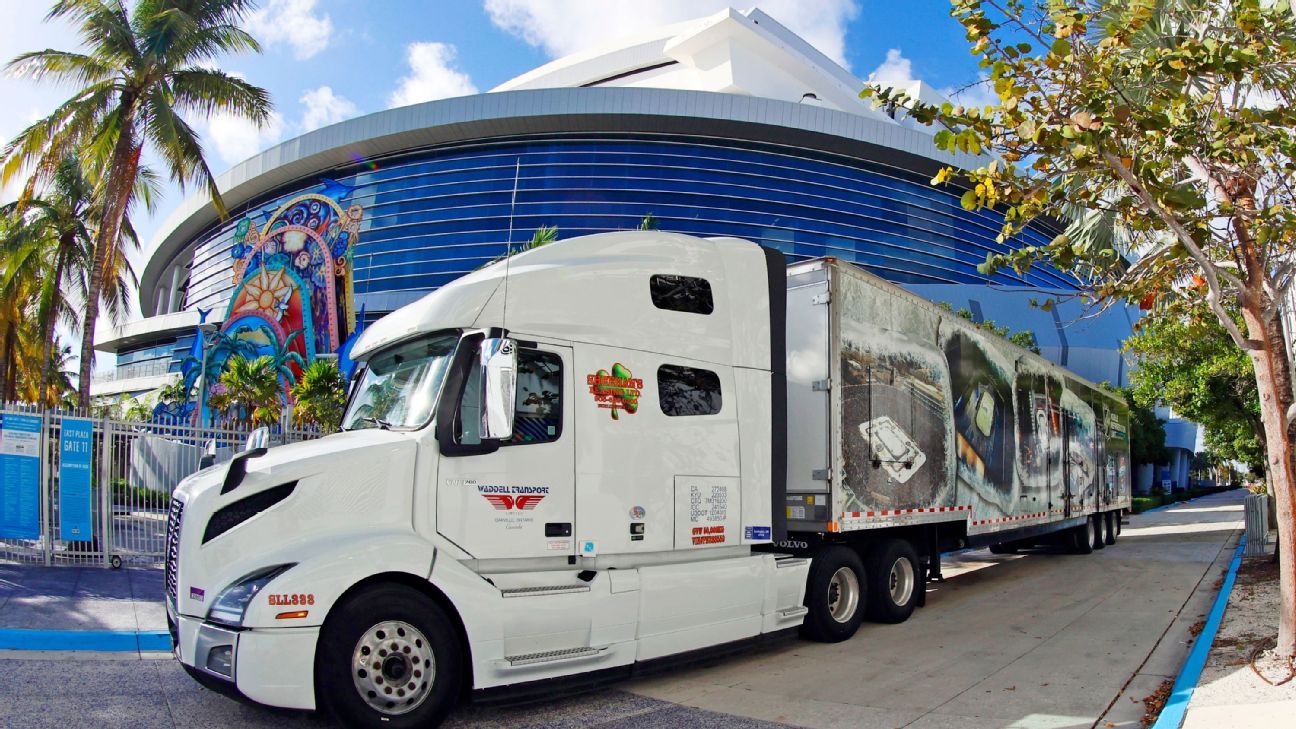
To build the rink, NHL engineers planned to use several generators, two 18-wheeler coolant trucks, approximately 20,000 gallons of water and around-the-clock care beginning in mid-December. Compared to other outdoor rinks he has built in much colder climates, this Miami build was easier to plan and execute, he said.
According to Steve Meyer, President of NHL Events and Content, the idea of holding the Winter Classic in Florida began years ago. League officials first considered hosting an all-Florida franchise matchup between the Tampa Bay Lightning and Florida Panthers. Ultimately, officials said they decided two games were better than one and awarded the Winter Classic to the Panthers, who will play the New York Rangers in Miami on Friday, and the Stadium Series to the Lightning, who will play the Boston Bruins on Feb. 1 at Raymond James Stadium in Tampa.
Meyer described it with a “field of dreams” analogy. “It’s an incredible sports story where you can go to a place that has never really participated [in hockey]Never really been exposed to a game, and then build it and they’ll come,” Meyer said, adding that filling a single arena would be an accomplishment. “And now we’re filling two stadiums that are huge, just filled with Panther fans and Lightning fans.”
Meyer called Florida “the new epicenter of hockey.” A Florida team has played in six previous Stanley Cup Final series. The Panthers are the defending back-to-back champions, having won in 2024 and 2025. The Lightning have won back-to-back titles in 2020 and 2021. Additionally, league officials say youth hockey participation rates have increased 212% since the NHL first expanded to Florida in the 1990s, and for the seventh consecutive season, at least eight Florida-born players are playing in the league. Fifteen years ago, there were never more than two players from the state in a single season.
Laundepot Park Event planners told ESPN that the retractable roof, which will help control conditions leading up to game day, is a major reason why the Florida heat is not such a big concern.
“The biggest enemy of ice is wind and sun,” said George Pinoncelli of Industrial Frigo, a winter recreation company that has built more than 500 outdoor ice rinks in the U.S. and is unaffiliated with the NHL.
The evening start time means direct sunlight won’t be a concern once the roof is retracted. But Pinoncelli cautioned that wind could be an issue.
Paquita Zuidema, an atmospheric science professor at the University of Miami, compared the effect of wind on an ice rink to a block of ice sitting in the backyard.
“The ice will constantly cool the air above it,” Zuidema said, helping to keep surface temperatures low. But the wind “will continue to remove that cold pool of air. So the ice will need to work harder to cool that layer of air.”
Derek King, the NHL’s vice president of facilities and hockey operations, said the optimal temperature for the ice level — the pockets of air above the ice and inside the glass — is about 60 degrees on game day.
“The inside of the glass is really important. However, we know we don’t have a lot of control over it,” he said. “So we’ll make that [ice] “We’ll put down as much cold blanketing as we can to control that area, and then we’ll monitor our temperatures.”
The league refined the process to build a rink with each of the 43 outdoor games played since 2003. From start to finish, it takes two weeks and about 100 people to build the Winter Classic’s on-field construction from a hockey rink, but only 24 people for the ice crew, according to King.
Work began as soon as the NHL’s two 18-wheel mobile refrigeration units arrived from Canada at LoanDepot Park, where they are stored. In cold climates like Chicago or Minneapolis, the NHL typically only requires one mobile refrigeration unit, but for Miami the league requires two.
Workers ran pipes that carried a mixture of 40% glycol and 60% water from refrigeration trucks to the baseball field. Also, before building the stage for the rink, they prepared about 80% of the field by covering it with armored subfloor. Crews used a closed ceiling to help keep indoor temperatures down to 60 degrees.
With the foundation complete, workers laid aluminum panels that connect to pipes that flow the glycol mixture. The freezing temperature of that mixture is lower than that of water and allows the metal plates to be cooler than the 32 degrees required for water to freeze.
According to King, laying pipe and building the foundation, rink and boards typically takes four to five days. Next comes a process where workers use ice and water to fill the spaces to create the smoothest surface possible – much like grouting between tiles.
From there, teams eventually begin making ice by slowly spraying water onto the rink over several days, gradually building the ice sheet to a game-time thickness of 2 to 2.5 inches and a surface temperature of 25 degrees.
During this process, they paint the rink white and add logos and lines before adding the top layer of ice.
After completion in Miami, the Panthers and Rangers got practice time. The league planned to use the remaining time to iron out any glitches and ensure the ice was ready for Friday’s game day.
“Taking Mother Nature.” out of the equation,” King said, adding that construction may be easier in 2022 than in colder places like Nashville, when rain dumped more than 4 inches of snow by game day, or during the 2025 Stadium Series in Columbus, where wind and snow hampered construction.
But hot spots are not free from danger. Six days before the 2020 Winter Classic at the Cotton Bowl in Dallas, heavy rain and warm weather melted the snow, forcing workers to restart the layering process.
When the league finally starts in Miami, King said his team will be ready to adapt to the weather conditions.
“We just need to look at how we deal with snow on game day. Are we going to limit the amount of time it takes to flood? Are we going to remove more snow and deal with what we know we can?” The king said. “So control the things we can control and really let nature in.”
But King admits his team faced an unusual challenge ahead of warm-weather production: what to wear.
“We’re not all bundled up in heavy coats and things like that, trying to stay warm,” said King, who lives in Canada and is looking forward to Florida’s T-shirt weather. “We all have to rethink our wardrobe for this production because we’re going to be in Miami.”