


-

Bill Barnwell
Multiple Authors
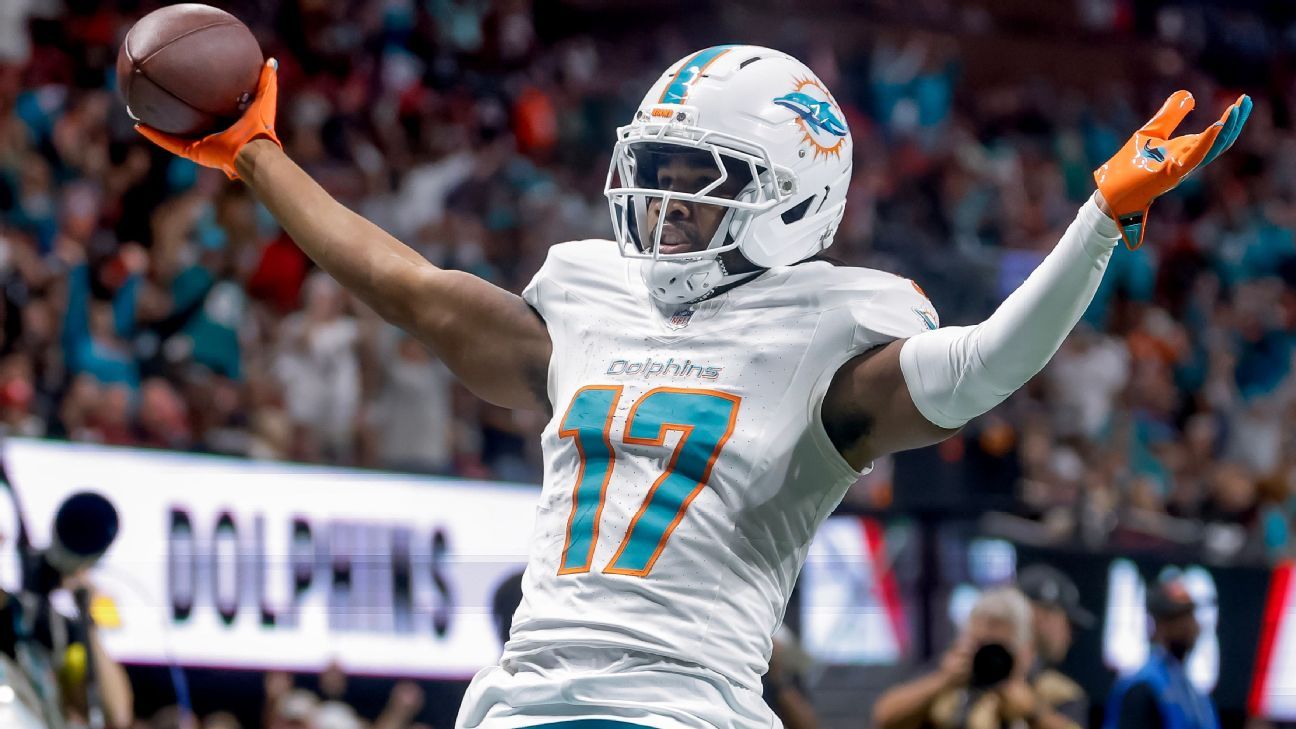
The Broncos needed another receiver for Bo Nix. On Tuesday, they got one — but it wasn’t the player many of us expected.
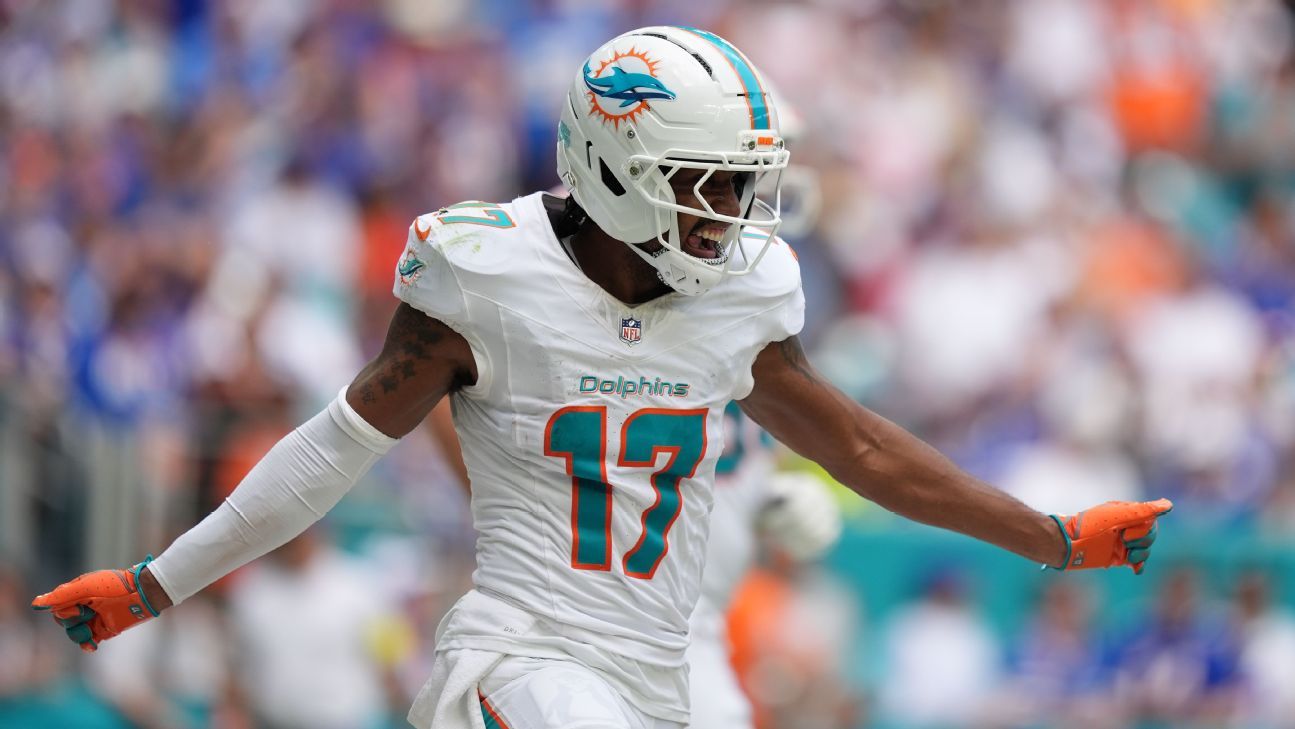
While there were suggestions that the Broncos might look into the free agent market for someone like Deebo Samuel or Jauan Jennings, coach Sean Payton and the Denver front office decided to take a much bigger swing. After getting within a score of making it to the Super Bowl, the Broncos traded their first-, third- and fourth-round picks in this year’s draft to the Dolphins for wideout Jaylen Waddle and a fourth-round pick.
Subscribe: ‘The Bill Barnwell Show’
The Dolphins, meanwhile, continue to indicate that they’re tearing down their roster to the studs. Seven years after they were widely accused of tanking as part of their efforts to rebuild their team and land Tua Tagovailoa, a new regime appears to be going down that same path. In addition to cutting Tagovailoa and Tyreek Hill, the Dolphins have now moved on from the third cornerstone of the devastating passing attack that looked to be fueling their turnaround.
The Broncos aren’t entirely all-in, and the Dolphins aren’t entirely tanking. But they’re both clearly heading in those directions with this trade. You can understand why this made sense for both teams, but should either have been aggressive enough to make this deal? Let’s break all of that down, starting with the player himself and how Waddle impacts the Broncos’ offense.
Jump to:
How does Waddle fit in Denver?
Are the Broncos legit contenders?
What’s next for Miami?


How does Waddle fit on the Broncos?
Payton and the Broncos could have stayed put at wide receiver, where Courtland Sutton was the unquestioned No. 1 option and everybody else was more promising than consistent. Troy Franklin took a step forward in his second season, but that included four games with 80-plus receiving yards and six where he managed fewer than 20 yards. Pat Bryant began to flash late in the regular season as a rookie. Marvin Mims Jr. has proven to be a useful gadget player. The Broncos were one receiver away from having an impressive group of wideouts, but they needed one of those young players to step up.
Now, that’s not as pressing of a concern. Sutton and Waddle are the co-lead wideouts, although I’d lean more toward Waddle’s upside as the true WR1 in the offense if I had to pick a player. Franklin and Bryant only have to be the third and fourth options. If one makes a big leap forward, the Broncos have one of the better wideout groups in football. If not, they’re still an above-average unit with Sutton and Waddle on the field.
Waddle fits the offense in a couple of needed ways. One is on the crossing routes that Payton wants Nix to throw off play-action. Nix was 20th in the league in EPA per dropback and 24th in success rate using play-action last season, per NFL Next Gen Stats. Waddle thrived running those routes with the Dolphins at the peak of the Mike McDaniel offense, creating quick completions for Tagovailoa and significant yards after catch.
The other is offering a more consistent level of vertical threat. As good as the Broncos’ season was last year, they might have been even better if there had been more work downfield. Nix’s 83.1 Total QBR on deep throws ranked 19th out of 28 qualifying passers, and his 11.6 yards per deep attempt ranked 24th. Some of that was simply firing wide, as Nix’s 40.3% off-target rate on deep throws was 25th in the league, but there were opportunities to hit more of those shots downfield. The Broncos narrowly missed on two deep shots in their regular-season loss to the Chargers, including a flea-flicker early on and a double-move to Sutton on the final drive of regulation; they might win that game and finish 15-2 if either throw gets completed.
Payton has never really had that receiver in Denver. The Broncos spent $23 million over two years to bring in Evan Engram last season, but the veteran tight end hasn’t offered any sort of consistent vertical threat during his time in the pros. Mims can be schemed open and is incredibly fast, but he’s not going to win with his route running against great defenses. Franklin’s the most plausible deep threat of the bunch, but he and Nix have struggled to reliably get on the same page downfield. He caught just 11 of 44 deep targets over his first two seasons in Denver and has averaged just 7.6 yards per deep target, roughly half of the NFL average of 14.1 over that same timeframe.
Waddle’s averaged 15.6 yards per deep target over that same timeframe, and he has done it without a quarterback with a high-end arm. Nix has the arm strength to throw with velocity and loft, but he can be let down by his footwork and doesn’t always reset when scrambling or extending plays, which leads to a lot of his off-target concerns. Nix improved there in 2025, and if he continues to get better, there could be a very effective downfield combination forming here.
It looks like Waddle’s 1,356-yard season in 2022 is a statistical outlier for the sixth-year pro, having failed to top 1,015 yards in any of his four other pro campaigns. But much of that is a product of simply running fewer routes thanks to injuries and more rotation by McDaniel on offense. Waddle topped 500 routes in each of his first two seasons before averaging just over 400 per year over the ensuing three campaigns.
On a per-route basis, Waddle’s 2025 season was much closer to what he did in 2022 and 2023 than a middling, injury-impacted 2024 campaign. Some of that was the absence of Tyreek Hill, who absorbed a massive target share in 2022 and 2023 alongside Waddle before suffering a severe knee injury early in 2025, but Waddle has still been able to command targets and produce efficiently when playing alongside a true WR1. Sutton won’t offer the same level of competition for targets, giving Waddle a chance to approach his 2022 production in Denver if things break right.
Waddle also presents a relatively team-friendly contract for a veteran wideout in the prime of his career, owing to the fact that the Dolphins already paid their former first-round pick significant bonuses in 2024 and 2025. Another $15.4 million bonus was coming due later this week, which placed a deadline on the Dolphins to decide whether they were going to trade Waddle this spring. The Dolphins are reportedly paying $10.4 million of that amount per ESPN’s Jeremy Fowler, which would make Waddle even more affordable.
In acquiring Waddle, the Broncos are on the hook for $6.8 million in 2026 and $24 million in 2027, most of which becomes guaranteed by the end of the week, before they would be in position to either negotiate a new deal or move on from Waddle in 2028. A deal averaging just under $16 million per year for Waddle feels like a bargain when you consider DJ Moore, an older player coming off the worst season of his career, will make $24.5 million per year in Buffalo. Wan’Dale Robinson, who might not be much more than a gadget receiver, is getting $38 million over the next two years in Tennessee. Alec Pierce is getting $60 million over the next two years to stay with the Colts.
Of course, the Broncos are also giving up three picks, which adds some implied cost onto Waddle’s deal. Using the Ben Baldwin chart, trading first- and third-round picks to the Dolphins and swapping fourth-rounders will cost the Broncos an additional $12.8 million in lost value per year over the next four years. If Waddle sticks around for four years and the Broncos pay him the equivalent of $19.6 million in 2026 and $36.8 million in 2027 before working on a new deal afterwards, that will be fine. If Waddle’s done after two years or doesn’t live up to expectations, the missing picks will hurt a lot more.
Can Waddle put the 2026 Broncos over the top?
I’ve covered why Waddle is a good fit on the field for the Broncos. If you’re a fan who wants to make a case for why Waddle would be more valuable to this specific team than some unknown draft picks, well, it’s not hard. The Broncos were the top seed in the AFC last season. They might have beaten the Patriots in the AFC title game if it weren’t for Nix suffering a season-ending ankle injury in overtime of the divisional round loss to the Bills. Maybe they lose to the Seahawks in the Super Bowl, but the Broncos were about as close as you can come to a championship game without getting there.
Waddle would have been a potential difference-maker on the 2025 Broncos. Is he likely to push the Broncos from contender to favorite in 2026? I’m not so sure. The Broncos should be well-positioned to compete again in 2026, but I’d be a little nervous that Denver could be overestimating how close they’re likely to be even after adding Waddle this upcoming season. And in part, that’s because some elements of what happened for them in 2025 aren’t likely to recur in 2026:
1. They ran hot in one-score games. It’s entirely fair to say that the Broncos were a little unlucky at times last season. They might have come within one deep completion and one field goal penalty of going 16-1, with their only loss by more than three points coming against the Jaguars in December.
Of course, the Broncos also had their fair share of late-game comebacks and last-second victories. They came back from a 14-point deficit to beat the Eagles, needed a stop in the final two minutes to beat the Jets, stormed back after giving up a lead with 32 seconds left in regulation to top the Giants, faded a missed field goal that would have pushed a game with the Raiders to overtime and stopped the Commanders on a two-pointer that would have won Washington the game in the extra quarter. Their final two games of the year came against backups in Chris Oladokun and Trey Lance, while their three-point win over the Texans was mostly against Davis Mills after C.J. Stroud was concussed.
The Broncos finished 9-2 in games decided by seven points or less. (I use seven points since a team can technically win a game it trails by seven in a single possession, but Denver also won two more games by eight points, including a Week 1 victory over the Titans where the offense played awful football for most of the game.) If you’ve been reading my work for any length of time, you know what I’m about to say: It’s incredibly difficult to pull that off year after year, and we can’t count on the Broncos winning so many of the close ones in 2026.
2. Their schedule will be tougher. So many of those close wins I mentioned came against middling teams. The Eagles and Texans were meaningful competition, but great teams don’t need to go to the final minute to beat the Giants, the Jets or a Commanders team with Marcus Mariota at quarterback.
The Broncos played the league’s 11th-easiest schedule during the regular season in 2025, per ESPN’s Football Power Index. That figure should be tougher in 2026. The Broncos will go from playing teams that finished in third place, as they did by virtue of where they finished in 2024, to other first-place teams this upcoming season. After playing the AFC South and NFC East last season, Denver gets the AFC East and NFC West in 2026 — which means games against the Rams, 49ers and Seahawks. Things will be tougher.
3. The defense might not be as good as it was a year ago. We know that defense is more inconsistent than offense in terms of year-to-year consistency and correlation. There are teams with great defenses who keep things up on an annual basis, but without a quarterback to dramatically raise the floor at the most important position in sports and with so much relying on turnovers and red zone performance, it’s tougher to consistently win if they are relying on their defense to play at an elite level.
1:57
Stephen A.: Jaylen Waddle a huge pickup for Broncos
Stephen A. Smith reacts to the Broncos trading for Jaylen Waddle and reflects on the Bills’ failed pursuit of the wide receiver.
The 2025 Broncos were more balanced than the 2024 team, but this was still a team that relied on the defense to win. The offense improved from 16th to 10th in EPA per play between 2024 and 2025, but the defense was still the focal point. The Broncos led the league in EPA per play allowed on defense in 2024, and through the Week 12 bye in 2025, Vance Joseph’s unit was continuing to dominate, ranking fourth by the same metric — despite losing star cornerback Pat Surtain II for a stretch of time.
After the bye, though, the defense wasn’t the same. Between Week 13 and Week 16, the Broncos fell all the way to 23rd in EPA per play on defense. Getting backup quarterbacks in Week 17 and Week 18 helped, but Denver then allowed 30 points to Josh Allen and Buffalo at home in the divisional round. They were much better against the Patriots in brutal conditions during the AFC Championship Game, but there were already signs that the Denver defense was fading during the second half of the year.
By the end of the season, the Broncos were seventh in EPA per play on defense. That’s still a very good unit, but it’s not the suffocating, dominant D that can singlehandedly carry teams to Super Bowls. Adding Waddle will help the offense pick up the slack, but I’m just not sure the defense will have the same impact in 2026, especially after losing underrated lineman John Franklin-Myers to the Titans in free agency.
4. This team isn’t as young as you think. There are certainly some exciting young players in Denver. Nix is in his third year, although as an overaged draftee, he’s already 26. Franklin and RJ Harvey flashed last year on rookie deals. Nik Bonitto is 26 and was a Defensive Player of the Year candidate. And Surtain, who has a strong case as the best cornerback in football, turns 26 in April. That’s a very good starting point for a young core.
In the big picture, though, the Broncos get a lot of snaps out of older players, in part because they sacrificed so much draft capital to acquire Payton and Russell Wilson. The Broncos were the league’s fifth-oldest team in 2025 on a snap-weighted age basis. The departure of the 29-year-old Franklin-Myers will make the defense a little younger up front. But one of the few places where the Broncos were fielding young players was across from Sutton at wide receiver. Now, those snaps will go to Waddle, who will be 28 in November.
Playing veterans is fine if they’re performing at a high level, as was the case for guys like Franklin-Myers and Garett Bolles, but relying so heavily on players who are approaching or past 30 incurs some meaningful risk. You’re counting on players to defy aging curves and wear-and-tear to continue excelling. And since veterans cost more than players on rookie deals, there’s less talent on the roster to replace those guys if they decline or get injured. The Broncos just don’t have a lot of young talent around the guys I mentioned above.
As always, if the comparison is between an established talent like Waddle and a draft pick, it’s going to be easy to make a case for the veteran player. It’s just not that simple, though. Veterans cost more. The Broncos aren’t paying Waddle a ton in 2026, which makes this easier, but this deal hints toward a new one over the next year or two given what they are paying in draft capital. We’ll never see what this roster would have looked like with those picks, but it’s not Waddle versus an unknown quantity. It’s Waddle (and a swap of fourth-round picks) versus a first-round pick, a third-round pick and $15 million or so per year to spend between 2026 and 2027.
Sometimes, those picks don’t turn into anything. Other times, as we’ve seen with the Bears in recent years, teams trade picks that turn into Joey Porter Jr. and Cooper DeJean to land “sure things” in Chase Claypool and Montez Sweat. The picks the Broncos traded for Wilson turned into Charles Cross, Devon Witherspoon, Boye Mafe and Derick Hall; that’s a franchise left tackle, an All-Pro caliber cornerback and two valuable edge defenders for a team that just won the Super Bowl while fielding the league’s third-youngest roster.
The Waddle trade is unlikely to be a disaster, and I like the fit in an ideal world for what he can do within the Broncos offense. I’m just not sure the 2026 Broncos are going to be as close to contending for a title as the 2025 team was by the end of the year.
What’s next for the Dolphins?
It seems ironic that this trade seems to firmly shut the door on the last generation of the Dolphins. Waddle was part of the package acquired through the Laremy Tunsil trade, which really established that the Dolphins were tanking in 2019. The Tunsil trade led to the Trey Lance deal, which landed Miami three more first-round selections. The Dolphins used two of them to move back up in 2021 and draft Waddle with the sixth pick, one of the first signs that they were going to get aggressive in adding talent. Tyreek Hill and Bradley Chubb, from these very Broncos, would follow. And while Waddle didn’t play in the game, the peak for this Dolphins team was very likely their 70-point performance in a win over the Broncos in September 2023.
Those franchise cornerstones are all gone, with new general manager Jon-Eric Sullivan cutting Chubb and Hill this offseason. McDaniel and Tagovailoa are out the door. Waddle now joins them. This Dolphins team was created by tanking, won zero playoff games and now appears to be heading back toward the bottom.
Is the tanking tag unfair? Maybe. The Dolphins did guarantee Malik Willis $45 million over the next two years to take over at quarterback. Many of their other moves were decisions that made football and financial sense. Hill was coming off a career-threatening injury and had refused to play in a game at the end of 2024. Ownership pretty clearly decided to pull the plug on Tagovailoa at the end of 2025 to avoid any future guarantees triggering. Chubb was due more than $20 million in 2026 and arguably wasn’t that caliber of player after suffering a multi-ligament knee injury in 2023. All of those moves were reasonable enough.
Beyond Willis, though, the Dolphins aren’t exactly using those savings to build up their roster. Outside of Willis and tight end Greg Dulcich, who will make $3.2 million in 2026, every other player Miami has signed this offseason has joined on a one-year deal for $1.5 million or less. In other words, the Dolphins are filling up their roster with players making the minimum or close to it. Some of those guys might turn out to be useful players, of course, but they’re not going to build a very good team out of league-minimum veterans.
Willis is also left in a completely hopeless position. His No. 1 wide receiver at the moment is likely Malik Washington. I like Dulcich, who was second in the NFL in yards per route run over the second half of 2025 among tight ends, but he shouldn’t be getting 8-10 targets per game, and that might happen in Miami’s offense. No quarterback’s capable of thriving with this group of playmakers at receiver, let alone one hoping to establish himself as a starter for the first time as a pro.
The Waddle trade is where the definition of what the Dolphins are doing changes, where the gauge leans more toward tanking than rebuilding. At 27, Waddle’s still in the prime of his career. The Dolphins aren’t going to be competitive, but the hope is naturally that they’ll be there in two or three years, once Sullivan has had a chance to turn over the roster, draft some talented players and add his quarterback of the future. Waddle might not be at his peak at that point, but he would still project to be good enough to serve as a talented receiver for that quarterback.
Trading Waddle essentially says that the draft picks are more valuable than having some infrastructure in place for their current or future QB. That might be true in the big picture, but if there’s any place a bad team should be willing to invest and hold onto talent, it should be in infrastructure for its quarterback. If the Dolphins do draft a quarterback in 2027 or 2028, they’re going to want to have the right pieces around him as he arrives in Miami, not a year or two later. Even if Hill had stayed healthy, holding onto a 32-year-old wide receiver for the future wouldn’t have made sense. Holding onto Waddle would have.
Back in 2019, as the Dolphins were putting together some of the worst football I’d ever seen to start the year, I wrote about the Dolphins and why I was opposed to the idea of tanking in football. Teams aren’t going to actively try to lose, but nothing about what the Dolphins are doing suggests that they’re attempting to field a competitive team in 2026.
I’m not sure it has done organizations like the Browns or Dolphins many favors with the benefit of hindsight, either. Amassing draft picks is the best way to build a sustainably good football team, but doing that at the expense of sacrificing any and all talent isn’t a great plan, either. The Browns sacrificed useful players for middle-round compensatory picks and paid premiums in free agency to eventually replace those missing talents. The Dolphins landed significant draft capital and then traded much of it away to move up for Waddle and acquire Chubb and Hill. Those two tanks produced a total of one playoff win between both organizations.
And yet, if the Dolphins are trading Waddle, it doesn’t really make sense to hold onto their other veteran standouts. If Waddle wasn’t going to be part of the next useful Dolphins team, why would other players in their late-20s be part of it? The Dolphins don’t have an incredibly talented roster, but they do have a few veteran standouts who are going to appeal to general managers around the league. What — and who — could be next in Miami?
• Running back De’Von Achane. There will naturally be conversation about the one remaining standout for the Dolphins on offense. Achane was one of the best backs in football last season, averaging 5.7 yards per carry and generating 1,838 yards from scrimmage. He doesn’t turn 25 until October, but he’s also in the final year of his rookie deal, which creates another conflict for Sullivan. Would the Dolphins sign their speedy lead back to an extension if he won’t actually be part of a competitive team until midway through that next contract? Would Willis try to go back in time and deliberately fail his physical if the Dolphins trade Waddle and Achane before he ever steps on the field?
At the moment, though, there are really aren’t many teams with an opening for a lead running back. The Titans could acquire Achane and move on from Tony Pollard if they don’t want to use their first-round pick on Jeremiyah Love. The Jaguars just made a surprisingly large commitment to Chris Rodriguez Jr. as part of a backfield with Bhayshul Tuten. The Broncos were reportedly in the market for a running back, but they re-signed J.K. Dobbins. The Commanders are going with the rotation plan, and the Vikings brought back Aaron Jones Sr.
There are teams that would benefit from adding Achane, of course, but Miami might be better off waiting until the trade deadline. While more teams will add backs in the draft between now and then, we’ll also see attrition as starting backs get injured or struggle. Signing Achane to an extension would be a way to argue that the Dolphins aren’t actually tanking, but it would be a surprise if the star back’s long-term future was in Miami.
• The best player on the Dolphins offense in 2025 might have been center Aaron Brewer, who was my first-team All-Pro at the pivot. Brewer’s athleticism played up in McDaniels’ scheme, and with an inexperienced set of linemen around the 28-year-old, he was the key reason why the Dolphins were able to run the ball and create holes for Achane in 2025.
Again, having a reliable center in the mix is a great thing for a young quarterback, whether that be Willis, Arch Manning or whoever else comes down the line in Miami. But Brewer’s entering the final year of his deal, and in a league where Tyler Linderbaum just landed $27 million per season on the open market, Brewer’s $6.9 million paycheck in 2026 is an enormous bargain. He is going to get a raise very soon; I’m just not sure whether that will come from the Dolphins or another franchise. Would the Ravens, who suddenly have an influx of draft capital, call the Dolphins about replacing Linderbaum?
• My other first-team All-Pro from the Dolphins was linebacker Jordyn Brooks, who made a ton of plays on a Miami defense that had little in the secondary. While Achane and Brewer might be valuable players for a young quarterback, moving on from Brooks would make more sense. Like Brewer, Brooks is in the final year of his deal, and playing a position that the league doesn’t always prioritize, his trade value will never be higher. Teams like the Colts and Jaguars should be calling the Dolphins about him.
There will be other players on the move, and the Dolphins are going to fall further before they hit bottom. Miami might not call it tanking for obvious reasons, and the players who are left will still be trying to win. If there was anybody on this roster who could have been a meaningful part of the next great Dolphins team, though, it was Waddle. And now, while the Dolphins will add a first-round pick to their coffers, I suspect it’s going to be more difficult to build that great team.