


-

Jeff Borzello
Multiple Authors
Much like last season, the true national title contenders have separated themselves into a tier of their own entering the 2026 men’s NCAA tournament.
Arizona and Michigan established themselves in the opening weeks of the season, and Duke definitively joined them after beating the Wolverines in Washington, D.C. in February. And, similar to last season, Florida surged in SEC play and has emerged as a clear threat to repeat its title.
In 2025, the tier break between the favorites and everyone else resulted in all four 1-seeds reaching the Final Four for the first time since 2008. Will that happen again?
A repeat of that is statistically unlikely, but those four teams — the top four at KenPom, Bart Torvik and in the NET with the most Quadrant 1 wins in the country — were the only ones to receive multiple votes to win the national championship in our annual poll of 25 coaches and scouts.
The official vote tally:
-
Arizona: 12
-
Duke: 5
-
Michigan: 3
-
Florida: 2
-
Houston: 1
-
Purdue: 1
-
UConn: 1
We also asked coaches about the strengths and potential flaws of the top four contenders; whether St. John’s or UConn has a deep run in them; the championship viability of preseason No. 1 Purdue; whether four trendy Cinderella picks can really make a run; and how far star freshmen could carry their teams.

TOP FOUR CONTENDERS

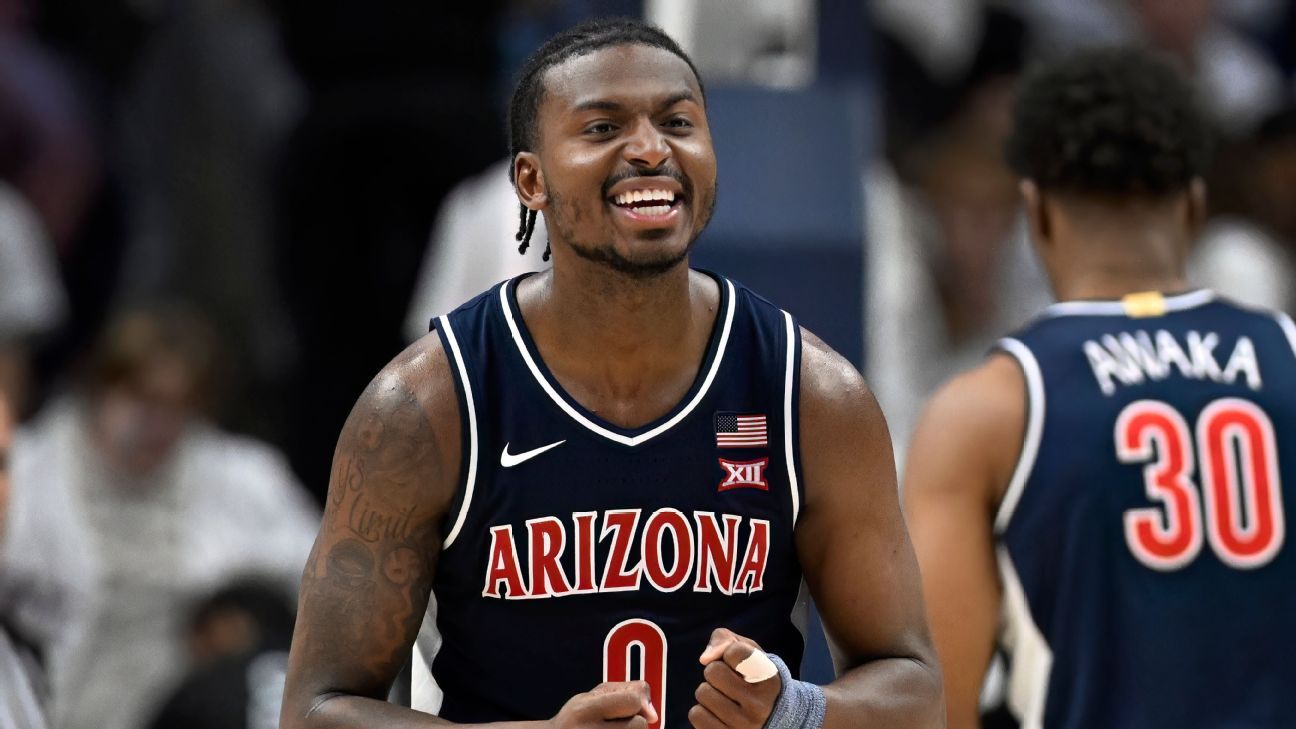
Strengths: Arizona received the most votes to win the title after its run through the Big 12 tournament. The Wildcats are dominant in the paint and on the offensive glass, and they rank in the top five nationally in both offensive and defensive efficiency. Tommy Lloyd has a deep, balanced unit with clutch late-game shotmakers in Jaden Bradley and Brayden Burries.
“When you play Arizona, you have to be ready for a heavyweight fight,” one coach said. “They’re so big, so physical, so strong at every position. … There’s no softness to them. There’s no quit in them. They just keep their heads down and keep playing. It’s like an old-school bully. When it’s over, they’ve just physically ripped you.”
“I just think they have all the components,” another coach added. “They have experience and leadership. Bradley has been to a Final Four. Brayden Burries is a top-20 pick. And they’ve got pros out there. They have a way to win that’s a little bit different, a little unconventional, but they’ve really bought into that. On a one-day prep, with the physicality they play with, I think that’s going to help them a lot.”
1:02
Arizona’s NCAA tournament preview
Joe Lunardi breaks down Arizona’s NCAA tournament prospects.
Potential fatal flaw: It’s perhaps the most obvious of any of the 1-seeds, but it hasn’t really hampered the Wildcats this season. They rank last in the Big 12 in 3-point attempt rate and percentage of points from 3-pointers, slotting in at No. 332 overall with just 5.9 3-pointers made per game.
“That’s the biggest thing,” one Big 12 coach said. “Let them take and make as many 3s as possible. You eliminate the paint stuff, but now you’ve got to rebound the missed shots. Long shots means longer rebounds and they’re coming off higher. [Motiejus] Krivas, [Tobe] Awaka, [Koa] Peat, [Ivan] Kharchenkov, Burries, Bradley — they’re all going after the basketball. And they’re doing it with physicality.”
Another Big 12 coach agreed with that assessment, adding that teams need to force the Wildcats to play in the half court, then make them beat you from the perimeter.
“You have to be able to take care of the basketball,” he said. “They’re sneaky defensively. They turn you over and they’re so good in transition. You end up giving 16 transition points and you’re looking at it like, they dominated us eight feet and in and they also scored 16 to 24 transition points.”

Strengths: Coaches and scouts who picked Duke pointed to one reason: National Player of the Year favorite Cameron Boozer. Boozer was the winningest, most decorated high school basketball player in modern history — and his winning ways haven’t changed in college.
“He’s the best player I’ve ever coached against in college basketball,” one ACC coach said. “Nobody has a matchup for him. He does everything. He scores in the post, unbelievable rebounder, can make 3s. Terrific IQ and passer and creator. Handles the ball in ball screens, and literally nobody maybe outside of Caleb Wilson is a good matchup for him in the country.”
“This is a classic Duke team,” another coach said. “They didn’t go after the most talent, [Scheyer] went after talent that fits. It’s not just a bunch of guys out there, it’s guys that are about the right things, playing for each other. As a coach, you love it. It matters. It matters when it’s a tight game.”
0:30
Duke’s NCAA tournament preview
Joe Lunardi breaks down the Duke Blue Devils’ NCAA tournament prospects.
Potential fatal flaws: Injuries to Caleb Foster and Patrick Ngongba II pose the biggest questions entering the tournament. Foster suffered a fracture in his foot earlier this month and is unlikely to be available for at least the first two weekends, and Ngongba has been wearing a boot on his foot and hasn’t played since March 2. There’s more optimism surrounding Ngongba, but both being out would set back the Blue Devils.
“There’s a lack of depth now,” one ACC coach said. “Without Ngbongba, it puts them down at six plus Darren Harris. That could hurt, because it’s a mix of not making enough shots to give Cam Boozer and space and then just purely from a numbers perspective. … It’s a bigger problem if Boozer ever gets into foul trouble. He’s going to have to play 35 minutes a game after Siena.
“They were better than last year with Pat and Foster. I don’t know if they are now.”
Duke has an elite defense, ranked No. 2 nationally in adjusted defensive efficiency, but the Blue Devils did show some vulnerabilities in the ACC tournament without Foster and Ngongba. Florida State had huge success against them for the second time this season, and Virginia scored 1.10 points per possession.
“You can put Boozer in isolation situations, especially against guards that can attack off the dribble. Give your guards as much space as possible and make it really hard to sit in gaps,” one ACC coach said on how to beat Duke. “You hope to create advantageous situations. But it also makes him guard every possession. And if he has to guard every possession, you’re hoping he’s worn out.”

Strengths: Michigan appeared to be the prohibitive favorite this time last month, steamrolling every team in its path while looking like one of the most dominant teams in recent memory. Then the Wolverines lost to Duke, lost L.J. Cason to injury, then lost to Purdue in the Big Ten tournament.
But with their size and depth, several coaches were not dissuaded from picking them.
“They probably have the most balanced roster,” one Big Ten coach said. “In order to win a national championship, you got to win games in multiple ways. … They can play big, they can play small. They can get in a shootout or they can win a game where they lock down and defend.”
“I hate using this word, but Yaxel [Lendeborg] is something of a unicorn in college basketball,” another coach said. “He’s 6-9, he can guard wings, he can dribble, pass and shoot, he can pick up guards full court. It makes them extremely different. Aday Mara is 7-3 and can clean up. The first line of defense is a long-limbed guard, then the second line of defense is 7-foot-3. They switch everything. Morez [Johnson Jr.] can guard guards. It’s overwhelming.”
0:44
Michigan’s NCAA tournament preview
Joe Lunardi breaks down the Michigan Wolverines’ NCAA tournament prospects.
Potential fatal flaws: Like Duke, Michigan’s biggest issue entering the tournament is an injury. Cason suffered a season-ending torn ACL in late February, and while he technically came off the bench, he was a game-changer for Dusty May’s team. Cason averaged 8.4 points but was becoming an increasingly important factor as the season progressed, scoring 18 against Northwestern, 13 against UCLA and Purdue, and 14 against Minnesota, impacting momentum when he was on the court.
It also allowed May to mitigate some of Elliot Cadeau’s inconsistencies. There were some games that Cadeau played only 18 to 22 minutes, with Cason jump-starting the Wolverines.
“He was the cheat code for them,” one Big Ten coach said. “They’re losing his shot creation. If you watch in Big Ten play for instance, LJ could score 18 and lift your team. Against Northwestern, he comes in and starts kicking ass and goes on a scoring run. You have to have a guard to go off the bounce and get you a good shot. He was that guard that could go get it for you.”
Wisconsin also might have demonstrated the blueprint on how to beat Michigan, with the Badgers winning in Ann Arbor and then taking the Wolverines to the wire in the Big Ten tournament. In those two games, Wisconsin made a combined 31 3-pointers while Michigan made only a combined 16. The Wolverines can make 3s, but they can be prone to getting outshot and outproduced from the perimeter.
“It’s consistent perimeter shooting and then on the defensive end, that’s the one thing they’re susceptible to,” a Big Ten coach said. “You got to be able to make 3s against them. If they give up 12 3s in a game and they only make seven, which can happen, that’s a 15-point swing against a good team in an NCAA tournament game.”

Strengths: Can Florida go back-to-back for the second time in the past 20 years? Some coaches believe a repeat title is possible. After starting the season 5-4 then losing their first game in conference play, the Gators lost only once over their final 17 games, winning 13 of those by double-digits.
“It always starts and ends with their frontcourt,” one coach said about the trio of Thomas Haugh, Alex Condon and Rueben Chinyelu. “That’s what’s going to carry them, that’s where they’re elite. As good as Michigan is and Arizona is, and they are tremendous, Florida is just as good if not better with the depth that they have. They scored 72 points in the paint against an SEC opponent. That’s their core, that’s who they are.”
“Chinyelu developed into, for me, a real case to be Player of the Year in the SEC,” an SEC coach said. “His dominance, from rebounding, defending, scoring on the interior, physical presence, he took a whole different leap this year. And Haugh, they turned him into a legit wing. His shotmaking ability really helped their perimeter game. … Those two guys have really grown.”
0:37
Florida’s NCAA tournament preview
Joe Lunardi breaks down Florida’s NCAA tournament prospects.
Potential fatal flaws: Florida was playing as well as any team in the country over the final two months of the season, riding a 12-game winning streak that was ended by Vanderbilt in the SEC tournament semifinals. The Gators are still very much a threat to go back-to-back, but their 324th nationally ranked 3-point shooting percentage reared its head against both Vanderbilt and Kentucky in the SEC tournament: They went a combined 8-for-37 from 3.
“It’s perimeter shooting, as a whole,” one SEC coach said. “To me, they’ve only had two guys that have consistently made shots. Haugh has been decent, [Urban] Klavzar off the bench has been good. The other guys have been, at best, inconsistent. It turns into a different type of game [when they’re not hitting shots]. They have to play faster, they have to force more turnovers. They have to beat up on teams on the offensive glass. Their defense has to be elite. They can still win games, it’s just harder.”
Though their frontcourt might be better than it was last season, their backcourt doesn’t have a Walter Clayton Jr. to bail them out.
“I don’t think this team is as good as it was last year,” an opposing coach said. “That team had three guards that got drafted, and their best player was Walter Clayton. … That team was really, really good. This team is too, but that one was a different level.”
CAN BIG EAST POWERS MAKE A DEEP RUN?

Yet another chapter of Rick Pitino’s legendary career was written this season, as St. John’s swept the Big East regular season and conference tournament championships for the second year in a row after not doing the double since 1986.
Last season, the Red Storm were a disappointment in the NCAA tournament, losing in the second round to 10-seed Arkansas. This season, the disappointment came earlier — on Selection Sunday, as they landed a 5-seed despite 28 wins and the Big East title sweep.
Do they have the recipe to outperform their seed and make a deeper run than last year?
“They’re just a unique team, “one Big East coach said. “And they know who they are. They’re going to play the whole game, they’re going to keep coming at you. They have a belief they can wear you down. It’s a clear identity.”
Zuby Ejiofor is the star. The Big East Player of the Year is one of the best two-way frontcourt players in the country, averaging 16.3 points, 7.1 rebounds, 3.5 assists and 2.1 blocks.
“He’s a throwback in this day and age,” one opposing coach said. “That doesn’t happen often. It seems that it means a lot to him to play for coach Pitino, playing for that staff, playing for teammates. … He and Pitino are a perfect match. From a playing standpoint, he’s so tough to prepare for, because he’s always doing something different. He’s always adding something to his game.
“College basketball is better off with guys like that. One of the guys you’re sad to see go.”
0:36
St. John’s NCAA tournament preview
Joe Lunardi breaks down the St. John’s Red Storm NCAA tournament prospects.
It’s more than just the former Kansas transfer. Ejiofor’s supporting cast has improved its consistency as the season has progressed, particularly point guard Dylan Darling and forward Dillon Mitchell. Darling replaced Ian Jackson in the starting lineup and has brought a spark at both ends of the court. Meanwhile, Mitchell moved from a sixth man role into the starting five on Jan. 6; St. John’s is 19-1 since that change.
“People don’t talk enough about Dillon Mitchell,” one Big East coach said. “He’s a 6-9 lefty, plays one-through-five. Ask him to do anything he’s going to do it. He rebounds the ball, pushes the ball in transition, the way he gets his points is so back-breaking. Oziyah Sellers and [Joson] Sanon, if they’re making shots, they’re a completely different team than last year. Those guys do not struggle to shoot the ball. Every time it leaves [Sanon’s] hands, it makes me nervous.”
Last season, St. John’s fell victim to its 3-point struggles in the NCAA tournament. The Red Storm ranked No. 340 in the country in 3-point percentage in 2024-25, and shot 2-for-22 in their loss to Arkansas last March. They’re better from the perimeter this season, but they still rank just No. 216 in 3-point percentage and No. 320 in percentage of points from 3s. It’s still a potential trouble spot.
“If they’re not making shots, and they’re playing a team that can really shoot the basketball,” one coach said, “the great equalizer is the 3-point line. So if they go 2-for-12 and the other team goes 9-for-18, that’s a big difference to try and make up on the offensive glass or at the foul line. Sanon, Jackson, Darling, the biggest hurdle for them is going against really hot shooting.”

For the first 23 games of the season, UConn looked as if it were in that top tier of national title contenders we discussed above. The Huskies started 22-1 with wins over Florida, Illinois, Kansas and BYU, and the solitary loss to Arizona happened when they were without two starters. They went just 7-4 down the stretch, though, with surprising losses to Creighton and Marquette — and a 20-point drubbing at the hands of St. John’s in the Big East title game.
During the recent 11-game stretch, UConn has struggled in a couple of key areas. The Huskies had the No. 2-ranked adjusted defensive efficiency at advanced analytics site BartTorvik through the first 23 games; they’re down at No. 29 over the past six weeks.
They’re also losing the 3-point battle. They were shooting better than 36% from 3 over the first 23 games, but they’re at 33% now. Moreover, they’re allowing opponents to shoot 33.5% from 3 after allowing them to make just 28.5% of their 3s to start the season.
The bench has also not been as effective, although some of that can be attributed to Jaylin Stewart’s injury.
0:42
UConn’s NCAA tournament preview
Joe Lunardi breaks down UConn’s NCAA tournament prospects.
The biggest thing moving forward, according to opposing Big East coaches, will be UConn’s shotmakers finding their rhythm. Chief among them is Alex Karaban, who was a starter on two title-winning teams but is averaging 11.2 points and shooting 34.5% from 3 in his past 11 games.
“Alex Karaban is one of the all-time winning guys,” one coach said. “Is he going to be able to step forward, as he’s done at times. Can you be that guy with a target on your back? He’s got to get going.”
“Their key is getting the ball inside with [Tarris] Reed [Jr.],” another coach said. “But when they’re not making shots, it’s easy to sink inside against him. And when they’re hitting shots, they can set up their defense in the half court.”
Dan Hurley has also publicly mentioned how UConn has historically had more success outside the Big East, when the Huskies are facing teams that are more unfamiliar with them. One coach agreed with Hurley, pointing out how difficult it is to prepare for their offensive system.
“It’s a huge factor,” the coach said. “Their offense is so hard to go against. It’s sets on top of sets. You can’t walk through their stuff because of how fast they run it. You need four days of good prep, so not only can you see what they’re going to run, you see how they’re going to run it, with speed and precision.”
“Their style, their movement, their physicality, can they get back to being who they are and really double down on their identity?” another coach said of the Huskies’ ceiling. “Their best is certainly good enough to be playing deep in the tournament.”

Is Purdue a legit contender?
About a week ago, Purdue looked like one of the most disappointing teams of the season. The Boilermakers had opened as the preseason No. 1 — a national title contender led by preseason player of the year Braden Smith. Yet they finished with the 7-seed in the Big Ten tournament, losing four of their final six games and going 6-7 down the stretch.
Then everything changed in the Big Ten tournament — Purdue won four games in four days, including a championship game victory over Michigan, 80-72. So which version of Matt Painter’s team will we see in the NCAA tournament? And what might have flipped for Purdue last week?
“Fletcher [Loyer], Braden [Smith] and [Trey] Kaufman-Renn are playing like it’s March,” one Big Ten coach said. “They’re seniors, they’re playing with a different sense of urgency. They knew they weren’t playing well.”
The supporting cast around Smith really produced last week, as the star point guard chases Bobby Hurley’s all-time NCAA assists record of 1,076. (Smith enters the tournament only two away from breaking it.)
“Oscar Cluff has stepped up big time,” a Big Ten assistant said. “[C.J.] Cox has stepped up late in his sophomore year, gives them another perimeter shooter next to Loyer. He can help space the floor. The blueprint on Braden Smith is to send two at him, try to get the ball out of his hands, or try to make him a scorer. But if Loyer is banging shots, you’ve got Cluff and Kaufman-Renn around the rim, Cox can bang shots.
“All of a sudden, if you want to put two on Smith, you’ve got shotmakers and they’re playing four on three, and when they’re making shots, they’re really hard to guard.”
0:34
Purdue’s NCAA tournament preview
Joe Lunardi breaks down Purdues’ NCAA tournament prospects.
Potential Cinderellas
OK, so we’ve gone through key Final Four contenders, but what about the double-digit seeds that could pull off potential first-round upsets? Cinderellas are what ultimately put the Madness in March. We spoke to coaches who faced the four most likely first-round upset picks — per the majority of predictive metrics — to get their take on whether the slipper might fit.

The case for Cinderella: “Their No. 1 thing is confidence level,” one MAC head coach said. “They’re the most confident group I’ve seen. They have really good pieces. They’re selfless, they share the basketball, they have multiple guys that can step up and score 20 points on any given night. They don’t depend on one or two guys. “[Eian] Elmer and [Peter] Suder can both do it late in games. When it comes down to crunch time, Suder is going to have the ball in his hands and they’ll run their flow chin series.
“The pace stats surprise me. I just think they’re very efficient. When they beat Akron, it was 76-73, they were efficient.”
The case against: “Their biggest deficiency is defense,” a MAC head coach said. “They’ve had six or seven one-possession games, and they probably should’ve lost four or five of them. … Their interior is very thin. If you can get [Antwone] Woolfolk in foul trouble, they struggle when they go to the bench in the frontcourt.

The case for Cinderella: “They rebound at such a high level, especially for us,” one American Conference assistant coach said. “They depend on those extra possessions.
“They spread you out and then [Izaiyah] Nelson down low, he’s such a difference-maker. … You think you’ve got an advantage down low with size, but he’s so quick-twitched, he can do so many things defensively. … It’s a huge key they have. I have no doubt he’ll have success against Louisville, to be honest with you. He can have success against size and athleticism.
“Especially if you can’t put pressure on the offensive boards or you don’t rebound it well, they’re extremely efficient at getting out and getting to the rim. … They spread you so quick and they can make shots with several different guys.”
The case against: “As good as they are on the glass, if you can dominate that aspect of the game, you’ll definitely have an advantage. That’s been the key to which team wins their games: the glass,” an American Conference assistant said.
“Louisville’s shooting can cause problems, especially if South Florida is aggressive in their ball-screen coverage. A lot of teams have issues getting out of their aggressive traps, they can turn you over left and right with their coverage. But if you’ve got a good point guard, you can get it out and get them stretched and find open shots on the back side.
“People are going to underestimate how hard they play. … But you can get them collapsed, you can get paint touches and spray-out 3s.”

The case for Cinderella: “They were the best team in our league, because of their depth and the way they dominated,” one MAC head coach said. “They’re unselfish, and they added a high-major piece in Evan Mahaffey. He’s a Swiss Army knife, does a lot of things really well. He’s a long defender, he can guard one through four or one through five. They have three guys on the bench that can start for anyone in our league.
“Tavari Johnson is a high-major guard. Shammah Scott could be a high-major guard. Sharron Young comes off the bench and plays like, 18 minutes a game and doesn’t flinch. He could play 30-plus on any other team. Winning helps, but everyone on their team has accepted a role.”
The case against: “Their interior defense isn’t great. They’re not very deep at the 5. I think a team who gets out in transition, one that can score in transition, will hurt them,” a MAC head coach said.
“Akron is going to switch a lot on the perimeter. Texas Tech’s ability to make 3s could be a problem, but it depends where they get them from. If they’re playing inside-outside, or they’re getting out in transition, that’s where it will hurt them.”

The case for Cinderella: “They’re a totally different team when they’re fully healthy. It was known they were getting hot at the right time,” a Missouri Valley assistant said. “They’re a very disciplined team. Defensively, they’re really, really good. They’re still in the top 25 at KenPom.
“[Ben] Jacobson has always been an unbelievable defensive rebounding coach. They’re always top 25 in the country. Because they don’t turn it over on offense they rebound the s— out of the ball, he really values possessions. They protect the paint, but they contest 3s at a really high level. They make you shoot 3s but because of their length and closeout discipline, they really contest those 3s.
“Trey Campbell has great size at the mid-major level. He can really shoot it, really pass it. Leon Bond is a glue guy, he’s athletic, he can score at the rim, defend anyone on the court. Max Weisbrod can really shoot it. Tristan Smith was an unbelievable portal pickup for them. One of the hardest-playing guys in the Valley. He’s an awesome defender, he gets fouled a ton. When he went out, they won two of eight games.
“They have a quiet confidence about them. Eleven guys returned from last season.”
The case against: “You have to find a way to get into the paint,” a Missouri Valley coach said. “They quick hedge, but you need your point guard to come off the ball screen and turn the corner, be aggressive. Your bigs got to roll really hard, put pressure on the defense, otherwise you won’t touch the paint. You can get a little bit off off-ball action. It’s definitely possible.
“St. John’s has better athletes than them. Can they offensive rebound? It’s really hard, but they can be efficient if they find a way.”
How far can freshman stars carry their teams?
We just witnessed the greatest freshman class in modern college basketball history dominate the landscape for five months, with the likely National Player of the Year a freshman, and at least three first-year players expected to be named to the All-American team.
With very few exceptions, the top freshmen are all headed to the NCAA tournament. How far can the best of the best — AJ Dybantsa, Darius Acuff Jr. and Darryn Peterson — carry their respective teams?
Dybantsa is the nation’s leading scorer, averaging 25.3 points. And his usage has only gone up since the season-ending injury to Richie Saunders.
“He’s just an unreal talent,” one Big 12 coach said. “The poise that he plays with is off the charts, especially for a freshman. You can trap the ball, but he constantly just makes the right play. It’s a generational talent. I’ve never seen anyone play like that, with the size that he plays with. The thing that makes him special, he can do everything, he can make every pass. He can see over the top of people.
“He’s somebody you don’t want to see in the NCAA tournament. Because he can score 40 and for the most part, he’s taking shots you can live with.”
Acuff is arguably the most Kemba Walker-like player in this year’s NCAA tournament, an electric guard who has consistently put up huge numbers for Arkansas. He became the first player since Pete Maravich in 1969-70 to lead the SEC in scoring (22.9 PPG) and assists (6.5). He just had 30 points and 11 assists in the SEC title game against Vanderbilt.
“It’s the combination of athleticism, shotmaking and decision-making,” an SEC coach said. “If you double him, he’ll get the ball out on time and on target. And they have other guys. If you make him play and create off ball screens and score for himself, he’s got a variety of ways to do that. He can explode at the rim, pull up easily, re-rescreen and get 3s off.
“He’s got the clutch gene as we’ve seen, he’s just so special. And he’s always calm, it’s hard to rock him.”
Peterson hasn’t operated at the same level as Dybantsa or Peterson — or Boozer — but is still in the mix to be the No. 1 NBA draft pick, and is still capable of otherworldly efforts thanks to his talent level. He seems to have found a way to manage the hamstring issues that caused him to sit out 11 games this season, playing more than 30 minutes in five of Kansas’ final seven games. He’s averaging 19.8 points in 22 games.
“He played better in the Big 12 tournament,” one coach in the league said. “He obviously can carry them; I don’t want to say he can’t. But there’s a different level of urgency with Acuff, Dybantsa and Boozer. Now he can go create his own shot and get his shot whenever he wants, I don’t want to take away his talent level. But when they play with pace, with [Melvin] Council, with Tre White, with Flory [Bidunga] at the rim, that’s more dangerous to me. They slow down and run a lot of sets when he’s in the game.”