




Adam Rittenberg

Multiple Authors
Some college coaches spend the final weekend of April wrapping up spring practice. Others are hitting the road or preparing for a recruiting push.
But most carve out time and join millions of other Americans in watching the NFL draft. Well, perhaps not Curt Cignetti of Indiana, the reigning national champion. While other college coaches joined top prospects in Pittsburgh or at their homes, Cignetti scheduled IU’s spring game on the same night as Round 1, which kicked off, as expected, with Hoosiers quarterback Fernando Mendoza going No. 1.
“You get so absorbed in your [current] team, you talk about turning the page,” Cignetti told ESPN days before the draft. “But I’m excited for all of them. They’ve earned that day. I’m excited to see where they all land.”
The excitement is shared by coaches around college football, who bring distinct perspectives to draft evaluation. They have coached the prospects, scouted them as recruits or opponents, and are able to recognize the traits, best fits, potential problems, position values and more.
I spoke with head coaches and coordinators in every Power 4 league, ahead of and after the draft, to gather opinions on what ultimately unfolded April 24-26 in Pittsburgh.
Here’s the evaluation of the NFL draft through the eyes of college coaches.
(Note: Coaches are listed according to their roles during the 2025 season.)

The Simpson surprise
In a draft light on top-end quarterbacks, Alabama‘s Ty Simpson generated significant debate. The Los Angeles Rams‘ selection of Simpson at No. 13 rattled the first night of the draft.
Simpson, who spent only one season as Alabama’s starter, never seriously challenged Mendoza for the No. 1 spot. Still, there was optimism, both internally at Alabama and beyond, that he would hear his name called on the draft’s first night in Pittsburgh. Just not necessarily at No. 13 and to a team, led by franchise quarterback Matthew Stafford, that is still in its championship window.
“I honestly was surprised,” an SEC defensive coordinator said. “I was surprised by the team, too.”
Another SEC defensive coordinator said Alabama’s previous two quarterbacks, Jalen Milroe and Bryce Young, were tougher to prepare for than Simpson.
“For him to go that high, I was a little bit like, ‘Wow, OK,'” the coach said. “I don’t know how he practices, I don’t know his mind. They were saying he was banged up in the back stretch, but he was just OK. Maybe he has those qualities that you can’t coach that some of these [NFL teams] fell in love with.”
Other SEC coaches acknowledged that Simpson’s profile has some clear concerns — “He’s not ready to go be a starter in the NFL right now, he’s got work to do,” one SEC coordinator said — but noted that he performed well for much of last season, even with an offense that had limitations with its run game. Another SEC coordinator said he expected Simpson to go late in the first round, but interest from the Arizona Cardinals sparked the Rams to select him earlier.
“It’s a great fit for him from a system standpoint, and who he’s going to be behind for a year,” an SEC coach said. “There’s a lot of similarities [with Stafford]. [The pick] was the biggest [surprise], a guy who didn’t have a ton of starts, but when he played, he played well. His long game is going to be really good.”
Other first-round takeaways
The draft ultimately had no drama at the top. Mendoza’s near-flawless performance during the College Football Playoff, capped by his heroics in the national title game against Miami — with Las Vegas Raiders majority owner Mark Davis, minority owner Tom Brady and others watching — secured his position at No. 1.
A Big Ten coach who has spent most of his career in the league said Mendoza is one of the more complete quarterback prospects he has seen. The coach pointed to Mendoza’s scarcity of turnovers or ill-advised throws, and his mix of intelligence, size and movement.
“His movement skills were very underrated, and I think his arm strength is very underrated,” Cignetti said.
A coach who had faced Mendoza in the ACC (while he played for Cal) was less bullish on his NFL outlook.
“He’s a good decision-maker, but I don’t think he’s got the NFL traits,” the coach said. “They’re all back-shoulder [throws]. That’s not working in the NFL. His receivers made plays to make him look better than he is. In the NFL, those throws are getting picked off.”
A Power 4 defensive coordinator added: “He had a lot of support, lot of help there, so we’ll see what he can do. What I was impressed with him is coming up big. You can’t teach that, and he has it.”
0:44
Why the Jets selected David Bailey with the 2nd pick
Rich Cimini breaks down what the Jets are getting in Texas Tech edge rusher David Bailey.

The No. 2 selection had a bit more suspense, as the New York Jets debated defensive standouts in Texas Tech’s David Bailey and Ohio State’s Arvell Reese. I spent a good chunk of the spring visiting or talking with Big 12 coaches, and they all called Bailey one of the best pure pass rushers they’ve seen.
Big Ten coaches also were complimentary of Reese, who had a breakout season in 2025, but his impact was viewed as less consistent than that of Bailey, who was selected by the Jets after leading the FBS with 14.5 sacks and posting 13 quarterback hurries. Reese was selected at No. 5 by the New York Giants.
“Everybody would talk about different guys and their upside or their ability, but people forget that David finally played a position that allowed him to do what he does at a high level,” Texas Tech coach Joey McGuire said of the Stanford transfer. “If you go back to Stanford, they were doing a lot of the same stuff that Ohio State did with their guys. And whenever [Bailey] got here, we identified him real early, like, this guy is going to rush the passer. We don’t need him dropping, we don’t need him playing off the ball. And so he put that on tape, and he did it consistently.”
Alabama offensive tackle Kadyn Proctor also generated different opinions entering the draft. His combination of size (6-foot-6, 352 pounds) and athleticism was hard to match, but he also anchored a Tide line that blocked for the nation’s No. 123 rushing attack, and allowed 2.13 sacks per game (90th nationally).
“He has more potential than production,” an SEC coordinator said. “He’s a big, strong kid that’s athletic. I didn’t think he was always as dominant as he should have been, for the traits.”
In the end, Proctor’s unique profile pushed him into the top half of the first round, as he went No. 12 to the Miami Dolphins.
“Anybody who sees this guy work out, they’re not going to be able to resist,” an SEC coordinator said. “Even if they wanted to, they’re going to see him moving around and they’re like, ‘Shoot we’ve got to take this guy.'”
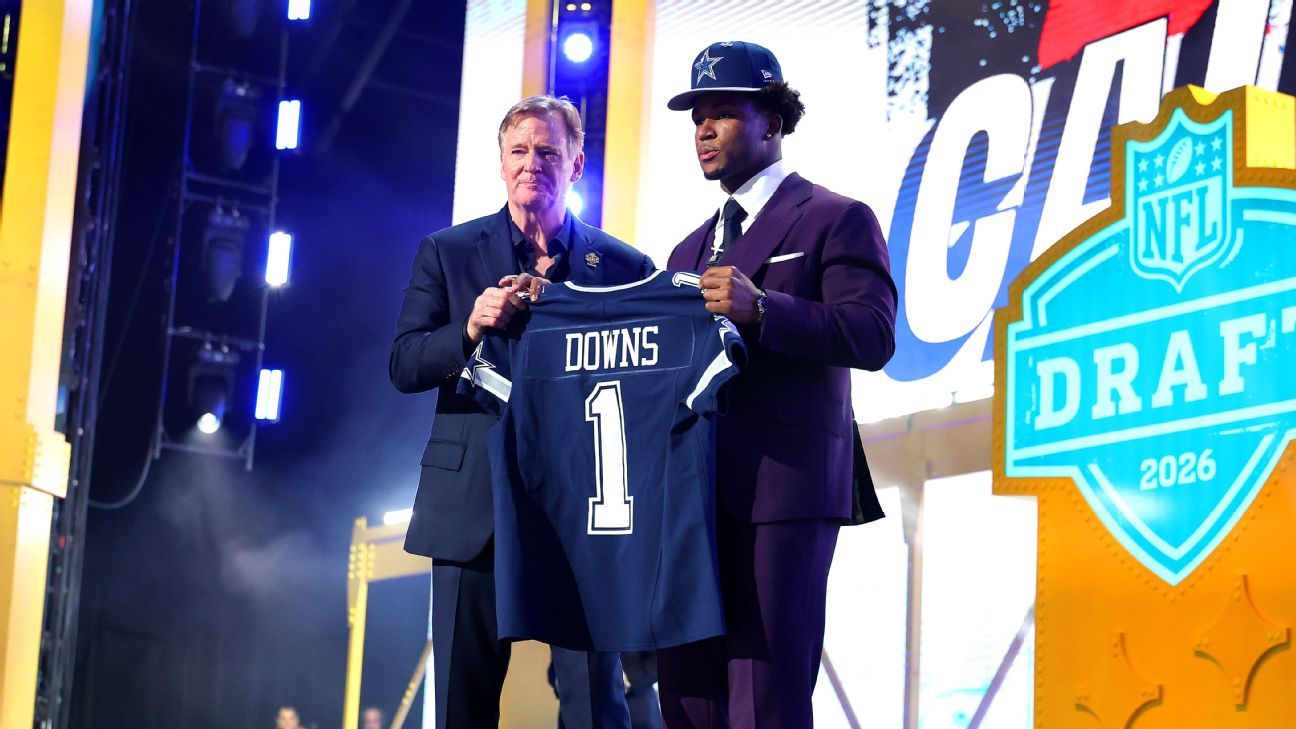
Certain prospects provide a window into how the NFL views position groups as Notre Dame running back Jeremiyah Love and Ohio State safety Caleb Downs did on Night 1. Some NFL evaluators viewed Love and Downs as the draft’s best overall players. A Big Ten coach recently told me that Downs was clearly the nation’s best defender in 2024, when Ohio State ended its national title drought. He earned All-America honors in both 2024 and 2025, when he won the Jim Thorpe Award as the top college defensive back.
But neither Downs nor Love plays a premium position.
Love ultimately didn’t wait long, going at No. 3 to the Arizona Cardinals, and becoming the highest-drafted running back since Penn State’s Saquon Barkley went No. 2 to the Giants in 2018. Downs, meanwhile, went 11th to the Dallas Cowboys, extending the drought of safeties missing the top 10. LSU‘s Jamal Adams is the most recent, going No. 6 to the Jets in 2017, and only eight safeties have gone in the top 10 since 2000. If a safety as decorated as Downs — Matt Miller’s favorite pick of the draft — couldn’t crack the top 10, who can?
“I don’t think there was any doubt that he is a generational player, talking to different clubs, the feedback we got in his interviews,” Buckeyes coach Ryan Day said. “Watching the draft year in and year out, you see certain things that kind of make you look at things sideways. … Just sitting there as a coach, when you see some guys come off the board in front of somebody like Caleb Downs, it just makes you think, ‘I wonder where they’re going to be in five to 10 years, looking back on this draft, and if they have any regrets.’ But I know the Cowboys got a great one.”
Florida defensive tackle Caleb Banks was a somewhat surprising first-round pick, after being limited to three games last fall because of a left foot injury. The 6-foot-6, 327-pound Banks, who entered the 2025 season as a projected high draft pick after recording 4.5 sacks and seven tackles for loss in 2024, broke a bone in the same foot at the NFL combine in February.
He underwent surgery in March, and the Minnesota Vikings selected him at No. 18, despite the fact that players like wide receiver Makai Lemon, safety Dillon Thieneman, and coveted offensive and defensive linemen were still available.
“The complicated part is the injury; it was very unfortunate,” former Florida (and current James Madison) coach Billy Napier told me. “Obviously, it would have made a huge difference in our team to have a first-round draft pick type of caliber, an explosive player. Caleb can play on third down. I think that makes him different. Not only is he 6-6, 325, but he’s got the twitch to be a matchup issue on third down as a rusher.”

Another SEC defensive lineman in the first round who generated attention was Auburn end Keldric Faulk, who went No. 31 to the Tennessee Titans. At 6-5 and 276 pounds, Faulk has excellent length on the edge, defends the run very well and joins a coach (Robert Saleh) who has had success with taller linemen like DeForest Buckner.
“He’s powerful, he can play [on the inside shade of an offensive tackle], he’s a really good run-stopper and he’s still learning how to pass rush,” an SEC coordinator said.
Faulk’s overall pass rush numbers don’t pop, though, as he had 10 career sacks at Auburn and two last season.
“He definitely had film,” an SEC offensive coordinator said. “… There were times where he just kind of got ground up a little bit and didn’t know how dedicated he was to the run game. He has a ton of ability. When he played and went, he was a good player. I was interested to see, because some people were talking about him being early first round, and I just thought there’s better edge players, but really, really long guys are tough to find.”
San Diego State cornerback Chris Johnson was the only Group of 6 player drafted among the first 57 picks, going at No. 27 to Miami. Aztecs coach Sean Lewis thought Johnson would be a Day 2 pick after the team’s season ended, but Johnson’s performances at the combine and during team interviews elevated his outlook.
“I was talking with [an NFL evaluator] the Monday or Tuesday before the draft, and I was like, ‘Oh, another day, another call about Chris,'” Lewis said. “And he was like, ‘We ain’t even going to be able to touch Chris. Like, he’s not going to be available when we pick.’ He wanted to talk about someone else. In that moment. I was like, ‘This guy’s not going to get out of the first day.’ So that was pretty cool.”
Johnson earned second-team AP All-America honors in 2025 and had four interceptions, two returned for touchdowns, nine pass breakups, a forced fumble and three tackles for loss. Lewis said his loyalty to the program also helped during NFL interviews, as teams peppered him about why he stayed at SDSU rather than going to the Power 4.
“That really differentiated himself from others, because that is the uncommon path now,” Lewis said. “It was a big piece of the process, his loyalty, his commitment. And it was just really interesting to hear the NFL side of it, of how that was such a huge plus for them, especially with the investment that they made in him and the decisions that they were making, like, ‘This is going to be a guy that we can pour into, and he’s going to be committed to us.'”
0:50
What Carson Beck brings to the Cardinals
What Carson Beck brings to the Cardinals
A down year for QBs
Back in November 2024, no one would have envisioned the following quarterback scenario for the 2026 draft: Mendoza at No. 1, zero QBs in the second round, Carson Beck kicking off the third round, Drew Allar going midway through the third, Cade Klubnik waiting until the fourth and Garrett Nussmeier being the very last quarterback drafted, behind Rutgers‘ Athan Kaliakmanis and Texas Tech’s Behren Morton in the seventh round.
Many factors fueled the quarterback draft order, but several players pegged as top picks during or after the 2024 season saw their stocks fall. Beck went through an injury and a transfer from Georgia to Miami, which he helped reach the national title game, but he wasn’t slotted as an early-round candidate, like he was following his 2023 season at Georgia.
Arizona selected Beck at No. 65.
“He’s probably reaching full health now,” coach Mario Cristobal told me. “Other teams had quarterbacks that missed the summer, too, and those guys didn’t even have winning seasons. He was a guy that missed a lot of time and still found a way to help us achieve postseason status and win multiple New Year’s Six games and eventually play for the [national] title. So that guy’s best football is ahead of him, too. He’s healthy, and I think he’s going to do great.”
“… I think what you see is what you get,” a Power 4 defensive coordinator said. “I think he’ll be solid. I don’t think he’ll be special. Whether it’s poise or accuracy at key moments, he just seems to have too many misses. But he’s a good, solid player.”
Allar helped Penn State reach the CFP semifinals after the 2024 season and likely would have been among the top quarterbacks drafted in 2025 if he skipped his senior season. He returned to State College and had a slower-than-expected start, before breaking an ankle in a midseason loss to Northwestern, the day before coach James Franklin was fired.
The 6-5, 228-pound Allar went No. 76 to the Pittsburgh Steelers. Big Ten coaches were lukewarm on Allar but noted that he went through multiple systems and wasn’t always set up to succeed.
“Hopefully [Pittsburgh] will be a coaching staff that can maximize what he’s good at,” a Big Ten coach said. “I’m not really sure that was the case [at Penn State].”
When LSU and Clemson opened the 2025 season, the game was billed as a matchup of potential No. 1 draft picks at QB. Clemson’s Klubnik posted a career high in completion percentage (65.6) but saw significant drops in passing yards and touchdown passes. He joins the Jets (110th pick).
“He’s a two-time ACC championship MVP with a couple titles, but he’s also had some moments that were not so good,” Clemson coach Dabo Swinney told me. “All those things make you better if you’re made of the right stuff, and he is made of the right stuff, and it has made him better. Especially going to a place like New York, you better have some thick skin. … I think Cade has a chance to be an outstanding pro.”
LSU’s Nussmeier dealt with several injuries, including a cyst on his spine discovered during testing at the combine. He landed with the Kansas City Chiefs (No. 249).
“Who knows why he fell so far, but I studied him and that kid is a stud,” said a defensive coordinator who faced Nussmeier. “Obviously, didn’t have a great season, but he’s a good player.”
0:51
D’Angelo Ponds NFL draft profile
Check out some of the top highlights from Indiana’s D’Angelo Ponds.
Day 2 and the run on tight ends
A draft that didn’t pop at some of the typical positions, such as quarterback and defensive tackle, created significant intrigue on Day 2, when teams often find the most value.
After only two cornerbacks went in the first round — LSU’s Mansoor Delane (No. 6, Chiefs) and San Diego State’s Johnson — the second round included five. Tennessee‘s Colton Hood went No. 37 to the Giants after recording two takeaways for touchdowns, 50 tackles and eight pass breakups in his only year with the Vols after transferring in from Colorado. Hood was a semifinalist for the Jim Thorpe Award.
“He was a one-year starter, did a tremendous job,” an SEC coordinator said. “His best football is still ahead of him. He’s a tough guy, can run. He’ll do well.”
Indiana’s D’Angelo Ponds rounded out the top 50, going to the Jets. Ponds was the Hoosiers’ top individual defensive performer during the team’s national title run, earning defensive MVP honors at both the Rose and Peach Bowls. He earned All-America honors in each of the past two seasons, was twice first-team All-Big Ten and recorded five interceptions, 8.5 tackles for loss and 116 tackles with the Hoosiers.
Coaches at Indiana and beyond said Ponds’ size (5-foot-8, 182 pounds) was the only factor keeping him out of the first round.
“I don’t know if I’ve seen a corner that small who is that big of an impact player,” said an offensive coordinator who faced Indiana last season. “He’s just so savvy and tough. Gosh, he’s a good player.”
The Philadelphia Eagles‘ pick of Vanderbilt‘s Eli Stowers at No. 54 kicked off a surge of tight end picks that went through the end of Day 2. Eight tight ends went between Stowers and Notre Dame’s Eli Raridon, who went No. 95 to the New England Patriots.
The overall number of tight end selections jumps out, but so does the range of profile types. Stowers won the Mackey Award as the top college tight end with 62 receptions, 769 receiving yards and four touchdowns. Ohio State’s Max Klare, who went late in the second round to the Rams, had 94 receptions in his last two college seasons.
But Texas A&M‘s Nate Boerkircher and Michigan‘s Marlin Klein each had fewer than 40 career receptions in college. Boerkircher, who went No. 56 to the Jacksonville Jaguars, had just 19 receptions in four years at Nebraska but matched the total in his lone season with Texas A&M, including the game-winning touchdown catch at Notre Dame.
“As people started diving into Nate, his stock was rising all the way through the draft process,” Texas A&M coach Mike Elko said.
Ohio State’s second tight end, Will Kacmarek, is an in-line player with no college season of more than 22 receptions but still went No. 87 to Miami. Even NFL teams seemingly set up well at the tight end spot, such as the Chicago Bears, were eager to take one on Day 2, adding Stanford’s Sam Roush at No. 69.
“Everybody wants to be in 12 personnel,” an ACC defensive coordinator said, referring to a grouping with one running back and two tight ends. “Everybody’s creating that second tight end as either a flex guy or an H-back kind of guy. That’s why they’re trying to find as many tight ends as they can. … Offenses are trying to find a way to have their new answer for what these defenses are doing. All these three high safety [formations] ain’t no good if you got two stud tight ends in the game.”
A Big Ten coach noted that the tight end “lean” stems from prospects bringing value beyond catching passes. Many appear on multiple special teams units and can assist with blocking top pass rushers.
“Week to week, you see more good guys playing that position than maybe 10 years ago,” the coach said. “We’ve probably leaned that way a little bit in college, too. There might be more two-tight end stuff than there was 10 years ago.”
College teams that were all over the draft
Several college teams stood out during draft weekend, and coaches weighed in on how things unfolded and who went where.

Texas Tech Red Raiders: Texas Tech’s spending spree became a top storyline before the 2025 season. The Red Raiders delivered their first Big 12 championship and College Football Playoff appearance and then shined on draft weekend with a team-record nine selections, three more than the previous mark set in 1956, and five more than the record in the common draft era, set in 2009.
Even more impressive, five of Texas Tech’s selections came in the top 75, including two non-transfers in linebacker Jacob Rodriguez (No. 42, Miami) and wide receiver Caleb Douglas (No. 75, Miami).
“A lot of people can sit there and say, ‘Well, those are transfers, and they’re only there a year,’ but every one of those guys had their best year,” McGuire said. “There were some projections last year, or when we’re looking at David Bailey, that he was a third-round draft pick, and he comes here, and he’s a first-round draft pick, plays his best football by far, and he’s put in a position to play his best football. The same way with [defensive end Romello Height] and then having the year that Jacob [Rodriguez] had, I was so proud that he went so early.
“It shows that we’re putting these guys in the right position.”
McGuire admitted being nervous about Rodriguez, who had incredible numbers last season — 128 tackles, 11 tackles for loss, seven forced fumbles, four interceptions, two fumble recoveries — but as an off-ball linebacker didn’t play a premium position. After Ohio State’s Sonny Styles went No. 7 to the Washington Commanders, McGuire felt good about Rodriguez in the second round but wasn’t sure where he’d be drafted. He ended up being the first of four linebackers selected in the round.
“I felt like he did enough, and at the pro day and at the combine,” McGuire said. “As we talked to different people, they kept saying, ‘This kid, he’s got his stuff together, he’s so mature.’ So, I thought that was going to be a big help for him.”

Miami Hurricanes: Mario Cristobal improved Oregon’s output of NFL linemen toward the end of his tenure in Eugene and had even bigger aspirations when he returned to Miami. His first full class of recruits and transfers produced three first-round picks in offensive tackle Francis Mauigoa (No. 10, New York Giants) and defensive ends Rueben Bain Jr. (No. 15, Tampa Bay) and Akheem Mesidor (No. 22, Los Angeles Chargers).
Miami had the most linemen drafted in the first round, four in the top 70 picks and five overall. Cristobal said 6-foot-9, 346-pound tackle Markel Bell, who went No. 68 to Philadelphia, could have been a first-round pick if he had come back.
“That puts us on course,” Cristobal said. “I think of the track record, we were at Oregon and a couple years into it, [offensive tackle Penei Sewell] is seventh overall and [defensive end Kayvon Thibodeaux] is seventh overall, so this is the blueprint of our programs. We’ve always felt really strongly about that. This is a lot of validation as it relates to development, particularly at the line of scrimmage. [Offensive line coach] Alex Mirabal and [defensive line coach] Jason Taylor, they’re the very best at what they do.”
Mauigoa started at right tackle throughout his career at Miami, and Bain and Mesidor combined for 11.5 sacks in propelling Miami in its first CFP appearance.
“You’ve got to cut them loose and let them play a physical brand of disruptive, explosive football,” Cristobal said. “Akheem is exactly what they were looking for there, and in Tampa and up in New York, they needed a big, physical, talented guy that could play multiple positions, and they got the best of the best in college football. Those guys are going to be unbelievable pros.”
Texas A&M Aggies: Texas A&M made its first CFP appearance in coach Mike Elko’s second year. The Aggies achieved another milestone during draft weekend with 10 selections, tying a team record set in 1976 and marking their most in the seven-round draft era. Texas A&M’s previous high was seven draft picks in 2019.
“If you look at the better programs, year in and year out, 10 seems to be the number that you’re trying to hit,” Elko told me. “That was one of the goals we set out to try to get when we got hired here, and it’s been a long time since we did it.”
The Aggies’ contingent had seven top-100 selections, including wide receiver KC Concepcion, who went No. 24 to the Cleveland Browns. Concepcion and others transferred in, whereas offensive lineman Chase Bisontis, a second-round selection of Arizona, and others developed within the program.
Seven of Texas A&M’s draft picks were linemen, which continued a trend on the defensive side — the Aggies had 10 D-linemen drafted between 2019 and 2025, including first-rounder Shemar Stewart last year — and started a new one on offense.
“To get it on the offensive line as well is a big step forward,” Elko said. “The SEC is a line-of-scrimmage league. For us to win the things that we want to win, being really good in the trenches is a big part of it.”

Clemson Tigers: Before the 2025 season, coach Dabo Swinney predicted Clemson would have nine or 10 players drafted and 15 total in camps. Despite a 7-6 record, Clemson matched or exceeded Swinney’s forecast with nine selections, tying the team record in the common draft era, and 16 signed with NFL teams. All nine drafted players went in the top 175 picks.
“We’ve developed well for a long time here, so it’s just more confirmation,” Swinney said. “We didn’t get some of the results that we wanted last year, but that’s on us as coaches. NFL teams, they don’t just pick guys because they like them. They pick them because of what they see on tape.”
Clemson’s draft achieved another milestone as tackle Blake Miller (No. 17, Detroit Lions) became the school’s first offensive lineman selected in the first round in the common draft era. Miller set a team record for snaps with 3,778, made 54 career starts and, according to Swinney, missed only two practices during his college career.
The three-time All-ACC selection is the likely replacement for Taylor Decker.
“I hadn’t had a first-round OL,” Swinney said. “I said, ‘If Blake Miller ain’t a first rounder, I’m never going to have one.’ This guy’s as good as we’ve ever seen. There’s nothing you could discount Blake Miller on. He’s got incredible size, length, athleticism, flexibility, he’s strong as an ox, smart, high character. I mean, he really checked every single box.”
Miller ended up leapfrogging defensive linemen Peter Woods and T.J. Parker, who went at Nos. 29 and 35, respectively. Swinney praised the 6-foot-2, 298-pound Woods, who played at multiple weights and at different positions at Clemson.
“He’s really learned how to take care of his body, but this guy’s a brick house, man,” Swinney said. “I told everybody, he’s kind of 1 of 1. I really haven’t had a guy like Peter, just his combination of speed and strength, power. He’s got twitchiness. He’s a really, really smart football player. The Chiefs got a good one.”

Iowa Hawkeyes: The correlation between recruiting/transfer rankings and NFL draft output is always a subplot of draft weekend, but some programs, such as Iowa, just consistently overperform their recruiting outlook. The Hawkeyes have had four or more draft picks in each of the past four years, and eight times since 2017.
But Iowa’s total of seven selections marked its most under coach Kirk Ferentz and for the seven-round draft era. Iowa didn’t produce a first-round pick but had representation in each of the final six rounds. Ferentz attributed the total to a supersized senior class that developed during its four or five years in the program.
“We didn’t have a first-round-type player, necessarily, but we had a lot of really good players,” Ferentz said. “Most of them had to work their way up the ladder to become NFL prospects.”
Iowa had three offensive linemen drafted in center Logan Jones (second round, Chicago), right tackle Gennings Dunker (third round, Pittsburgh) and left guard Beau Stephens (fifth round, Seattle Seahawks). The offense’s bottoming-out in 2022 and 2023 could be traced to problems with the line, but Iowa now has had five linemen drafted in the past two years, and in 2025 won the Joe Moore Award as the top college offensive line.
“All three of these guys clearly played their best football last year,” Ferentz said. “They kept going up a level every year, and that’s the idea of the game. Really representative of the line, and then also representative of our team.”
Iowa’s draft output wasn’t all brawn. Kaden Wetjen, who had only 23 career receptions and 23 runs with the Hawkeyes but shined as a returner with 2,492 yards and five touchdowns, went in the fourth round to Pittsburgh.
“I don’t know if I’ve ever been around a better returner, at any level, in my career,” Ferentz said. “It’s been really cool to watch him, from a guy three years ago, you didn’t know how to predict what he’s going to do, to being such a good player, so productive and so impactful.”


