


Hi, this is Evelyn, writing to you from Beijing. Welcome to the latest edition of The China Connection — a succinct snapshot of what I’m seeing and hearing from local businesses.
Today, I talk to a smart glasses exec about why price-conscious Chinese consumers are paying $100 more for AI frames. What’s his strategy for taking on Meta’s Ray-Ban Display outside China?
The big story
While smart-glasses wearers in the U.S. got a small corner screen with the release of the Meta Ray-Ban Display, here in China, two companies are selling smart frames with a virtual display that sits right in front of the user.
At the top of China’s sales rankings is Rokid. Despite a price tag about $100 higher than its closest rival Alibaba, Rokid’s AI-powered frames have held first place for the past three months, according to online electronics retailer JD.com. That’s a big deal in budget-conscious China.
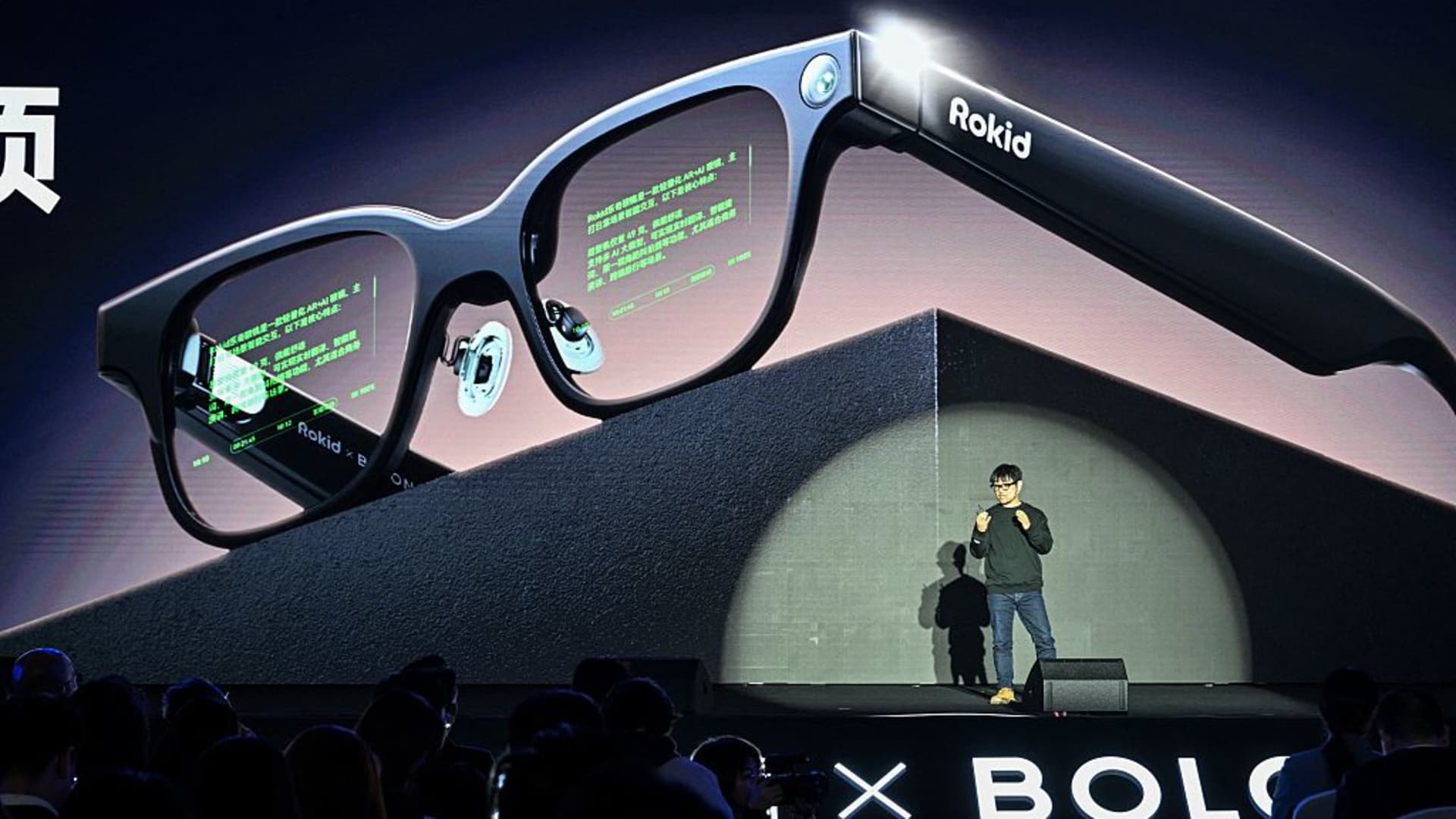
One of Rokid’s most popular features is a virtual screen that scrolls through the text of a prepared speech during a presentation. It’s popular with company executives and government officials, Gary Cai, vice president of the company, told me.
“A lot of people buy our glasses for this teleprompting capability,” he said in Mandarin, translated by CNBC.
Rokid is ramping up sales globally — it held 3.9% market share last year — while Alibaba also plans an overseas rollout after showing off its smart glasses at the Mobile World Congress in Barcelona this year. Meanwhile, Meta says it has delayed the overseas release of the Ray-Ban Display due to inventory constraints and “unprecedented” U.S. demand.
Rokid currently ships its AI display glasses to countries including the U.K. and Canada, according to its website — but not the U.S. The frames retail outside China for $599; that’s less than the Meta Ray-Ban Display, which starts at $799 but is not officially sold in China, where a firewall blocks access to Facebook.
The global AI glasses market is expected to grow by more than 70% this year to 15 million unit sales, according to Omdia, which predicts Chinese sales will double to 2.1 million frames.
But AI glasses with virtual displays are still niche — expected to grow only modestly to account for just 10% of global sales, according to Jason Low, Shanghai-based research director for connected life at Omdia.
He noted that in China, however, despite some “rudimentary” displays, consumers prefer them because they want to interact with their devices in this way.
Technically, Rokid and Alibaba use augmented reality technology to display green-colored text and some images with their glasses, while Meta offers a colored screen. And the fact that Meta’s frames are Ray-Ban certainly makes them fashionable.
But in China, Rokid users on social media say they like the central display because it makes navigation easy when riding a bike, for example, and it allows them to order a coffee by talking while walking.
This spring, Rokid integrated AI agent OpenClaw into its frames, allowing users to manage their AI assistants by talking to their glasses. Critically for its commercialization plans, Rokid also lets users complete Alipay mobile payments by looking at QR codes, and use AI agent store features to connect with Teslas, do homework tutoring and manage internet-connected home appliances.
Misa Zhu, CEO and founder of Rokid, presents the company’s newest pair of smart glasses in collaboration with Bolon in Hangzhou, in China’s eastern Zhejiang province, on Nov. 13, 2025.
Hector Retamal | Afp | Getty Images
Early days
Getting consumers to adopt new tech, not to mention new hardware, is far from easy.
For years after its founding in 2014, Rokid struggled to gain customers, even as — in the spirit of “try before you buy” — passengers on Hainan Airlines were able to watch movies with the glasses. Younger rivals such as Xreal leaped ahead with better hardware.
Now, Rokid is reportedly planning to file for an initial public offering in Hong Kong by the end of April. The startup did not respond to a request for comment on its plans.
Cai acknowledged that previous versions of Rokid’s glasses, before the current display technology, were used primarily as a niche product by gamers.
But he said the company’s close relationships with its suppliers allowed it to manufacture the newer AI display glasses at scale – and 20 grams lighter than Meta’s. Rokid already generates 40% of its revenue outside mainland China, and aims to sell up to 1 million pairs this year, including through a collaboration with eyewear brand Bolon.
Still, will that be enough to help Rokid survive? Cai predicts large companies – such as ByteDance and Huawei – could join Alibaba in entering the smart glasses market.
Chinese parts manufacturers also want in. At the Consumer Electronics Show in Las Vegas earlier this year, Chinese laser company Appotronics showed off its rival optical engines — including one for color display. Michael Chen, general manager of Appotronics’ innovation center, told me at the time that the company planned to meet with Google and Meta after the expo.
Smart glasses still present many privacy issues that need to be resolved, Cai said. But he is bullish on the technology as it develops, saying that AI-powered display glasses could have the potential to render smartphones obsolete.
Need to know
Business trumps politics in China’s efforts for an Iran ceasefire
China says it has made “active efforts” to end the conflict, but even a political studies director at a state-affiliated think tank underscores that for Beijing, the bigger worry is the Iran war’s economic impact.
Ray Dalio is optimistic about a planned Trump-Xi meeting
The hedge fund magnate told CNBC’s Eunice Yoon in Shanghai that he expects the U.S. and Chinese presidents to discuss trade and capital flows at a highly anticipated meeting in Beijing next month.
Alibaba launches a China AI data center using homegrown chips
Together with China Telecom, the e-commerce company is opening a data center in southern China that uses 10,000 of Alibaba’s Zhenwu semiconductors. On the same day, Alibaba CEO Eddie Wu announced he will head a newly created internal tech committee.
BYD and KFC team up in China for battery charging stations
The Chinese EV giant is working with KFC parent Yum China to let drivers order drive-thru meals from inside their cars, while using nine-minute fast chargers for vehicle batteries at fried chicken stores.
Coming up
April 14: China March trade data
April 16: China Q1 GDP along with retail sales, industrial production and investment data for March
April 16 – 25: Beijing International Film Festival
April 19: 2026 Beijing Yizhuang Half Marathon and Humanoid Robot Half Marathon
April 20: People’s Bank of China monthly loan prime rate release